
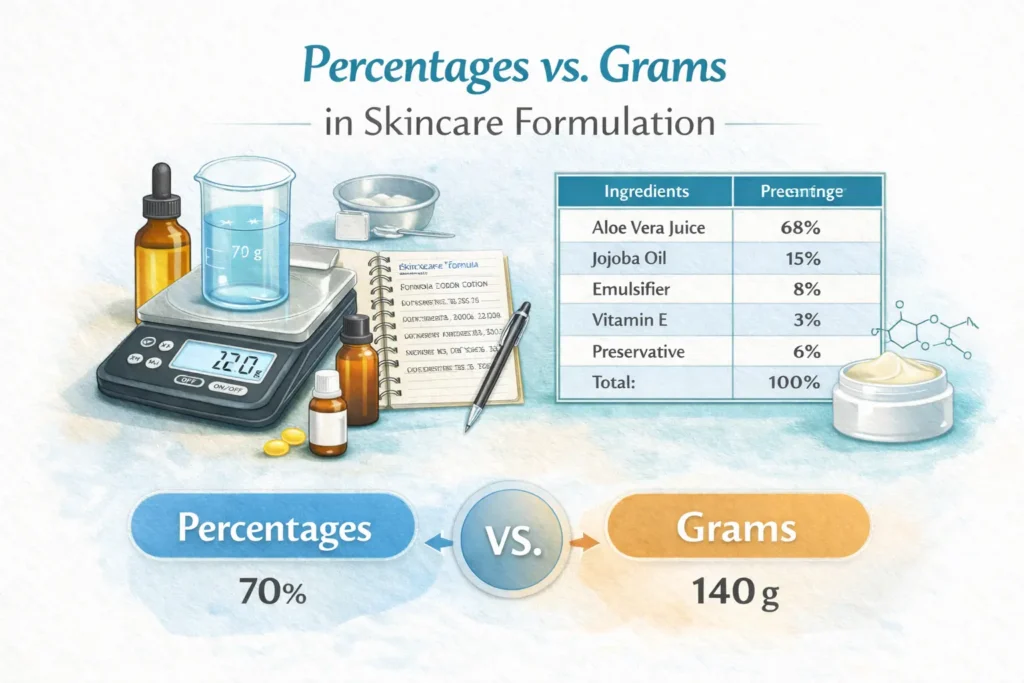
If you’ve ever found a skincare recipe that makes 100 grams but you want to make 500 grams, you’ve probably wondered how to know exactly how much of each ingredient to use. This is where percentages come in.
Understanding the difference between percentages and grams is one of the most important skills to learn when you’re making homemade skincare products. Percentages allow you to create formulas that can be easily scaled to different batch sizes while keeping the concentration of each ingredient consistent.
In this guide, I’ll show you how skincare formulas work, how to convert percentages into grams, how to scale a formula up or down, and some of the common mistakes beginners make when working with percentages.
Once you understand this, you’ll be able to look at a formula written in percentages and know exactly how to turn it into the amount you need to make.
Why Are Skincare Formulas Written in Percentages?
Skincare formulas are commonly written in percentages because percentages make it easy to understand the concentration of each ingredient and to scale a formula up or down.
For example, if a formula contains 5% shea butter, that means shea butter makes up 5% of the total finished formula—regardless of whether you’re making 100 grams, 500 grams, or 1,000 grams.
This makes percentages especially useful when creating and adjusting cosmetic formulas. Once you know the percentage of each ingredient, you can calculate the exact weight needed for whatever batch size you want to make.
Percentages also make it easier to compare formulas and maintain the intended concentration of an ingredient when changing the batch size. However, the percentage of an ingredient does not automatically mean that the ingredient is safe or effective at that concentration. Always follow the supplier’s recommended usage rate and formulation guidelines for individual ingredients.
If you’re new to making skincare products, start with our guide:
Skincare Formulation for Beginners
Why Cosmetic Formulas Use Percentages
Percentages allow a formula to work at any batch size.
Instead of being tied to a specific amount of ingredients, the formula simply describes how much of each ingredient should be present relative to the total formula.
For example:
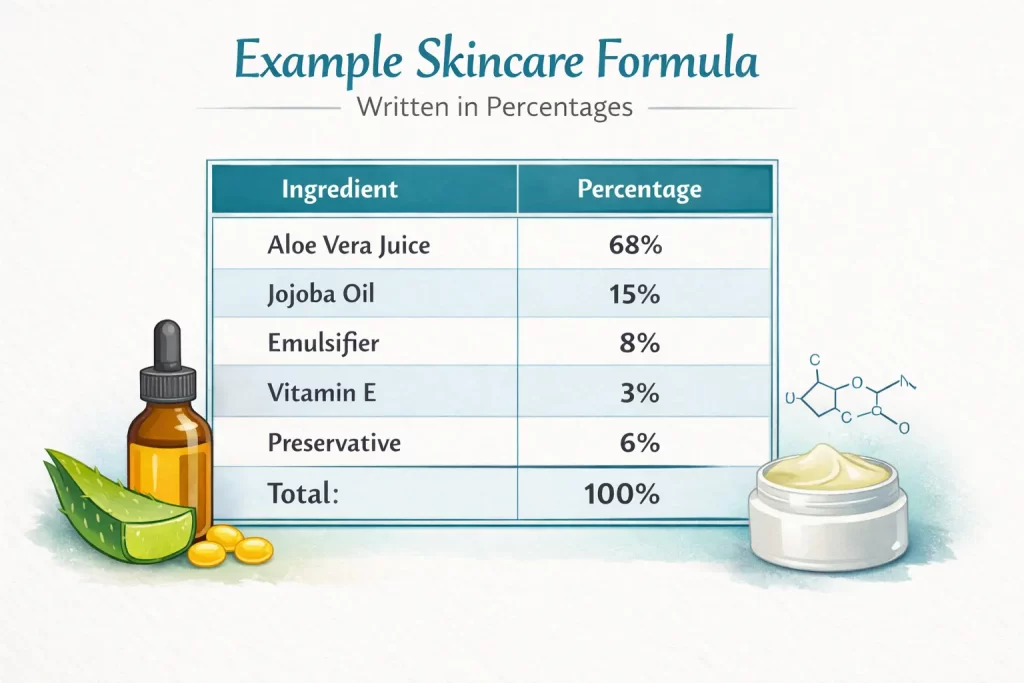
| Ingredient | Percentage |
|---|---|
| Water | 70% |
| Carrier Oil | 20% |
| Emulsifier | 5% |
| Additives | 5% |
This formula will always add up to 100%.
Because the ingredients are listed as percentages, you can easily make:
100 grams
500 grams
1 kilogram
The ratio between ingredients remains exactly the same.
Why Grams Are Still Important
While professional formulas are written in percentages, you still need to convert them into grams when making the product.
Grams are used during production because they allow for accurate measurement.
Weight-based measurement is far more precise than measuring ingredients by volume (like teaspoons or tablespoons).
This is especially important when working with ingredients such as:
preservatives
emulsifiers
active ingredients
Using too much or too little of these ingredients can affect product stability and safety.
Learn why preservatives are essential in water-based formulas here:
Why Preservatives Matter in DIY Skincare
How Percentages Work in Skincare Formulas
A percentage represents the portion of the total formula that an ingredient occupies.
For example:
If a formula contains 10% oil, it means that oil represents 10% of the total product weight.
If your batch size is 100 grams, then:
10% oil = 10 grams.
If your batch size is 500 grams, then:
10% oil = 50 grams.
The ratio remains consistent.
This flexibility is the reason percentages are used in professional formulation.
How to Convert Percentages to Grams
Converting percentages into grams is simple.
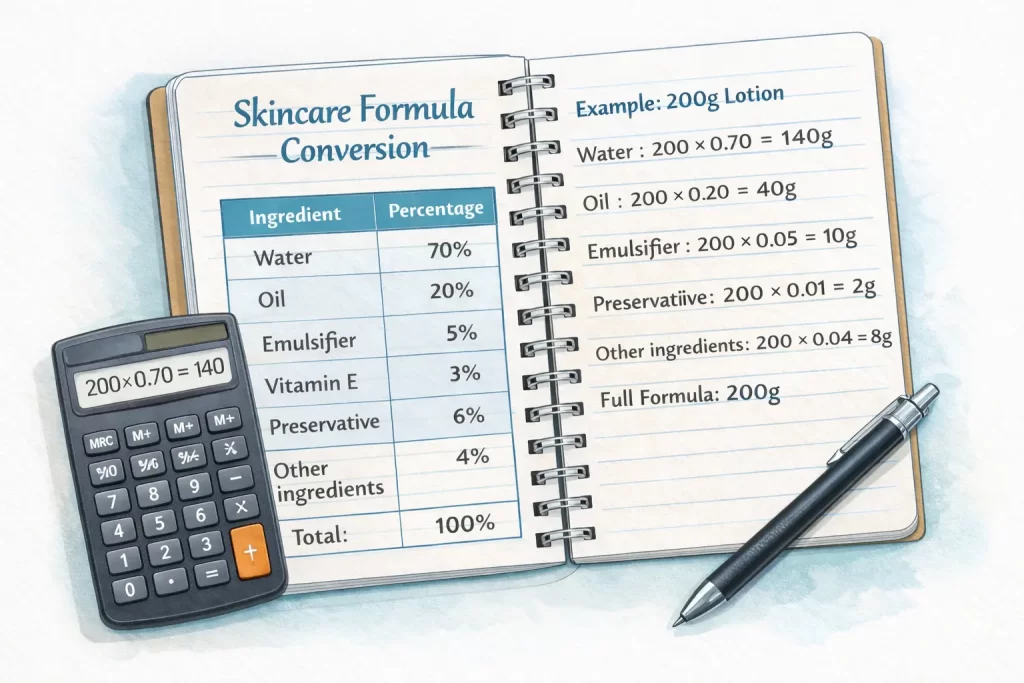
Use this formula:
Ingredient weight = total batch size × percentage
Example:
If you want to make a 200g lotion with the following formula:
| Ingredient | Percentage |
|---|---|
| Water | 70% |
| Oil | 20% |
| Emulsifier | 5% |
| Preservative | 1% |
| Other ingredients | 4% |
You calculate each ingredient like this:
Water
200 × 0.70 = 140g
Oil
200 × 0.20 = 40g
Emulsifier
200 × 0.05 = 10g
Preservative
200 × 0.01 = 2g
Other ingredients
200 × 0.04 = 8g
Now you have the full formula in grams.
Why Your Formula Should Always Equal 100%
When you’re creating a formula using percentages, all of the ingredients should add up to 100%.
For example:
- Oil: 20%
- Shea butter: 10%
- Emulsifier: 5%
- Water: 60%
- Preservative: 1%
- Other ingredients: 4%
Total = 100%
If your percentages don’t add up to 100%, you don’t yet have a complete formula.
A simple way to check your work is to add every ingredient percentage together before converting the formula into grams.
Once your formula totals 100%, you can use the total batch size to calculate the exact gram weight of every ingredient.
Example Lotion Formula Conversion
Let’s walk through a simple lotion example.
Percentage Formula
| Ingredient | Percentage |
|---|---|
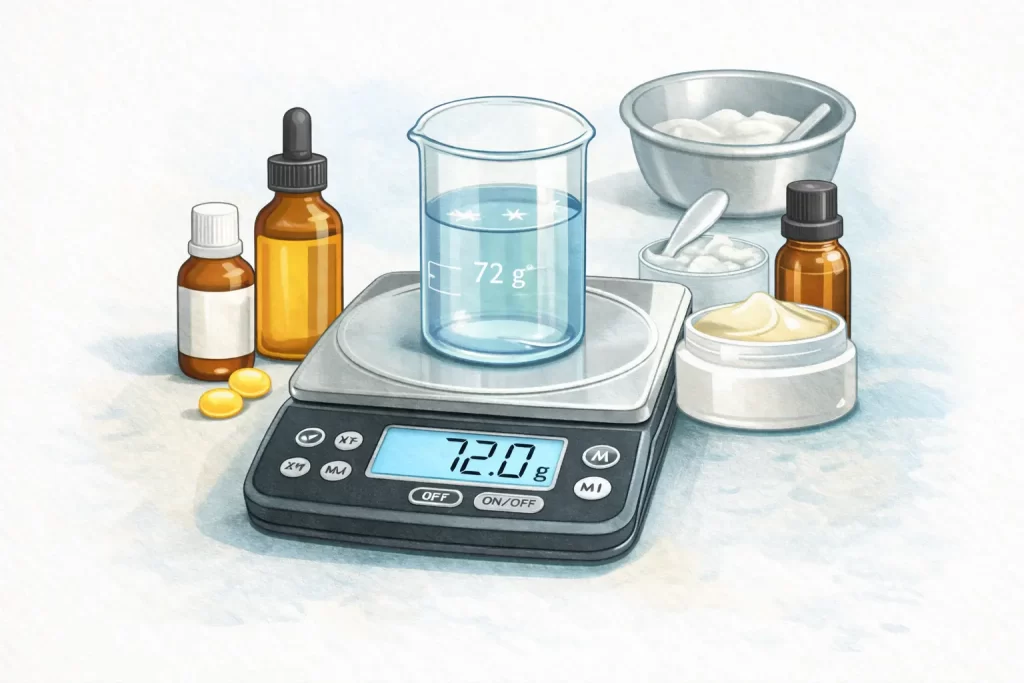
| Distilled Water | 72% |
| Carrier Oil | 15% |
| Emulsifier | 6% |
| Glycerin | 4% |
| Preservative | 1% |
| Fragrance | 2% |
Total = 100%
Now we convert this formula to grams.
100g Batch
| Ingredient | Weight |
|---|---|
| Water | 72g |
| Oil | 15g |
| Emulsifier | 6g |
| Glycerin | 4g |
| Preservative | 1g |
| Fragrance | 2g |
If we increase the batch size to 500g, we simply multiply each percentage again.
This scaling ability is one of the biggest advantages of percentage-based formulas.
Why Percentages Make Formulation Easier
Using percentages allows formulators to:
Scale formulas easily
Adjust ingredient levels
Maintain formula balance
Compare formulas quickly
For example, if you want a richer lotion, you might increase the oil phase from 15% to 20%.
If the formula were written in grams, it would be harder to see the relationship between ingredients.
Understanding Formula Structure
Most skincare formulas follow a basic structure.
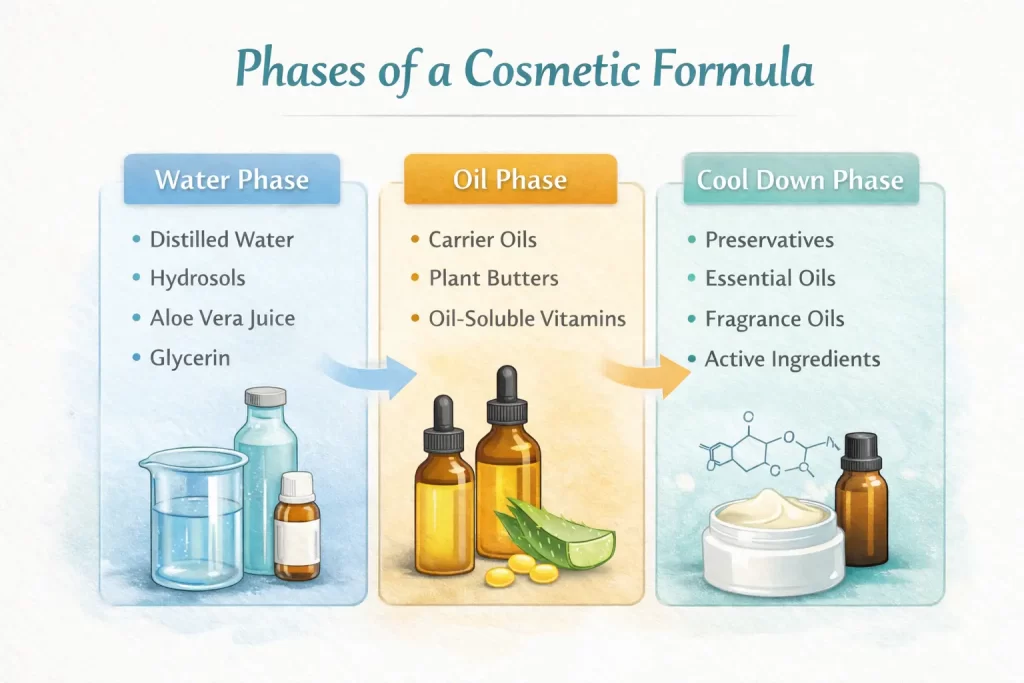
Water Phase
The water phase typically contains:
distilled water
hydrosols
aloe vera juice
glycerin
These ingredients provide hydration.
Oil Phase
The oil phase contains ingredients such as:
carrier oils
plant butters
oil-soluble vitamins
Carrier oils play a major role in skincare products.
Learn more in our guide:
Carrier Oils in Skincare: How to Choose the Right Oil for Your Skin
Do Oil and Water Always Need an Emulsifier?
Oil and water naturally separate because they have different chemical properties. When a cosmetic formula is designed to combine an oil phase with a water phase into a stable emulsion, an emulsifier is generally used to help create and maintain that emulsion.
However, simply adding an emulsifier does not guarantee that a product will remain stable. The type and amount of emulsifier, oil phase, water phase, processing method, temperature, and other ingredients can all affect the finished emulsion.
This is why it’s important to follow the supplier’s recommended usage rate and processing instructions for the particular emulsifier you’re using.
You can learn more about emulsions and how they work in Emulsifiers in Skincare: What They Are and How They Work
Cool Down Phase
What Is the Cool-Down Phase?
Many cosmetic formulas have ingredients that are added during the cool-down phase rather than during the heated portion of the formulation.
This can include certain preservatives, fragrances, essential oils, botanical extracts, and heat-sensitive ingredients. However, not every ingredient that is commonly added during cool-down must always be added at the same temperature.
The correct processing temperature depends on the specific ingredient and the manufacturer’s instructions.
Always check the supplier’s technical information for:
- Recommended usage rate
- Maximum temperature
- Recommended addition temperature
- pH requirements
- Compatibility with other ingredients
- Any special processing instructions
Examples include:
preservatives
essential oils
fragrance oils
active ingredients
These ingredients are added once the formula has cooled.
Common Beginner Mistakes with Percentages
Learning to work with percentages takes practice. Beginners often make a few common mistakes.
Not Adding Up to 100%
A proper formula should always total 100%.
If the percentages add up to more than 100%, the formula needs adjustment.
What Happens When You Change a Formula?
When you change the amount of an ingredient in a formula, you need to recalculate the formula so that the total still equals 100%.
For example, if you increase an oil from 10% to 15%, you have added 5 percentage points to the formula. Those additional 5 percentage points need to come from somewhere else if you want the finished formula to remain at 100%.
This doesn’t necessarily mean that you always have to reduce one specific ingredient. Depending on the formula, you may adjust one ingredient, several ingredients, or a designated “q.s. to 100%” portion of the formula.
This is one of the major advantages of working with percentages: you can clearly see how a change affects the entire formula.
Using Volume Instead of Weight
Skincare ingredients should always be measured by weight.
Volume measurements can be inconsistent and lead to inaccurate formulas.
When to Use Percentages vs Grams
| Situation | Best Method |
|---|---|
| Writing a formula | Percentages |
| Producing the product | Grams |
| Scaling batches | Percentages |
| Measuring ingredients | Grams |
Professional cosmetic formulation uses both methods together.
Percentages define the formula, while grams are used during production.
Why Percentages Are Important for Stable Products
Maintaining the correct ratios between ingredients is critical for product stability.
For example:
Too little emulsifier can cause a lotion to separate.
Learn more about this problem here:
Why Some DIY Skincare Separates and How to Fix It
Using percentages helps ensure that ingredients stay within safe and effective ranges.
Tips for Beginners Learning Percentages
If you’re new to formulation, these tips can help.
Start with 100g test batches.
This makes percentage conversion simple.
Use a digital scale that measures grams.
Keep a formulation notebook to track changes and improvements.
Over time, working with percentages becomes second nature.
FAQ
Why do cosmetic formulas use percentages?
Percentages allow formulas to be scaled to any batch size while maintaining the correct ratio between ingredients.
How do you convert percentages to grams?
Multiply the total batch size by the ingredient percentage.
Example:
200g batch × 10% = 20g ingredient.
Do DIY skincare recipes need percentages?
Using percentages is not required for simple recipes, but it becomes extremely helpful when developing or modifying formulas.
Why is weight better than volume in skincare formulation?
Weight measurements are more precise and consistent than volume measurements, which can vary depending on ingredient density.
Once You Understand Percentages, You Can Start Building Formulas
Learning to work with percentages is one of the most useful skills you can develop as a skincare maker. It allows you to scale formulas, compare ingredient concentrations, make controlled adjustments, and reproduce a formula consistently.
But percentages are only one part of formulation. You also need to understand what each ingredient does, how ingredients interact, preservation, pH, emulsification, processing temperatures, packaging, and stability.
If you’re new to formulation, start with my Skincare Formulation for Beginners guide and work your way through the other formulation topics on Summer Rain.
Pingback: How to Make Lavender Shower Steamers (Easy DIY Aromatherapy Recipe) - Summer Rain
Pingback: How to Make Natural Body Lotion - Summer Rain
Pingback: DIY Lotion Dots: Easy Mini Lotion Bars Recipe - Summer Rain
Pingback: Emulsifying Wax NF: How to Use it - Formulation Guide - Summer Rain