
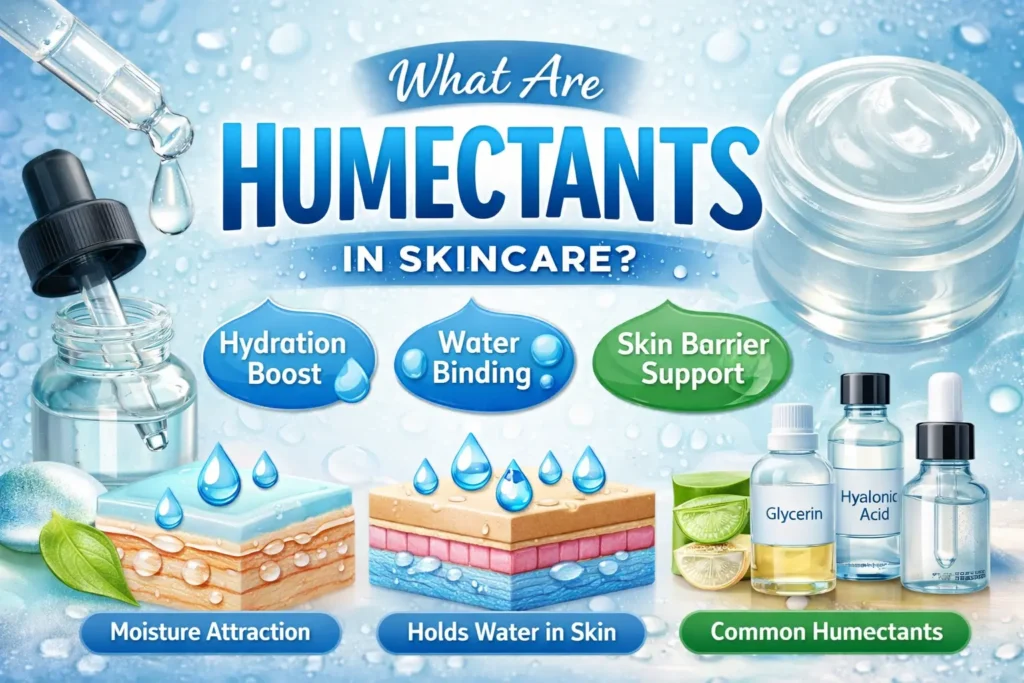
What Are Humectants in Skincare?
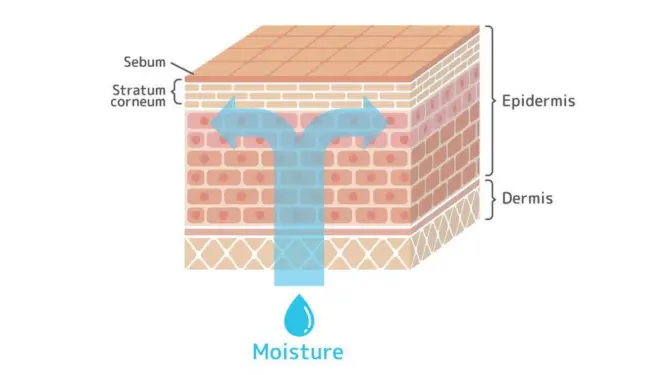
Humectants are ingredients used in skincare that attract and bind water molecules. Their main job is to increase hydration in the skin by pulling moisture from the environment or deeper layers of the skin and holding it in the outer layer (stratum corneum).
In simple terms:
👉 Humectants are “water magnets” for your skin.
They are a critical part of almost every modern skincare product, including:
- serums
- lotions
- cleansers
- toners
- sheet masks
- gel moisturizers
Without humectants, most skincare products would feel dry, less effective, and far less hydrating.
Why Humectants Matter in Skincare Formulation
Hydration is not just about adding water to the skin—it’s about keeping water in the skin long enough to improve texture, elasticity, and barrier function.
Humectants help with:
- Increasing skin hydration
- Improving product feel and slip
- Reducing tightness or dryness after cleansing
- Supporting skin barrier function
- Enhancing absorption of other ingredients
They are especially important in:
- dry skin formulations
- anti-aging products
- hydrating serums
- barrier repair creams
How Humectants Work (Simple Science Explanation)
Humectants work through a process called hydrogen bonding.
Water molecules naturally “stick” to certain ingredients that have hydrophilic (water-loving) groups. Humectants contain these groups, allowing them to attract and hold water.
In skincare, this happens in three ways:
1. Drawing moisture from the environment
If humidity is high, humectants pull water from the air into the skin.
2. Holding water in the skin
They bind water within the stratum corneum, improving hydration levels.
3. Redistributing water within skin layers
They help move water more evenly across the upper layers of the skin.
Common Humectants Used in Skincare
There are many humectants, but a few are used most frequently in formulation.
1. Glycerin (Vegetable Glycerin)
Glycerin is one of the most widely used humectants in skincare.
Why it’s used:
- Extremely effective at attracting water
- Stable across a wide pH range
- Inexpensive and widely available
- Works in almost every formulation type
Typical usage rate:
👉 1% – 10% depending on product type
Formulation notes:
- Too much glycerin can feel sticky
- Works best when balanced with oils and emulsifiers
- Enhances skin softness significantly
2. Hyaluronic Acid
Hyaluronic acid is a high-molecular-weight humectant known for its ability to hold up to 1000x its weight in water.
Benefits:
- Provides “plumping” effect
- Smooths appearance of fine lines
- Improves surface hydration
Usage rate:
👉 0.1% – 2%
Important formulation note:
- Needs proper dispersion (often pre-mixed in glycerin or water phase)
- Can feel tacky if overused
- Works best in leave-on products like serums
3. Propanediol
A modern humectant often used as a glycerin alternative.
Benefits:
- Lightweight feel
- Less sticky than glycerin
- Improves penetration of actives
Usage rate:
👉 1% – 10%
4. Sorbitol
A sugar-derived humectant often found in cleansers.
Benefits:
- Mild hydration
- Improves skin feel
- Works well with surfactants
5. Sodium PCA
A component of the skin’s natural moisturizing factor (NMF).
Benefits:
- Naturally found in skin
- Excellent hydration support
- Non-sticky feel
Humectants vs Other Skincare Ingredient Types
To understand humectants fully, it helps to compare them with other ingredient types.
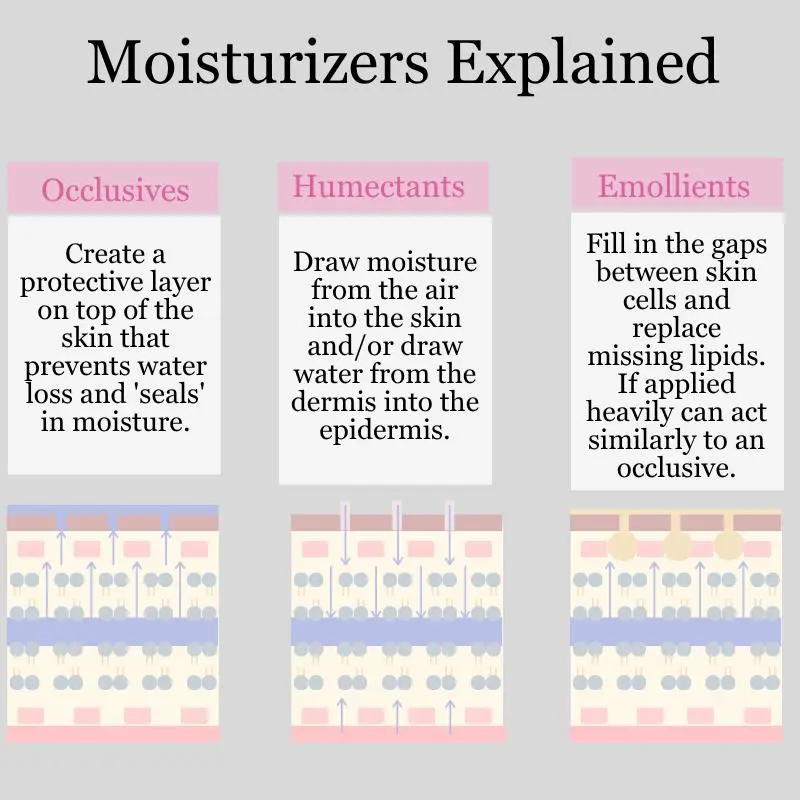
Humectants vs Emollients
- Humectants = attract water
- Emollients = smooth and soften skin
Example:
- glycerin = humectant
- jojoba oil = emollient
Humectants vs Occlusives
- Humectants = add water
- Occlusives = seal water in
Example:
- hyaluronic acid = humectant
- petrolatum = occlusive
Why this matters in formulation:
A good moisturizer usually contains all three:
- humectants (hydrate)
- emollients (soften)
- occlusives (seal)
How to Use Humectants in DIY Skincare Formulation
Humectants are part of the water phase in formulations.
Step 1: Decide your product type
Lotion or cream:
- Humectants go in water phase
Serum:
- High humectant concentration possible
Toner:
- Mostly water + humectants
Step 2: Choose your humectant blend
A common professional blend:
- 3% glycerin
- 1% propanediol
- 0.5% hyaluronic acid solution
This creates:
- balanced hydration
- non-sticky feel
- improved skin absorption
Step 3: Balance with oils and emulsifiers
Humectants alone are not enough.
You must pair them with:
- emulsifiers (to combine oil + water)
- oils or butters (to prevent moisture loss)
- sometimes occlusives (for dry skin formulas)
Step 4: Avoid overloading humectants
Too much humectant can cause:
- sticky texture
- pilling
- dehydration in dry climates (moisture pulled from skin instead of air)
Balance is key.
Common Formulation Mistakes with Humectants
1. Using too much glycerin
Leads to sticky, heavy products.
2. No occlusive layer in dry climates
Humectants may pull moisture from deeper skin layers instead of the environment.
3. Poor hyaluronic acid dispersion
Causes clumping or uneven texture.
4. Not balancing with emollients
Creates watery or “unfinished” skin feel.
Best Humectant Combinations (Professional Formulator Tip)
Here are proven combinations used in skincare formulation:
Hydrating Serum Blend:
- glycerin + hyaluronic acid + propanediol
Lightweight Moisturizer:
- glycerin + sodium PCA + light emollient oils
Barrier Repair Cream:
- humectants + ceramides + occlusives
Why Humectants Are Essential in Modern Skincare
Humectants are not optional—they are the foundation of hydration science in skincare.
Without them:
- products feel dry
- skin loses moisture faster
- barrier function weakens over time
With them:
- skin feels hydrated and plump
- texture improves
- overall product performance increases
Final Thoughts
Humectants are one of the most important ingredient categories in skincare formulation. They act as the hydration engine of almost every cosmetic product, working alongside emulsifiers, oils, and occlusives to create balanced, effective skincare.
Understanding how they work is essential if you want to move from basic DIY recipes to professional-level formulation thinking.