
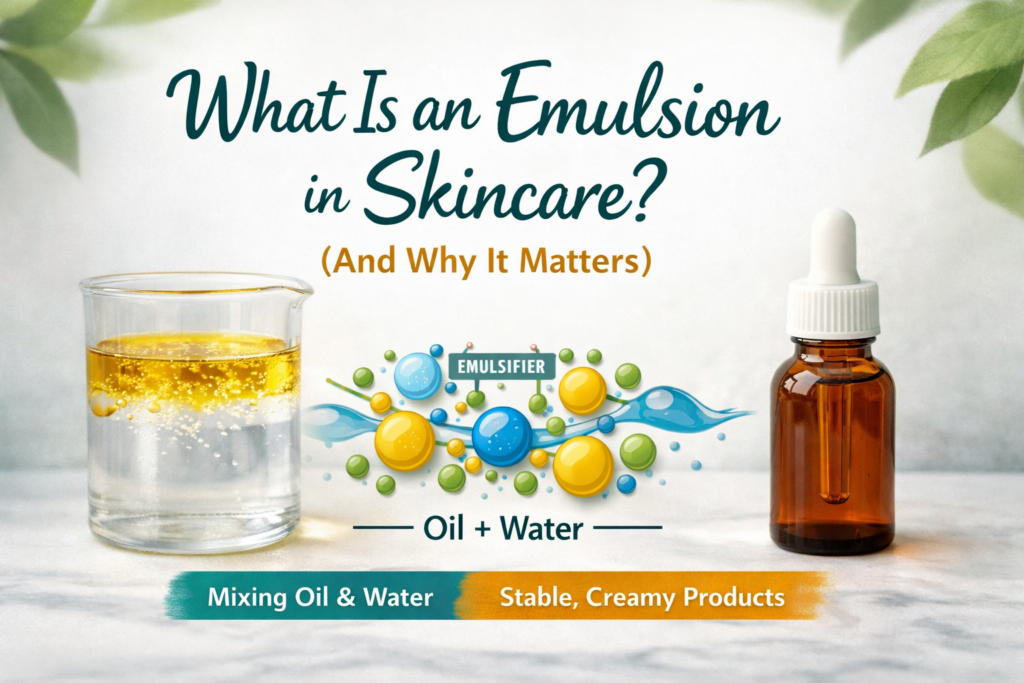
If you’ve ever made a lotion that separated, felt watery, or broke down after a few days, you’ve already encountered the importance of emulsions — even if you didn’t know the term yet.
An emulsion is the foundation of most skincare products, including lotions, creams, and many facial products. Understanding what an emulsion is (and why it matters) is one of the biggest turning points for DIY formulators. Once this clicks, formulation stops feeling like guesswork and starts to make sense.
This post explains emulsions in plain language, how they work, why they fail, and how they connect to everything from ingredient choice to finished texture.
What Is an Emulsion?
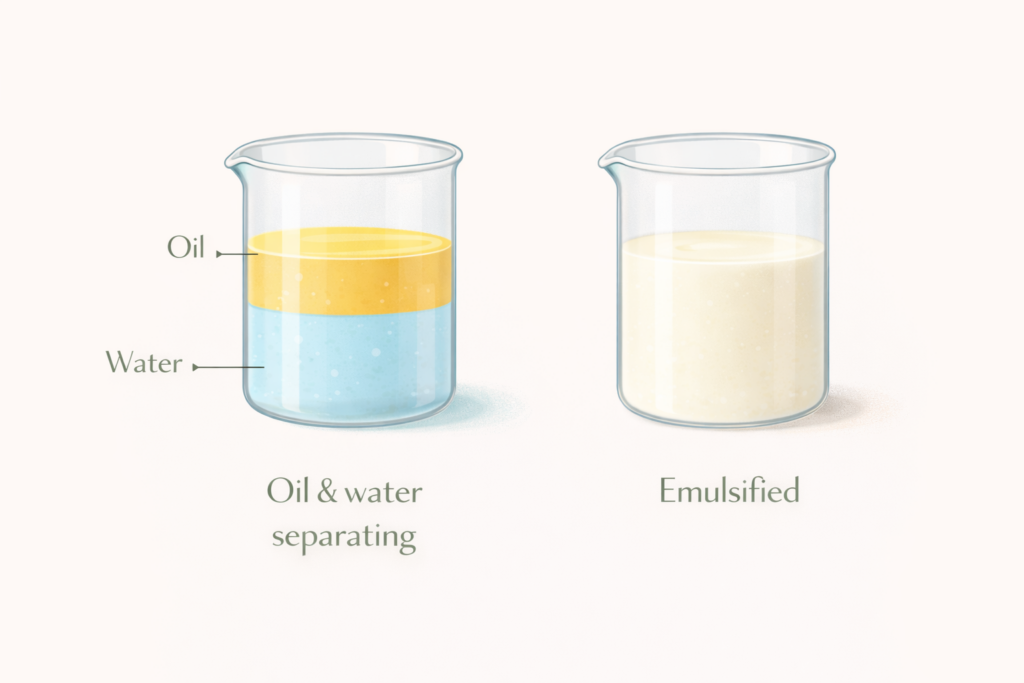
An emulsion is a mixture of oil and water that are held together using an emulsifier.
Normally, oil and water do not mix. An emulsion forces them to stay combined long enough to create a stable, usable skincare product.
In skincare, emulsions allow you to:
- Deliver oil-soluble and water-soluble ingredients together
- Create lightweight but moisturizing textures
- Improve absorption and skin feel
Most lotions and creams you use every day are emulsions — even if they don’t look technical or complicated.
Oil vs Water in Skincare Formulation
Water and oil behave very differently in a formula.
- Water hydrates, dissolves humectants, and creates light textures
- Oil softens skin, reduces moisture loss, and adds richness
Without an emulsifier, these two phases will separate over time. Shaking may temporarily recombine them, but that’s not a stable or safe solution for most skincare products.
This is why understanding water vs oil is foundational before attempting lotions or creams.
Why Emulsions Matter in Skincare
Emulsions are not just about appearance — they affect performance, safety, and user experience.
A well-made emulsion:
- Applies evenly
- Absorbs predictably
- Delivers hydration and oils together
- Remains stable over time
A failed emulsion can:
- Separate or weep
- Feel greasy or watery
- Break down preservatives
- Shorten shelf life
This is why emulsions are central to effective skincare formulation.
Types of Emulsions (Simplified)
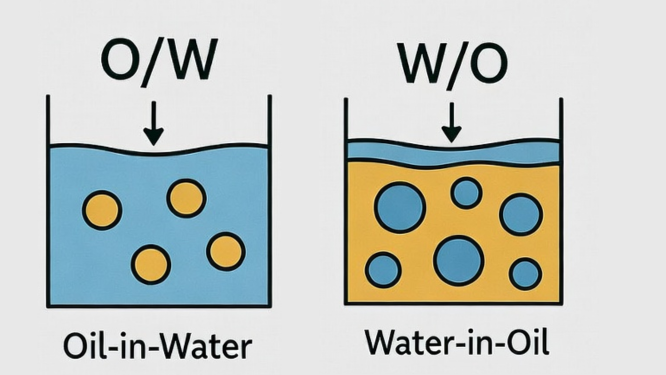
You don’t need to memorize chemistry to understand emulsions. Most DIY skincare uses one of two types:
Oil-in-Water (O/W)
- Oil droplets dispersed in water
- Lightweight feel
- Common in lotions and facial products
Water-in-Oil (W/O)
- Water droplets dispersed in oil
- Heavier, more protective
- Less common in beginner DIY
Most home formulators work almost exclusively with oil-in-water emulsions.
What Does an Emulsifier Actually Do?
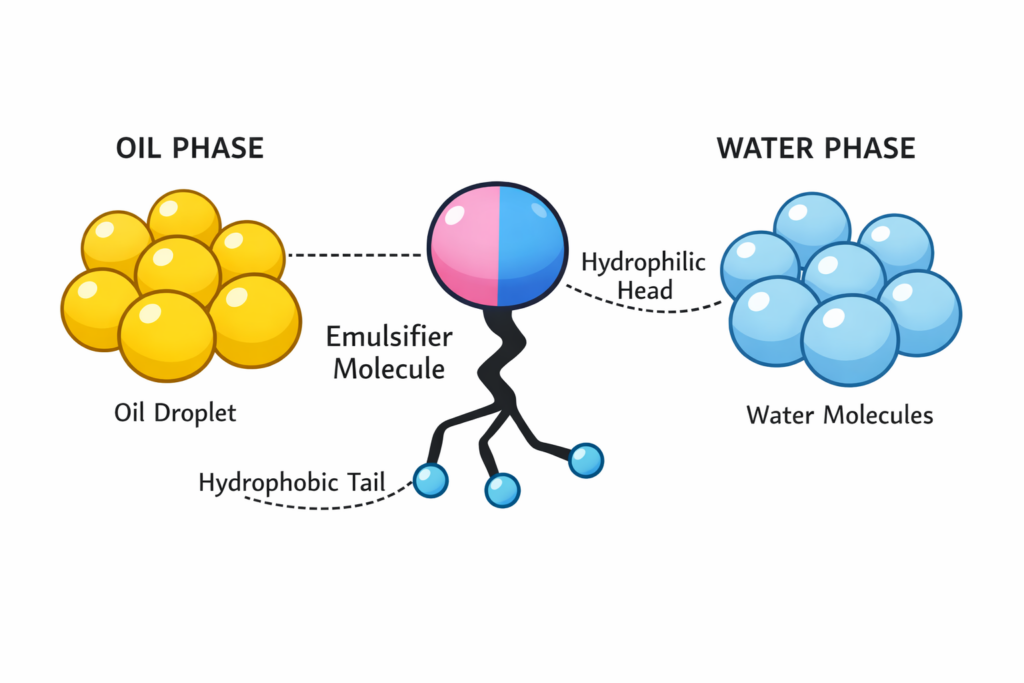
An emulsifier has one part that loves water and one part that loves oil. This allows it to sit at the boundary between the two and keep them from separating.
Beyond holding oil and water together, many emulsifiers also:
- Influence thickness
- Improve glide
- Affect absorption
- Contribute to skin feel
This is why emulsifiers are not interchangeable without adjusting the formula. Each ingredient has a role, check out What Each Ingredient Does in Skincare Formulation.
Why DIY Emulsions Often Fail
Emulsion failure is one of the most common beginner frustrations.
Common causes include:
- Incorrect emulsifier usage rate
- Skipping proper heating or mixing
- Imbalanced oil-to-water ratio
- Incompatible ingredients
- Missing preservatives in water-based products
When a lotion separates, it’s not random — it’s feedback from the formula.
When You Need an Emulsion (And When You Don’t)
You need an emulsion when your formula contains:
- Both oil and water
- Emulsifiers or emulsifying waxes
You do not need an emulsion for:
- Pure oils
- Anhydrous body butters
- Oil-based balms
Understanding this distinction prevents unnecessary complications.
Emulsions and Beginner-Friendly Formulation
For beginners, emulsions can feel intimidating — but they don’t have to be.
Using:
- Reliable emulsifiers
- Balanced formulas
- Double-duty ingredients
Makes emulsions far more forgiving and successful.
This is why lotions are often the best place to start learning real formulation skills.
Conclusion
An emulsion is more than a technical term — it’s the structure that allows modern skincare to work.
Once you understand emulsions, you gain control over texture, stability, and performance. This knowledge connects ingredient choice, product type, and formulation logic into one clear system.
From here, understanding why formulas separate and how to fix them becomes much easier.
Pingback: Why Preservatives Matter in DIY Skincare (And When You Need Them) - Summer Rain
Pingback: Double-Duty Ingredients in Skincare Formulation (And Why They Matter) - Summer Rain
Pingback: Water vs Oil in Skincare Formulation: Why Balance Matters - Summer Rain
Pingback: Percentages vs Grams in Skincare Formulation (Beginner Guide) - Summer Rain
Pingback: Creamy Whipped Sugar Body Scrub Recipe - Summer Rain
Pingback: Making Lotion From Scratch - Summer Rain
Pingback: How to Make Professional Lotion at Home | Beginner Recipe Explained - Summer Rain