
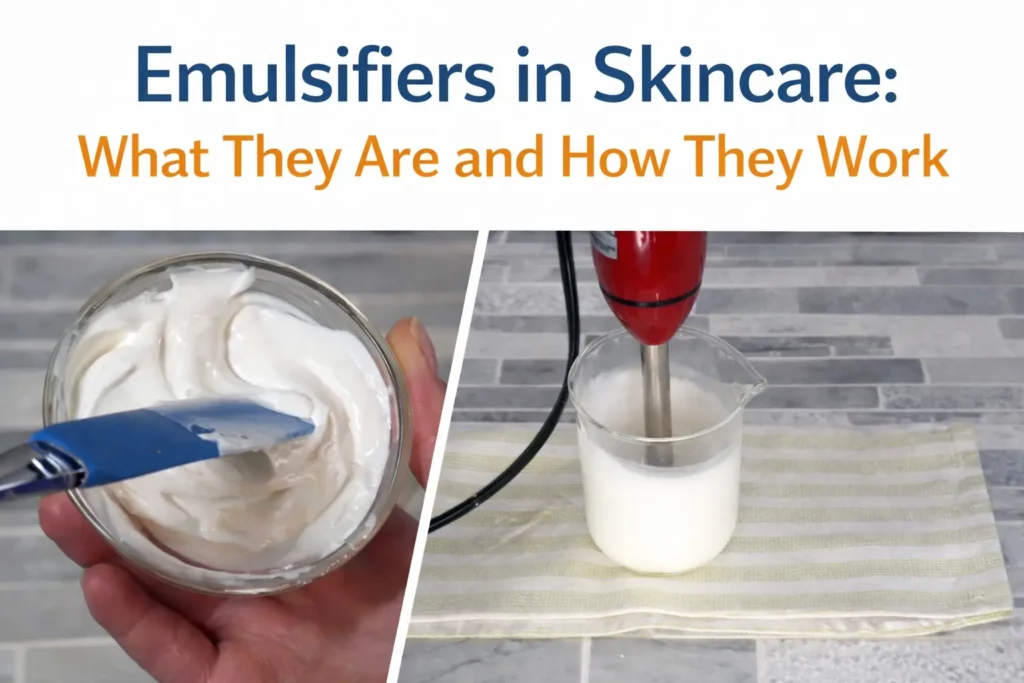
Most skincare products contain both oil and water. Lotions, creams, and conditioners all rely on a combination of these ingredients to moisturize and protect the skin.
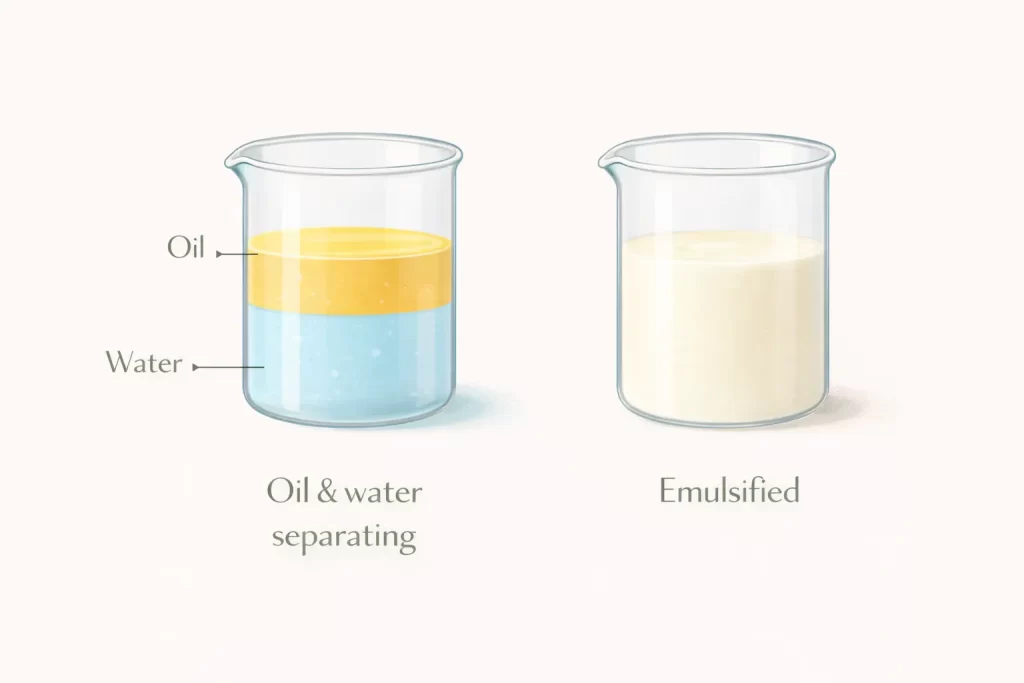
But oil and water naturally separate.
If you pour oil into a glass of water, the oil floats on top. Even if you shake the mixture, it quickly separates again.
To keep oil and water blended together in skincare products, formulators use emulsifiers.
Emulsifiers are essential for creating stable lotions and creams that stay smooth and evenly mixed.
If you’re learning how to make your own skincare, understanding emulsifiers is a key step in creating products that are both effective and stable.
If you’re new to skincare formulation, start with my complete guide:
Skincare Formulation for Beginners
What Is an Emulsifier?
An emulsifier is an ingredient that allows oil and water to mix and stay mixed in a skincare formula.
Without an emulsifier, any formula containing both oil and water will separate into layers.
Emulsifiers make it possible to create products such as:
- lotions
- creams
- conditioners
- facial moisturizers
- hair masks
These products are called emulsions, which are mixtures of oil and water stabilized by emulsifiers.
If you’re unfamiliar with emulsions, read the full explanation here:
What Is an Emulsion in Skincare and Why It Matters
Why Emulsifiers Are Important in Skincare
Emulsifiers do much more than simply mix oil and water.
They help determine the:
- texture of a product
- thickness of creams and lotions
- stability of the formula
- feel of the product on the skin
Without emulsifiers, many common skincare products would not exist.
For example:
Lotions combine water-based hydration with nourishing oils.
Creams provide rich moisture by blending oil and water phases.
Conditioners smooth the hair using emulsified oils and conditioning ingredients.
Emulsifiers also help distribute ingredients evenly throughout a formula, ensuring that each use of the product delivers consistent results.
How Emulsifiers Work
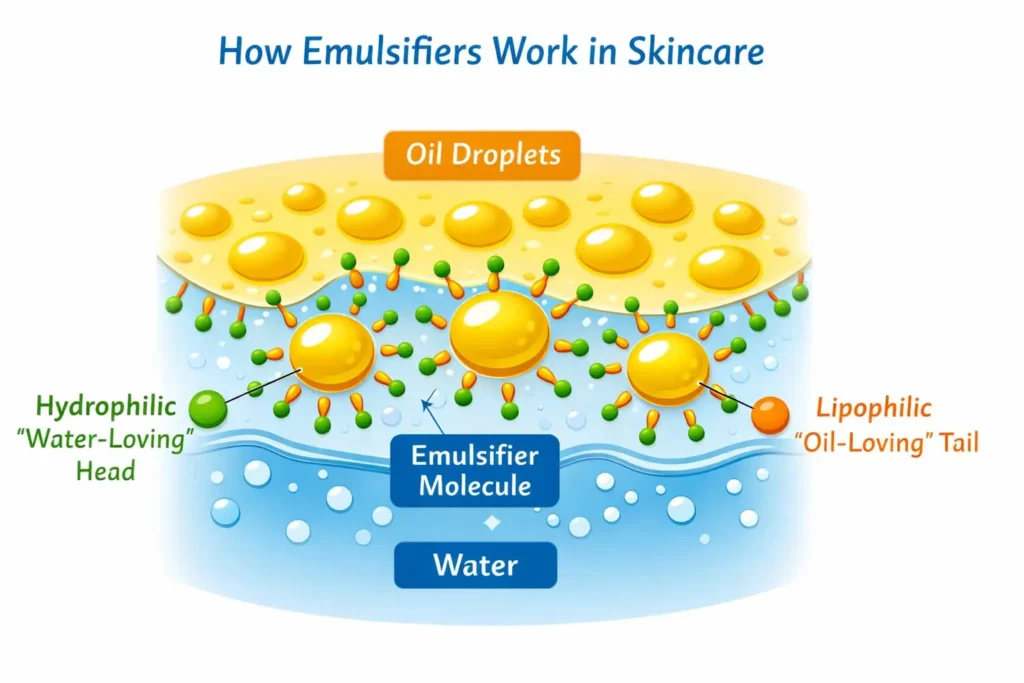
Emulsifier molecules have two different parts.
One part is water-loving (hydrophilic).
The other part is oil-loving (lipophilic).
Because of this structure, emulsifiers can attach to both oil and water at the same time.
When a formula is mixed, emulsifiers surround tiny droplets of oil and hold them evenly within the water phase.
This creates a stable mixture called an emulsion.
Without emulsifiers, the oil droplets would combine again and separate from the water.
Types of Emulsions in Skincare
There are two primary types of emulsions used in skincare formulations.
Oil-in-Water (O/W) Emulsions
Oil-in-water emulsions contain small droplets of oil dispersed in water.
These formulas feel lightweight and absorb quickly.
Most lotions and facial moisturizers use this type of emulsion.
Characteristics:
lightweight texture
non-greasy feel
fast absorption
Water-in-Oil (W/O) Emulsions
Water-in-oil emulsions contain small droplets of water suspended in oil.
These formulas are thicker and more protective.
They are often used in richer creams and barrier-repair products.
Characteristics:
heavier texture
longer-lasting moisture
more occlusive
Common Emulsifiers Used in DIY Skincare
There are many emulsifiers available for cosmetic formulation. Some are widely used by DIY formulators because they are relatively easy to work with.
Emulsifying Wax
Emulsifying wax is one of the most beginner-friendly emulsifiers.
It produces stable lotions and creams and is widely used in DIY recipes.
Typical usage rate: 3–6%
BTMS (Behentrimonium Methosulfate)
BTMS is a conditioning emulsifier often used in hair products.
It provides both emulsification and conditioning properties.
Typical usage rate: 3–5%
Common uses:
hair conditioners
hair masks
creamy lotions
Olivem 1000
Olivem 1000 is a plant-derived emulsifier made from olive oil.
It produces smooth, elegant emulsions with a soft skin feel.
Typical usage rate: 4–8%
Lecithin
Lecithin is a natural emulsifier derived from soy or sunflower.
It is commonly used in natural skincare formulations.
However, lecithin produces looser emulsions and is often combined with other emulsifiers.
Emulsifier Comparison Table
| Emulsifier | Best Use | Typical Usage Rate | Texture |
|---|---|---|---|
| Emulsifying Wax | Lotions & creams | 3–6% | Smooth |
| BTMS | Hair conditioners | 3–5% | Creamy |
| Olivem 1000 | Natural lotions | 4–8% | Lightweight |
| Lecithin | Natural formulations | 1–3% | Thin |
The Basic Structure of an Emulsion Formula
Most skincare emulsions follow a similar structure.
Water Phase
The water phase contains water-based ingredients such as:
distilled water
aloe vera juice
hydrosols
glycerin
Oil Phase
The oil phase contains oils, butters, and oil-soluble ingredients.
Examples include:
carrier oils
plant butters
vitamin E
oil-soluble extracts
Carrier oils are commonly used in this phase. Learn more in:
Carrier Oils in Skincare: How to Choose the Right Oil for Your Skin
Emulsifier
The emulsifier holds the water and oil phases together.
Cool-Down Phase
This phase includes heat-sensitive ingredients such as:
preservatives
fragrance oils
essential oils
active ingredients
Preservatives are especially important in products that contain water.
Learn why here:
Why Preservatives Matter in DIY Skincare
Common Emulsion Problems
Even with an emulsifier, problems can occur if the formula is not prepared correctly.
Separation
Separation occurs when oil and water split into layers.
This can happen if:
too little emulsifier is used
the phases are not mixed properly
the formula is unstable
Learn more here:
Why Some DIY Skincare Separates and How to Fix It
Grainy Texture
Sometimes creams can develop a grainy or uneven texture.
This is often caused by butter crystallization rather than the emulsifier itself.
Thin or Runny Lotion
A lotion may be too thin if:
the oil phase is too small
the emulsifier percentage is too low
no thickening ingredients are used
Tips for Working With Emulsifiers
To create stable emulsions, keep these tips in mind.
Heat both phases
The oil phase and water phase should be heated to similar temperatures before combining.
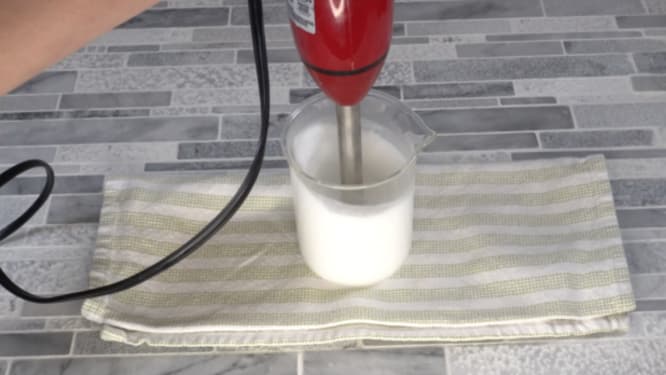
Blend thoroughly
Using an immersion blender helps create smaller droplets and a more stable emulsion.
Use correct percentages
Too little emulsifier can cause separation.
Allow proper cooling
Some emulsions thicken as they cool.
Emulsifiers and Skincare Stability
A well-formulated emulsion should remain stable for months without separating.
However, stability depends on several factors:
correct emulsifier selection
proper ingredient ratios
accurate mixing technique
Formulators often test products over time to ensure the emulsion remains stable.
Learning how ingredients function within formulas is key to improving results.
For more on ingredient roles, read:
What Each Ingredient Does in Skincare Formulation
FAQ
What is an emulsifier in skincare?
An emulsifier is an ingredient that allows oil and water to mix and remain blended in a skincare formula.
Why are emulsifiers used in lotions?
Emulsifiers keep oil and water from separating, creating smooth and stable lotions.
Are emulsifiers safe for skincare?
Yes. Cosmetic emulsifiers are widely used in skincare and personal care products and are considered safe when used properly.
Can you make lotion without an emulsifier?
No. Oil and water will separate without an emulsifier, making it impossible to create a stable lotion.
Pingback: Sugar Scrub Cubes: How to Make Solid Exfoliating Bars (That Actually Work) - Summer Rain
Pingback: How to Make Solid Bubble Bars (Beginner-Friendly Recipe) - Summer Rain