
Coconut oil is one of those ingredients that seems to show up everywhere in DIY skincare. You’ll find it in body butters, scrubs, lip products, hair treatments, soap, massage products, and more.
It is popular for good reason. Coconut oil is a rich, solid-at-room-temperature oil with excellent glide, a relatively high melting point for a natural oil, and a fatty acid profile that makes it especially useful in certain types of formulations.
But coconut oil isn’t automatically the best choice for every recipe.
It can make a product feel richer, add structure to an anhydrous formula, and provide excellent slip. In hair care, it has some unique properties that make it different from many other plant oils.
In this guide, I’ll explain what coconut oil does, how it behaves in different types of DIY products, how to use it in a formula, and when you might want to choose a different oil instead.
Coconut Oil at a Glance
| Coconut Oil | |
|---|---|
| INCI Name | Cocos Nucifera (Coconut) Oil |
| Ingredient Type | Vegetable oil / emollient |
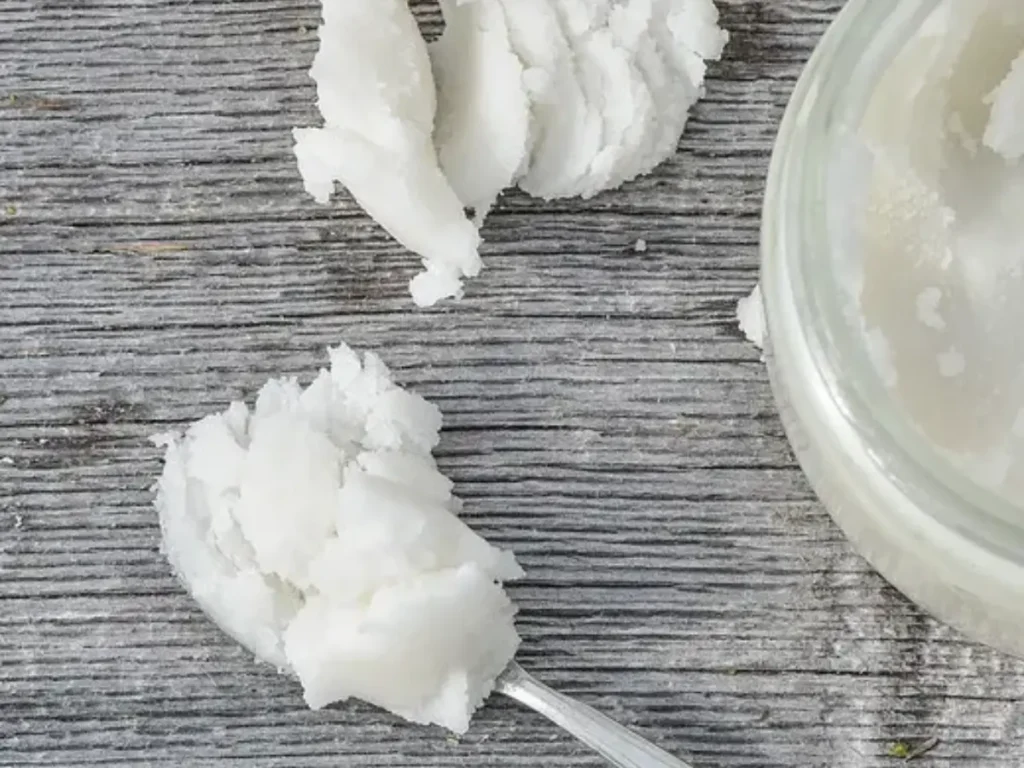
| Appearance | White to off-white solid when cool; clear liquid when melted |
| Solubility | Oil soluble; insoluble in water |
| Skin Feel | Rich, smooth and occlusive; can feel greasy depending on the formula |
| Common Uses | Body butters, balms, scrubs, lip products, hair care, massage products and soap |
| Oil Phase | Yes |
| Typical Use Rate | Formula dependent; can be used at a wide range of percentages |
| Melting Point | Approximately 24–26°C / 76–79°F, depending on the coconut oil |
| Best Known For | Rich emollience, excellent glide, solid structure and use in hair care and soap |
| Shelf Life | Follow the shelf life provided by your supplier – typically 3-5 years |
What Is Coconut Oil?
Coconut oil is a vegetable oil obtained from the meat of coconuts.
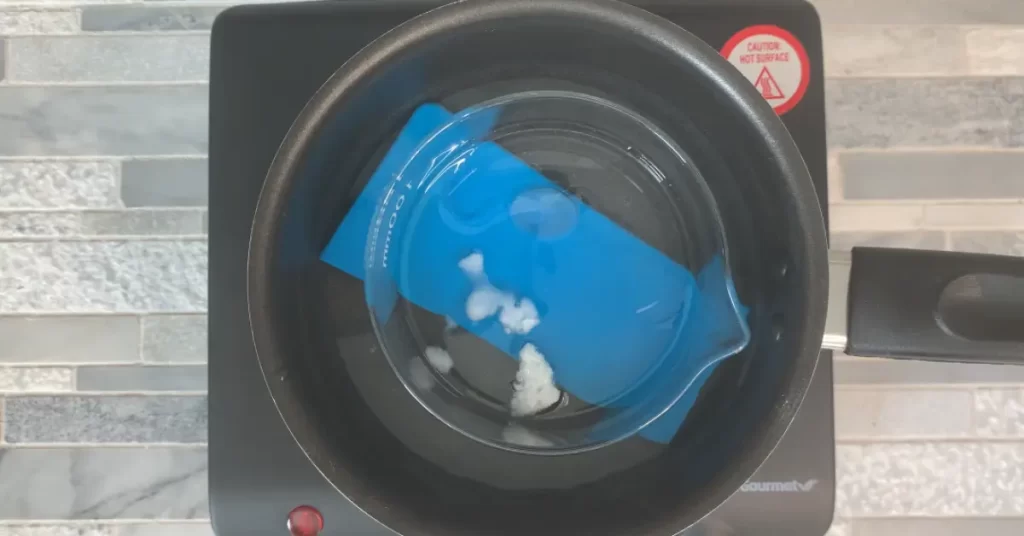
Unlike many liquid carrier oils, coconut oil is normally solid at room temperature. It melts easily with gentle heat and becomes a clear liquid.
This makes coconut oil particularly useful when you want an oil to contribute some structure to an anhydrous product.
For example, coconut oil can help give a body butter, balm or solid scrub a firmer texture than a formula made entirely with liquid oils.
The exact characteristics of coconut oil can vary depending on how it was processed.
You may see:
- Refined coconut oil
- Unrefined or virgin coconut oil
- Fractionated coconut oil
These are not interchangeable ingredients.
Refined vs. Unrefined Coconut Oil
Refined coconut oil has been processed to remove impurities and typically has little to no coconut scent.
Virgin or unrefined coconut oil is less processed and generally retains more of its natural coconut aroma and characteristics.
For most DIY formulations, either can work depending on what you want from the finished product.
If you want a formula without a noticeable coconut scent, refined coconut oil is usually the easier choice.
If you like the natural coconut aroma, unrefined coconut oil can be a good option.
Always check the specifications from your supplier because different coconut oils can have slightly different characteristics.
What Does Coconut Oil Do in Skincare?
Coconut oil is primarily an emollient.
Emollients help soften and smooth the skin by improving the feel of the skin’s surface.
Coconut oil also has occlusive properties, meaning it can help slow the loss of water from the skin.
This is an important distinction:
Coconut oil does not add water to the skin.
Instead, it is an oil that can help soften the skin and reduce moisture loss.
This is why coconut oil works particularly well in oil-based products such as body butters, balms and massage products.
If you’re learning about the difference between oils, humectants and occlusives, my guide to Humectants, Occlusives and Emollients Explained is a helpful place to start.
Why Does Coconut Oil Feel So Different From Liquid Oils?
One of the biggest differences between coconut oil and oils such as sunflower or grapeseed oil is that coconut oil is solid at normal room temperature.
That gives it two useful characteristics in formulation:
It can add structure.
A formula containing coconut oil will generally be firmer than the same formula made with an equivalent amount of a liquid oil.
It provides excellent glide.
When coconut oil melts against the skin, it spreads easily and provides a smooth, slippery feel.
That combination makes it especially useful in products where you want both structure and slip.
Coconut Oil in Body Butters
Coconut oil is a popular ingredient in whipped body butters because it contributes both richness and structure.
I use coconut oil in my Whipped Body Butter recipe along with shea butter and olive oil.
In a body butter, coconut oil can help:
- Make the butter feel rich and smooth
- Improve glide during application
- Add firmness
- Give the finished product a creamy texture
- Provide an emollient feel
However, coconut oil also has a relatively low melting point compared with many cosmetic butters and waxes.
That means a body butter containing a large amount of coconut oil can soften considerably in a warm room.
If you’re making a whipped body butter, keep that in mind when choosing the ratio of hard and soft ingredients.
Coconut Oil in Scrubs
Coconut oil works especially well in sugar and salt scrubs.
The oil coats the exfoliating particles and provides slip while you massage the scrub over the skin.
It can also make a scrub feel richer than one made with a lighter liquid oil.
One thing to remember is that coconut oil will become firmer as it cools.
That can affect the final texture of an oil-based scrub.
If a scrub contains a large amount of coconut oil, it may become quite firm in a cool room and much softer when warm.
The rest of the formula matters too, so don’t choose the coconut oil percentage based only on how the oil behaves by itself.
If you’re learning how exfoliating products work, you can also read my guide to physical exfoliation and choosing the right exfoliator.
Coconut Oil in Lip Products
Coconut oil can be useful in lip balms, lip scrubs and other anhydrous lip products.
It provides a smooth, rich feel and helps the product glide across the lips.
Because it is solid at room temperature, it can also contribute to the structure of a lip product.
However, coconut oil alone generally isn’t enough to create a firm lip balm.
Lip balms typically rely on a combination of:
- Oils
- Butters
- Waxes
The wax provides much of the structure, while the oils and butters influence the feel and glide.
I use coconut oil in my Lip Scrub recipe.
Coconut Oil for Hair
Coconut oil is particularly interesting in hair care because it behaves differently from many other oils.
Research has found that coconut oil can penetrate the hair shaft and may help reduce protein loss from hair.
That is one reason coconut oil has remained popular in pre-wash hair treatments and hair masks.
This does not mean coconut oil is automatically the best oil for every hair type.
Hair is different from skin, and the amount of oil that feels good can vary considerably.
Some people find coconut oil leaves their hair soft and conditioned, while others find it makes their hair feel heavy, stiff or coated.
The best way to use it is to consider the entire formula and the needs of your hair rather than assuming that more oil will provide more benefit.
I use coconut oil in my DIY Hair Mask and Hair Conditioner recipes.
Coconut Oil vs. Fractionated Coconut Oil
These two ingredients are related, but they are not the same thing.
Regular coconut oil is normally solid at room temperature.
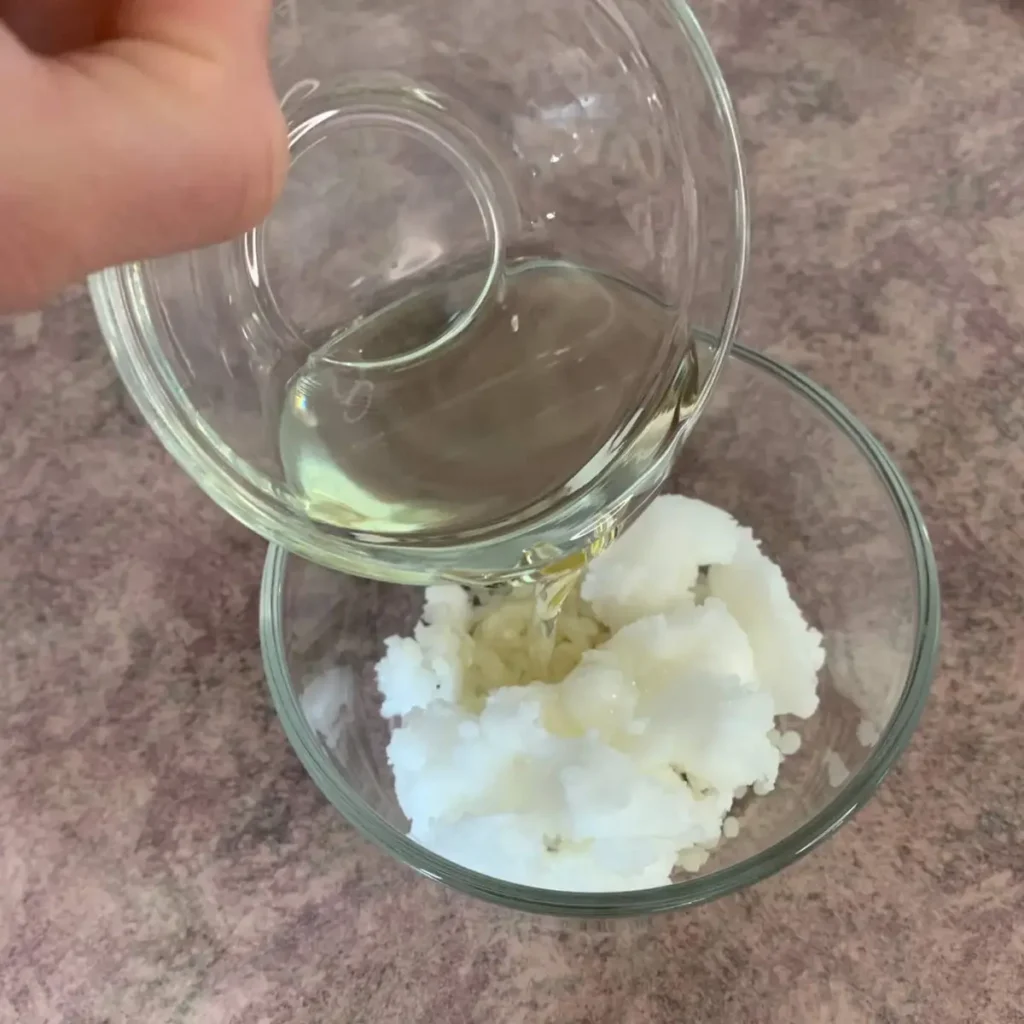
Fractionated coconut oil has had some of the longer-chain components removed, leaving a lightweight liquid oil that remains liquid at room temperature.
This gives fractionated coconut oil a very different feel.
Regular Coconut Oil
- Solid at room temperature
- Richer feel
- Adds structure
- Excellent glide
- Can feel greasy on some skin
- Useful in body butters, balms, scrubs and hair treatments
Fractionated Coconut Oil
- Liquid at room temperature
- Lightweight feel
- Spreads easily
- Generally feels less greasy
- Useful in massage oils, serums and lightweight oil-based products
Because they behave differently, fractionated coconut oil is not always a one-for-one substitution for regular coconut oil.
Replacing solid coconut oil with a liquid oil can change the texture and stability of the finished product.
I use fractionated coconut oil in several lightweight oil formulations, including my Cooling Foot Massage Oil.
How Much Coconut Oil Should You Use?
There isn’t one universal percentage of coconut oil that works for every type of product.
The appropriate amount depends on what you’re making and what you want the coconut oil to do.
For example, a body butter may contain a significant amount of coconut oil because the oil is part of the structure and feel of the formula.
A lotion may use a much smaller percentage because coconut oil is only one part of the oil phase.
A hair treatment may use coconut oil differently again.
Instead of asking, “What is the maximum amount of coconut oil I can use?” it is more useful to ask:
What job is coconut oil doing in this formula?
Is it there for:
- Emollience?
- Structure?
- Slip?
- Hair conditioning?
- A richer skin feel?
- Part of the oil phase?
Once you know its role, you can determine how much makes sense for the formula.
Always follow the recommended usage information from your ingredient supplier when one is provided.
Where Does Coconut Oil Go in a Formula?
Coconut oil belongs in the oil phase of a formulation.
It is an oil, so it does not dissolve in water.
In an emulsion such as a lotion, coconut oil would normally be included with the other oil-phase ingredients and heated as needed to melt it.
For anhydrous products such as body butters and balms, it can be combined with the other oils, butters and waxes according to the recipe.
If you’re new to formulation, understanding the difference between the water phase and oil phase is one of the most useful things you can learn.
My Skincare Formulation Basics guide explains how these phases work and why oil and water require an emulsifier to remain combined.
Does Coconut Oil Dissolve in Water?
No.
Coconut oil is oil soluble and does not dissolve in water.
If you put coconut oil into water, the two will separate.
This is why products containing both water and coconut oil require an appropriate emulsifier if you want them to remain as one stable product.
For example, you cannot simply add coconut oil to water and expect to create a lotion.
You need a properly formulated emulsion.
Coconut Oil in Soap
Coconut oil is one of the classic oils used in cold-process soap.
It is valued for its ability to contribute cleansing and bubbly lather to a soap formula.
However, using a large amount of coconut oil in soap can produce a bar that feels very cleansing and may feel drying to some people.
This is why coconut oil is often balanced with other oils that contribute different properties to the finished bar.
Soap formulation is different from lotion or body-care formulation because the oils are chemically transformed through the saponification process.
So the properties of coconut oil in a finished soap are not exactly the same as the properties of coconut oil sitting on your skin in an oil-based product.
Is Coconut Oil Good for Your Face?
Coconut oil can be used in some facial products, but I wouldn’t consider it a universal facial oil.
It can feel rich and occlusive, and some people find it too heavy for facial use.
If you have oily or acne-prone skin, you may prefer a lighter-feeling oil.
This is one of those situations where an ingredient being popular doesn’t necessarily mean it is the right choice for every formulation.
The finished product matters just as much as the individual ingredient.
For a lightweight facial product, you may want to look at oils such as jojoba oil or other oils selected specifically for the skin feel you want.
Can Coconut Oil Make Skin Greasy?
Yes.
This is one of the most important things to consider when formulating with coconut oil.
Coconut oil provides excellent glide, but that doesn’t necessarily mean it will feel lightweight.
In a body butter or massage product, that richer feel may be exactly what you want.
In a facial moisturizer or lightweight lotion, you may prefer to use less coconut oil or choose a lighter oil instead.
This is a good example of why ingredient selection should be based on the finished product, not just the individual ingredient.
Coconut Oil for Dry Skin
Coconut oil can be useful in products designed for dry skin because it provides emollience and can help reduce moisture loss from the skin.
However, an oil by itself does not hydrate the skin in the same way that a water-containing product does.
A well-formulated moisturizer may combine:
- Humectants to attract water
- Water to provide hydration
- Emollients to soften the skin
- Occlusives to reduce moisture loss
Coconut oil can fill part of that emollient and occlusive role, but it isn’t the entire moisturizing system.
Coconut Oil and Heat
Because coconut oil melts at a relatively low temperature, temperature can have a noticeable effect on products containing it.
A body butter that is firm in a cool room may become much softer during the summer.
A lip product containing coconut oil may also become softer when exposed to heat.
Keep this in mind when choosing packaging and deciding how much structure your formula needs.
If a finished product is too soft, adding more coconut oil isn’t necessarily the solution.
You may need to look at the balance between your liquid oils, butters and waxes.
How Should Coconut Oil Be Stored?
Keep coconut oil in a cool, dry place with the container tightly closed.
Protect it from excessive heat, moisture and contamination.
Because coconut oil can melt and solidify repeatedly as temperatures change, the appearance and consistency may change during storage without necessarily meaning that the ingredient has gone bad.
Always follow the storage recommendations provided by your supplier.
Does Coconut Oil Expire?
Yes.
Like other vegetable oils, coconut oil can eventually oxidize and become rancid.
The shelf life depends on the specific coconut oil and how it has been processed and stored. Typically 3 – 5 years.
Always use the expiration date or recommended shelf life provided by your supplier rather than assuming that every coconut oil has the same shelf life.
Signs that an oil may no longer be suitable include an unpleasant rancid or stale odor, significant changes in appearance, or other changes that are inconsistent with the original ingredient.
Choosing Coconut Oil for DIY Formulations
When purchasing coconut oil for DIY skincare or hair care, look at the supplier’s information rather than simply buying the first coconut oil you find.
Check for:
- INCI name
- Refined or unrefined status
- Intended cosmetic use
- Melting point
- Recommended storage conditions
- Shelf life
- Supplier specifications
If you’re making skincare products, choose an ingredient intended for cosmetic use.
Food-grade coconut oil can sometimes be appropriate for DIY projects, but cosmetic ingredients give you more information about the specific material you’re putting into a formulation.
Coconut Oil vs. Other Oils
Coconut oil isn’t automatically better or worse than other carrier oils.
It simply has different characteristics.
| Oil | General Feel | Room Temperature | Good For |
|---|---|---|---|
| Coconut Oil | Rich, smooth | Solid | Body butters, balms, scrubs, hair care |
| Fractionated Coconut Oil | Lightweight | Liquid | Massage oils, lightweight products |
| Sunflower Oil | Light to medium | Liquid | Lotions, body oils, general skincare |
| Jojoba Oil | Silky, lightweight | Liquid | Facial products, lotions, body oils |
| Olive Oil | Rich | Liquid | Body products, soap |
| Sweet Almond Oil | Medium, silky | Liquid | Lotions, body oils, massage |
The best oil depends on the formula you’re making and the skin feel you want.
If you’re trying to decide which carrier oil to use, my How to Choose the Right Oil for Your Skin guide goes into this in more detail.
Frequently Asked Questions
Is coconut oil an emollient?
Yes. Coconut oil functions primarily as an emollient and can also provide occlusive properties. It helps soften the skin and can reduce moisture loss.
Is coconut oil water soluble?
No. Coconut oil is oil soluble and does not dissolve in water.
Is coconut oil solid or liquid?
It depends on temperature. Coconut oil is normally solid at room temperature and melts at approximately 24–26°C / 76–79°F.
Can coconut oil be used in lotion?
Yes. Coconut oil can be included in the oil phase of a lotion. Because it is solid at room temperature, it can also influence the texture of the finished lotion.
Can coconut oil be used in body butter?
Yes. Coconut oil is commonly used in body butters because it provides richness, glide and some structure.
Can coconut oil be used in a sugar scrub?
Yes. Coconut oil works well in oil-based sugar scrubs and provides slip while helping coat the sugar particles.
Is coconut oil good for hair?
Coconut oil has properties that make it particularly useful in hair care, including its ability to penetrate hair and help reduce protein loss. However, how it feels depends on the hair and the finished formulation.
What is the difference between coconut oil and fractionated coconut oil?
Regular coconut oil is normally solid at room temperature, while fractionated coconut oil remains liquid. They have different textures and should not automatically be substituted one-for-one.
Can coconut oil be used on the face?
It can, but it isn’t ideal for everyone. Coconut oil has a rich, potentially greasy feel, so people who prefer lightweight facial products may prefer other oils.
Does coconut oil hydrate skin?
Not in the same way that water or a humectant does. Coconut oil is an emollient and occlusive ingredient that can soften skin and help reduce moisture loss.
DIY Recipes Using Coconut Oil
Ready to use coconut oil in a DIY project?
Here are some Summer Rain recipes that use coconut oil:
For a lighter oil-based product, you can also look at recipes that use fractionated coconut oil instead of regular coconut oil.
Final Thoughts
Coconut oil is a useful ingredient to understand because it does more than simply add “moisture” to a DIY recipe.
It is a rich emollient oil that can soften skin, provide excellent glide, contribute some structure to anhydrous products, and play a useful role in hair care.
Its biggest characteristic is also one of the most important things to remember: coconut oil is solid at room temperature but melts easily with heat.
That makes it useful in body butters, balms and scrubs, but it also means the amount you use can have a noticeable effect on the final texture.
The main things to remember are:
- Coconut oil is an emollient and can also provide occlusive properties.
- It belongs in the oil phase of a formulation.
- It does not dissolve in water.
- Regular coconut oil is normally solid at room temperature.
- It can provide excellent glide and richness.
- It can contribute structure to anhydrous products.
- It is commonly used in body butters, scrubs, lip products, hair care and soap.
- Fractionated coconut oil is a different ingredient with a lighter, liquid texture.
- More coconut oil does not necessarily mean a better product.
- Always consider the finished formula and the skin or hair feel you want.
- Follow your supplier’s recommended storage and shelf-life information.
Once you understand how coconut oil behaves, it becomes much easier to decide when it belongs in a formula—and when another oil would be a better choice.
Pingback: Fractionated Coconut Oil: How To Use In Skincare - Summer Rain