
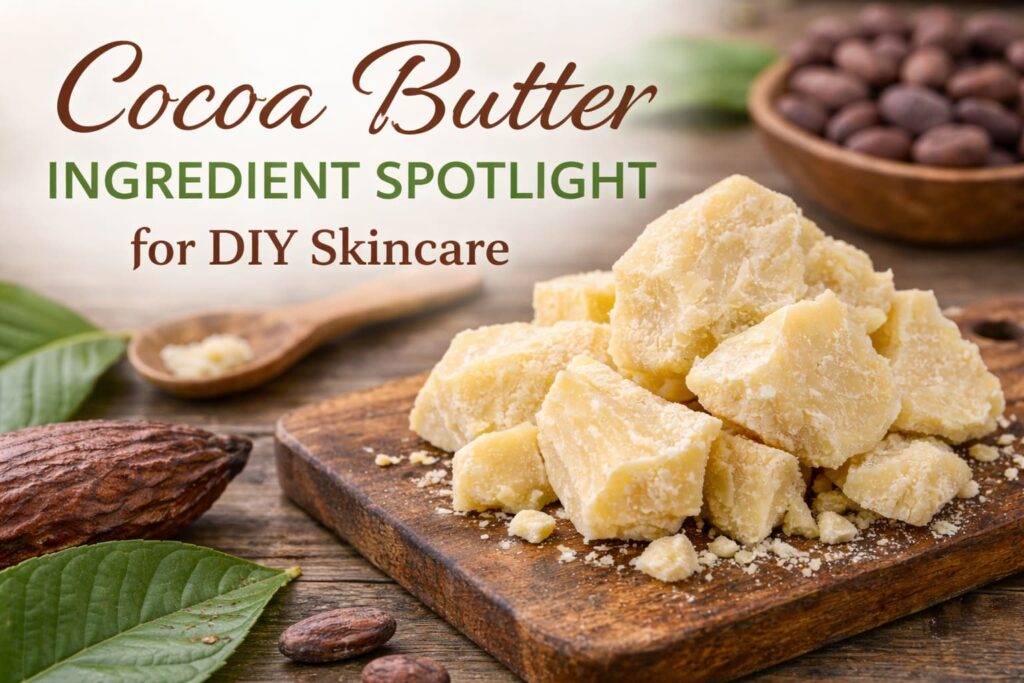
If you’ve ever made lip balm, body butter, lotion, or a solid skincare product, you’ve probably come across cocoa butter.
And if you’ve ever opened a container of natural cocoa butter, you probably noticed the smell before anything else.
That unmistakable chocolate-like aroma is one of the things that makes cocoa butter so much fun to work with.
But cocoa butter isn’t just an ingredient you add because it sounds luxurious.
It is a firm plant butter that can add richness, emollience, and structure to your skincare formulas.
It can change the texture of a body butter, give a balm more firmness, and help turn a soft mixture of oils and butters into a product that actually holds its shape.
So what exactly does cocoa butter do for your skin?
How do you use it in skincare?
How much should you use?
What’s the difference between natural and deodorized cocoa butter?
And can you substitute cocoa butter for shea butter?
Let’s take a look.
Cocoa Butter at a Glance
| Cocoa Butter | |
|---|---|
| INCI Name | Theobroma Cacao (Cocoa) Seed Butter |
| Ingredient Type | Plant butter / emollient |
| Appearance | Firm solid |
| Solubility | Oil soluble; insoluble in water |
| Skin Feel | Rich, smooth and protective-feeling |
| Common Uses | Body butter, lotion, balm, lip balm and solid products |
| Oil Phase | Yes |
| Natural Aroma | Characteristic cocoa aroma |
| Best Known For | Richness, firmness and structure |
The quick answer
Cocoa butter is a firm, oil-soluble plant butter used in skincare to add richness, emollience, and structure.
It’s especially useful in body butters, lip balms, lotion bars, balms, and other solid or anhydrous products.
Natural cocoa butter has a noticeable cocoa aroma, while deodorized cocoa butter has that aroma significantly reduced.
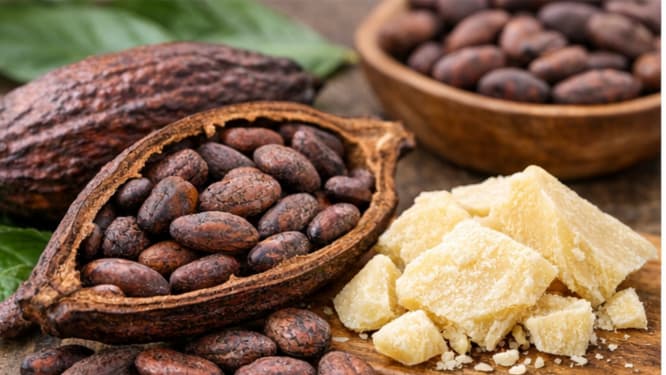
Cocoa butter comes from the seeds of the cacao tree, Theobroma cacao.
And while it comes from the same plant associated with chocolate, cosmetic-grade cocoa butter isn’t chocolate.
It’s a purified plant fat used in cosmetic formulations.
What Is Cocoa Butter?
Cocoa butter is a vegetable fat that is naturally solid at room temperature.
That one characteristic tells us a lot about why it’s useful in skincare formulation.
Unlike a liquid carrier oil, cocoa butter can add firmness and structure to a formula.
Think about the difference between pouring olive oil into a container and adding a solid butter.
The olive oil makes the formula more fluid.
The butter gives it body.
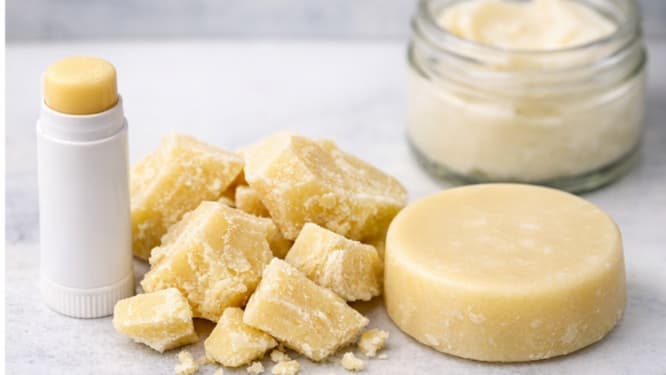
That’s why cocoa butter is especially useful in products such as:
- Body butters
- Lip balms
- Lotion bars
- Balms
- Massage bars
- Solid perfumes
- Solid skincare products
It can also be incorporated into lotions and creams as part of the oil phase.
What Are the Benefits of Cocoa Butter for Skin?
Cocoa butter is primarily an emollient and structuring ingredient.
When used in a skincare formula, it can help soften and condition the skin while giving the finished product a rich, substantial feel.
Some of the benefits of using cocoa butter in skincare include:
- Providing emollience
- Helping soften and condition the skin
- Adding richness to a formula
- Creating a smooth, creamy feel
- Adding structure to anhydrous products
- Increasing firmness
- Giving products a more substantial skin feel
- Helping create a protective-feeling finish
One important thing to remember is that cocoa butter doesn’t do all of these things in exactly the same way in every product.
The rest of the formula matters.
A body butter made with cocoa butter, jojoba oil, and shea butter will behave differently from a lip balm made with cocoa butter and beeswax.
That’s one of the reasons I like looking at skincare ingredients from a formulation perspective.
What Is Cocoa Butter Good For?
Cocoa butter is especially useful when you want to add richness or firmness to a skincare product.
It’s commonly used in:
- Body butter
- Lip balm
- Lotion bars
- Body balms
- Lotion
- Creams
- Solid perfume
- Massage bars
- Body scrubs
- Other anhydrous skincare products
It’s particularly useful when you’re working with a formula that needs more structure.
For example, if you’re making a body butter that’s too soft, a firm butter such as cocoa butter may help change the consistency.
If you’re making a lip balm, cocoa butter can help give the product the firmness it needs.
And if you’re making a lotion bar, cocoa butter can be part of the structure that allows the bar to remain solid at room temperature.
Is Cocoa Butter a Moisturizer?
You’ll often see cocoa butter described as a moisturizer.
When we’re talking about formulation, though, I prefer to think of cocoa butter primarily as an emollient.
An emollient helps soften and condition the skin while also contributing to the feel of the finished product. You can learn more about emollients on my Humectants, Occlusives and Emollients Explained post.
Cocoa butter is not a humectant like glycerin.
And it isn’t an emulsifier.
Think about the jobs this way:
Cocoa butter = Emollient + structure
Glycerin = Humectant
Emulsifying wax = Emulsifier
Once you start understanding what each ingredient actually does, formulation becomes much easier.
Instead of asking whether an ingredient is “good for your skin,” you can ask:
What job do I need this ingredient to do?
Why Use Cocoa Butter in a Skincare Formula?
It adds structure
This is one of the biggest reasons to use cocoa butter.
Because cocoa butter is firm at room temperature, it can help make an anhydrous product more solid.
That makes it useful for:
- Lip balms
- Body balms
- Massage bars
- Lotion bars
- Body butters
- Solid perfumes
If you’re trying to make a product that needs to hold its shape, a firm butter can be incredibly useful.
It adds richness
Cocoa butter gives formulas a rich, substantial feel.
That can be exactly what you want in a body butter or balm.
On the other hand, if you’re trying to make an extremely lightweight facial serum, cocoa butter probably isn’t where I’d start.
The goal isn’t to use the richest ingredient possible.
The goal is to choose ingredients that create the texture and skin feel you want.
It has a natural cocoa aroma
This is one of the fun things about natural cocoa butter.
Un-deodorized cocoa butter has a characteristic chocolate-like aroma.
That can be beautiful in the right formula.
Think vanilla, chocolate, peppermint, orange or coconut.
But that same aroma can be a problem if you’re trying to create a delicate floral lotion.
That’s where deodorized cocoa butter comes in.
How Much Cocoa Butter Should You Use?
There isn’t one percentage of cocoa butter that works for every formula.
The amount you use depends on the product you’re making and the texture you’re trying to achieve.
You’ll want to consider:
- How firm you want the finished product
- The other butters in the formula
- How much liquid oil you’re using
- Whether you’re using waxes
- Whether you’re using fatty alcohols
- The skin feel you want
A lip balm and a body butter have completely different formulation goals.
So instead of asking:
“How much cocoa butter can I use?”
I think a better question is:
“How much structure does my formula need?”
More cocoa butter can contribute to a firmer and richer product.
Less cocoa butter allows the liquid oils and softer ingredients to have more influence on the finished texture.
But remember that cocoa butter doesn’t work alone.
The entire formula determines the final product.
How to Use Cocoa Butter in Skincare

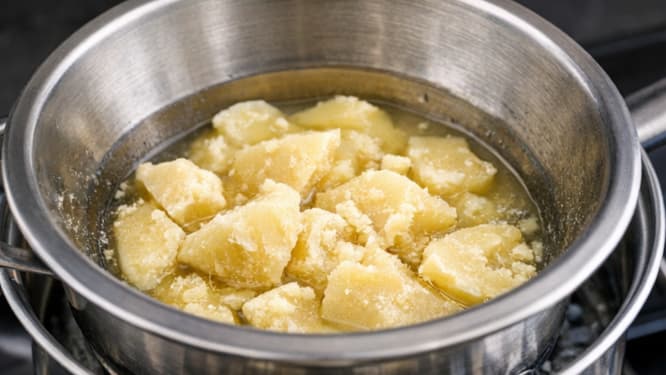
Cocoa butter is an oil-phase ingredient.
Because it’s solid at room temperature, you’ll generally need to melt it before incorporating it into your formula.
Melting Point:
90–100°F (32–38°C)
Using cocoa butter in an anhydrous product
For something like a balm or body butter:
- Weigh your ingredients.
- Add the cocoa butter to your heated oil phase.
- Melt until completely liquid.
- Combine with the rest of the formula.
- Cool according to your formulation method.
- Whip, pour or otherwise process the product as directed.
When you’re working with a formula that contains several solid ingredients, make sure everything is completely melted before moving on.
Uneven melting can affect the final texture.
Using cocoa butter in lotion
Cocoa butter can also be used in a lotion.
Because lotion contains water, cocoa butter is incorporated into the oil phase.
You’ll also need an appropriate emulsifier and preservative system.
Cocoa butter contributes richness and emollience.
The emulsifier is what helps keep your water and oil phases together.
Those are two completely different jobs.
Cocoa Butter in Body Butter
Cocoa butter is a great ingredient to experiment with when you’re making body butter.
It can make a formula feel thicker, richer and more substantial.
But here’s something important to remember:
Cocoa butter does not determine the entire texture of your body butter.
The finished consistency comes from the whole formula.
For example:
- More liquid oil can soften the product.
- More hard butter can increase firmness.
- Wax can add additional structure.
- Fatty alcohols can change the texture.
- Different butters can change how the product melts and spreads.
This is why changing just one ingredient can completely change a body butter.
If you’ve ever made a recipe exactly as written and then substituted an ingredient, you’ve probably experienced this yourself.
Cocoa Butter in Lotion
Yes, you can absolutely use cocoa butter in lotion.
It can add richness and body to an emulsion.
However, you don’t want to simply add cocoa butter to a finished lotion and hope for the best.
If you’re formulating from scratch, think about the entire oil phase.
How much oil are you using?
Which emulsifier are you using?
How much cocoa butter do you want?
What kind of texture are you trying to create?
Cocoa Butter in Lip Balm
Lip balm is one of the classic uses for cocoa butter.
Because it’s firm at room temperature, cocoa butter works especially well when you’re trying to make a solid balm.
It can contribute:
- Firmness
- Richness
- Smooth application
- Emollience
- A creamy feel
Cocoa butter can be combined with ingredients such as:
- Beeswax
- Candelilla wax
- Shea butter
- Mango butter
- Castor oil
- Other cosmetic oils
The ratio between these ingredients determines whether your finished lip balm is hard, soft, creamy or glossy.
That’s the fun part of formulation.
Small changes can create a completely different product.
Cocoa Butter in Lotion Bars
If you really want to see what cocoa butter can do, try using it in a solid lotion bar.
Lotion bars don’t contain water, so they can be made with combinations of:
- Cocoa butter
- Shea butter
- Beeswax
- Candelilla wax
- Liquid oils
Cocoa butter contributes both richness and firmness.
It’s particularly useful when you want a solid product that softens as it warms against your skin.
Cocoa Butter in Body Scrubs
Cocoa butter can also be used in anhydrous body scrubs.
It can give a scrub a richer, creamier feel while helping balance the rough texture of the exfoliant.
Natural Cocoa Butter vs. Deodorized Cocoa Butter
This is probably the biggest decision you’ll make when buying cocoa butter.
The difference is simple:
Natural cocoa butter has its characteristic cocoa aroma.
Deodorized cocoa butter has been processed to reduce that aroma.
Neither one is better.
They’re simply useful for different formulations.
Natural Cocoa Butter
Natural cocoa butter is a great choice when you want the cocoa aroma to be part of the finished product.
Choose it when:
- You like the chocolate-like scent.
- You’re making a chocolate-inspired product.
- You want the ingredient’s natural aroma.
- Your fragrance works well with cocoa.
It can pair beautifully with fragrances and essential oils such as:
- Vanilla
- Chocolate
- Coffee
- Coconut
- Orange
- Peppermint
Deodorized Cocoa Butter
Deodorized cocoa butter is useful when you don’t want the natural cocoa aroma competing with your fragrance.
Choose it when:
- You don’t want a chocolate aroma.
- You’re using a delicate fragrance.
- You want your fragrance oil to be the main scent.
- You’re making a minimalist or lightly scented product.
Which cocoa butter should you buy?
Honestly?
If you make a lot of DIY skincare, I’d keep both in your formulation stash.
Natural cocoa butter is wonderful when you want that warm cocoa aroma.
Deodorized cocoa butter is incredibly useful when you don’t.
Cocoa Butter vs. Shea Butter vs. Mango Butter
Cocoa butter, shea butter, and mango butter are all popular plant butters, but they don’t behave exactly the same way.
| Cocoa Butter | Shea Butter | Mango Butter | |
|---|---|---|---|
| Firmness | Firm | Softer | Medium-firm |
| Aroma | Cocoa aroma when natural | Mild | Mild |
| Texture | Rich | Creamy | Smooth |
| Adds structure | High | Medium | Medium |
| Common uses | Balms, lip products, body butter | Body butter, lotion | Body butter, lotion |
Which butter should you use?
Want more firmness and structure?
Cocoa butter may be a good choice.
Want a softer, creamier body butter?
Shea butter may be a better starting point.
Want a firm butter without the characteristic cocoa aroma?
Mango butter may be worth trying.
And you don’t necessarily have to choose just one.
Blending different butters is one of the easiest ways to experiment with texture.
Cocoa Butter vs. Shea Butter
Cocoa butter and shea butter are both popular plant butters, but they don’t behave exactly the same way.
Cocoa Butter
Cocoa butter is generally:
- Firmer
- More structured
- Richer
- Useful for solid products
- Naturally cocoa-scented when non-deodorized
Shea Butter
Shea butter is generally:
- Softer
- Creamier
- Very versatile
- Popular in body butters and lotions
- Useful when you want a softer finished product
So which one should you use?
It depends on what you’re trying to make.
Want more firmness?
Cocoa butter may help.
Want a softer, creamier body butter?
Shea butter may be a better starting point.
Want both?
You can absolutely use them together.
Cocoa Butter vs. Mango Butter
Mango butter is another popular plant butter and can be a great alternative when you want a different skin feel.
One major difference is aroma.
Natural cocoa butter has a recognizable cocoa scent.
Mango butter generally has a much more subtle aroma.
Cocoa butter also tends to provide more firmness and structure.
Mango butter can be a good choice when you want a butter without that chocolate aroma or when you’re looking for a different balance of firmness and skin feel.
Neither one is universally better.
They’re simply different tools for your formulation.
Can You Substitute Cocoa Butter for Shea Butter?
Sometimes.
But I wouldn’t automatically make a 1:1 substitution and expect the finished product to behave exactly the same.
Cocoa butter is generally firmer than shea butter.
Replacing shea butter with cocoa butter can make your product:
- Firmer
- More structured
- Different in melting behavior
- Different in skin feel
If you’re making a product for yourself, try the substitution in a small batch.
If you’re making products to sell, treat the substitution as a reformulation rather than a simple ingredient swap.
What Ingredients Work Well With Cocoa Butter?
Cocoa butter works beautifully with a lot of other formulation ingredients.
Liquid Oils
Liquid oils can help soften the firmness of cocoa butter.
Some options include:
- Jojoba oil
- Sweet almond oil
- Sunflower oil
- Apricot kernel oil
- Avocado oil
- Fractionated coconut oil
- Castor oil
The oil you choose will also affect the final skin feel.
For example, a body butter made with cocoa butter and a lightweight oil will feel very different from one made with cocoa butter and a heavier oil.
Other Butters
Cocoa butter can also be blended with:
- Shea butter
- Mango butter
- Kokum butter
This is one of my favorite ways to experiment.
Instead of thinking about each butter separately, think about what happens when you combine them.
A soft butter can balance a firm butter.
A firm butter can give a soft butter more structure.
And suddenly you have a lot more control over the finished texture.
Waxes
If you’re making something that needs additional structure, cocoa butter can be combined with:
- Beeswax
- Candelilla wax
This is particularly useful for:
- Balms
- Lotion bars
- Lip products
- Solid perfumes
Does Cocoa Butter Need a Preservative?
Pure cocoa butter is an anhydrous, oil-soluble ingredient.
By itself, it doesn’t need a broad-spectrum preservative simply because you’re using it.
But what matters is the finished product.
For example:
Cocoa butter + oils + wax
No water phase.
Cocoa butter + water + oils
Now you have a water-containing product.
That second formula needs an appropriate preservation system.
This is why you always need to look at the entire formulation rather than deciding whether something needs a preservative based on one ingredient.
Does Cocoa Butter Go Bad?
Cocoa butter is relatively stable compared with many unsaturated plant oils, but that doesn’t mean it lasts forever.
It typically has a shelf life of 2-5 years.
Always follow the supplier’s recommended storage conditions and shelf life.
For the best storage:
- Keep the container tightly closed.
- Store it somewhere cool and dry.
- Protect it from excessive heat.
- Keep it away from direct sunlight.
- Avoid introducing water or contaminants into the container.
Pay attention to changes in:
- Smell
- Color
- Texture
- Overall appearance
If your cocoa butter develops a noticeably rancid or unusual smell, it’s time to replace it.\
Common Cocoa Butter Mistakes
Mistake #1: Assuming cocoa butter and shea butter are interchangeable
They’re both plant butters, but they don’t behave exactly the same way.
Cocoa butter is generally firmer and more structured.
A direct substitution can change your finished product.
Mistake #2: Forgetting about the natural aroma
Natural cocoa butter smells like cocoa.
That can be wonderful.
Or it can completely overpower the fragrance you were trying to create.
Know which type you’re buying before you formulate.
Mistake #3: Adding more because you want a richer product
More cocoa butter doesn’t automatically mean a better product.
Too much can make a formula harder, firmer and potentially waxier-feeling.
The goal is balance.
Mistake #4: Ignoring the rest of the formula
Cocoa butter doesn’t determine texture by itself.
Your liquid oils, other butters, waxes, fatty alcohols and emulsifiers all play a role.
Frequently Asked Questions About Cocoa Butter
Is cocoa butter good for your skin?
Cocoa butter is commonly used in rich, emollient skincare products. It can help soften and condition the skin while contributing a rich, substantial feel to the finished product.
What are the benefits of cocoa butter for skin?
Cocoa butter provides emollience and can help create a rich, conditioning feel. In skincare formulations, it can also add firmness and structure to products such as body butter, balms and lip products.
Is cocoa butter oil soluble?
Yes.
Cocoa butter is oil soluble and is incorporated into the oil phase of a formulation.
Is cocoa butter a butter or an oil?
From a formulation perspective, cocoa butter is a solid plant butter or fat.
Like many vegetable oils and fats, it is made primarily of triglycerides.
Can I use cocoa butter directly on my skin?
Cocoa butter is commonly used as a cosmetic ingredient on its own, but everyone’s skin is different.
If you’re trying a new ingredient directly on your skin, testing a small area first is a good idea.
Can I use cocoa butter in lotion?
Yes.
Cocoa butter can be incorporated into the oil phase of lotions and creams.
Because lotion contains water, however, the complete formula also needs an appropriate emulsifier and preservation system.
Can I use cocoa butter in body butter?
Yes.
Cocoa butter is particularly useful in body butter when you want to add richness and firmness.
The finished texture will depend on the entire formula, including the other butters and oils you use.
Can I use cocoa butter in lip balm?
Yes.
Cocoa butter is a popular ingredient in lip balm because it is firm at room temperature and can contribute richness, structure and a smooth application.
Can I whip cocoa butter?
Yes, cocoa butter can be used in whipped body butter.
However, because it is a relatively firm butter, you’ll want to formulate the recipe specifically for the whipped texture you’re trying to achieve.
Using a large amount of cocoa butter can make a whipped body butter much firmer.
Why is my cocoa butter so hard?
That’s normal.
Cocoa butter is naturally a relatively firm plant butter.
That firmness is actually one of the reasons it’s so useful in balms, lip products and solid skincare.
Does cocoa butter clog pores?

There isn’t a universal answer that applies to everyone.
How an ingredient behaves depends on the entire formulation and the individual using the product.
For facial products, I would not use cocoa butter as it is a comedogenic ingredient.
Does cocoa butter smell like chocolate?
Natural, non-deodorized cocoa butter usually has a characteristic cocoa or chocolate-like aroma.
Deodorized cocoa butter has been processed to significantly reduce that aroma.
Does cocoa butter expire?
Cocoa butter has a relatively long shelf life (2-5 years) compared with many plant oils, but it can still deteriorate over time.
Follow the shelf-life information provided by your supplier and discard it if it develops a noticeably rancid or unusual odor.
Can I substitute cocoa butter for shea butter?
Sometimes.
Just remember that cocoa butter is generally firmer, so the finished product may become harder and behave differently.
Treat significant substitutions as formulation changes rather than assuming they’re identical.
DIY Recipes Using Cocoa Butter
Now for the fun part.
Cocoa butter is especially useful in rich, solid and anhydrous DIY products.
DIY Lip Balm
Cocoa butter adds richness and structure to homemade lip balm, making it a natural choice for a solid lip product.
DIY Lotion Bars
Make a solid lotion bar that softens as it warms against your skin.
DIY Body Butter
Cocoa butter can be combined with softer butters and liquid oils to create a rich, decadent body butter.
DIY Body Scrubs
Cocoa butter can add richness and conditioning to an exfoliating formula.
Ready to Formulate With Cocoa Butter?

If you’re just beginning to experiment with cosmetic ingredients, cocoa butter is a great one to keep in your formulation stash.
It’s useful in simple DIY recipes, but it also gives you a chance to start thinking more like a formulator.
You can experiment with:
- Oil phases
- Melting points
- Texture
- Structure
- Ingredient substitutions
- Butter blends
- Anhydrous formulations
And once you understand how cocoa butter behaves, you can start combining it with other ingredients to create completely different textures.
A softer body butter.
A firm balm.
A creamy lip product.
That’s the fun of formulating.
Want to Learn More About Skincare Formulation?
If you’re ready to stop simply following recipes and start understanding why each ingredient is there, check out my Skincare Formulation for Beginners guide.
You’ll learn how ingredients such as emollients, humectants, occlusives, emulsifiers, preservatives and other formulation ingredients work together to create finished skincare products.
Start the Skincare Formulation for Beginners Guide
More Ingredient Guides
Butters & Waxes
Learn how this versatile plant butter works in body butters, lotions, balms and more.
See how mango butter compares with cocoa butter and other plant butters.
Oils & Emollients
Emulsifiers
Humectants
Surfactants
The Bottom Line
Cocoa butter is much more than an ingredient that makes your DIY skincare smell like chocolate.
It’s a firm, versatile plant butter that can add richness, emollience and structure to a formula.
Its biggest strength is its ability to change the physical character of a product.
Want something firmer?
Cocoa butter may help.
Want a richer, more substantial feel?
Cocoa butter can contribute to that, too.
Want a chocolate-inspired product?
Natural cocoa butter gives you a head start.
And once you understand what cocoa butter is actually doing in your formula, you can stop thinking of ingredients as a collection of “good things for your skin.”
Instead, you can start using them as formulation tools.
And that’s where DIY skincare gets really interesting.