
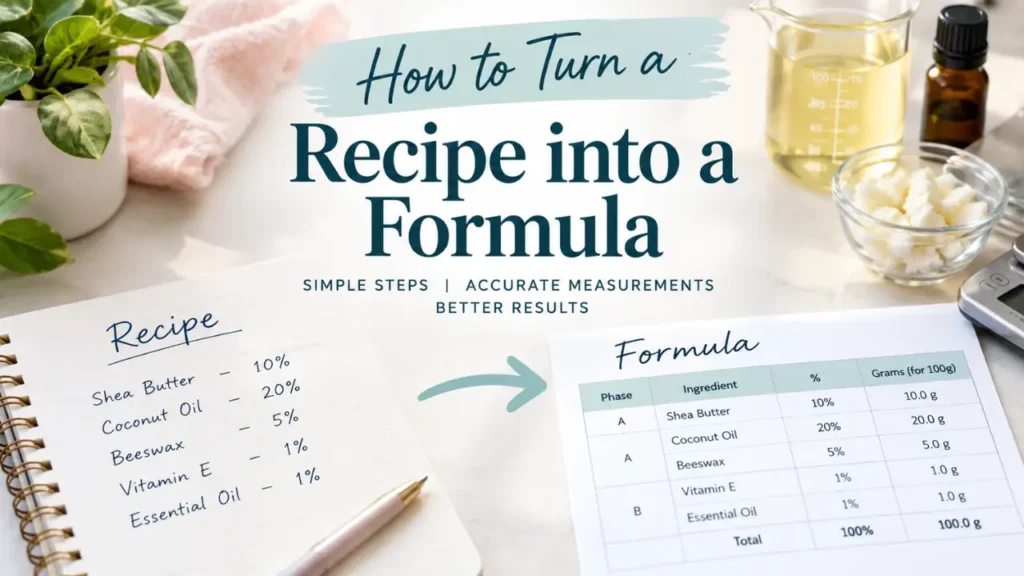
If you’ve ever made a DIY lotion, body butter, scrub, or other skincare recipe and wondered how people come up with percentages like 5% emulsifying wax or 10% oil, you’re not alone.
The good news is that converting a recipe to a formula is actually pretty simple.
In this guide, I’ll show you how to convert a recipe from grams into percentages using one of my actual lotion recipes as our example. Then we’ll use those percentages to make different batch sizes.
Once you understand the math, you’ll see why cosmetic formulas are usually written in percentages rather than just grams.
Recipe vs. Formula: What’s the Difference?
A recipe usually tells you exactly how much of each ingredient to use for one particular batch.
For example, a recipe might say:
- 188.4 g distilled water
- 7.2 g vegetable glycerin
- 19.2 g sweet almond oil
- 4.8 g shea butter
- 12 g emulsifying wax
- 4.8 g stearic acid
- 2.4 g fragrance oil
- 1.2 g preservative
That makes a 240 g batch.
A formula expresses those same ingredients as percentages.
The same recipe becomes:
| Ingredient | Percentage |
|---|---|
| Distilled Water | 78.5% |
| Vegetable Glycerin | 3% |
| Sweet Almond Oil | 8% |
| Shea Butter | 2% |
| Emulsifying Wax | 5% |
| Stearic Acid | 2% |
| Fragrance Oil | 1% |
| Germall Plus | 0.5% |
| Total | 100% |
The formula doesn’t change the recipe. It simply describes the recipe in a way that makes it much easier to scale and modify.
Why Use Percentages in Formulation?
Percentages make cosmetic formulation much easier because they aren’t tied to one specific batch size.
A 240 g recipe is useful if you want to make 240 g.
But what if you want to make:
- 100 g for testing
- 200 g for a small batch
- 300 g for several bottles
- 500 g for a larger batch
You could recalculate every ingredient each time, but once you have the formula in percentages, the process becomes much easier.
You simply multiply each percentage by your desired batch size.
That’s one of the biggest reasons cosmetic formulas are written in percentages.
Let’s Convert a Real Summer Rain Recipe
Rather than using a made-up example, let’s use my 240 g beginner lotion recipe.
The original recipe contains:
Water Phase
| Ingredient | Weight |
|---|---|
| Distilled Water | 188.4 g |
| Vegetable Glycerin | 7.2 g |
Oil Phase
| Ingredient | Weight |
|---|---|
| Sweet Almond Oil | 19.2 g |
| Shea Butter | 4.8 g |
| Emulsifying Wax | 12 g |
| Stearic Acid | 4.8 g |
Cool Down Phase
| Ingredient | Weight |
|---|---|
| Fragrance Oil | 2.4 g |
| Germall Plus | 1.2 g |
The total batch is 240 g.
Now let’s convert each ingredient to a percentage.
The Formula for Converting Grams to Percentage
The calculation is:
Ingredient weight ÷ total batch weight × 100 = ingredient percentage
That’s all there is to it.
Let’s start with the sweet almond oil.
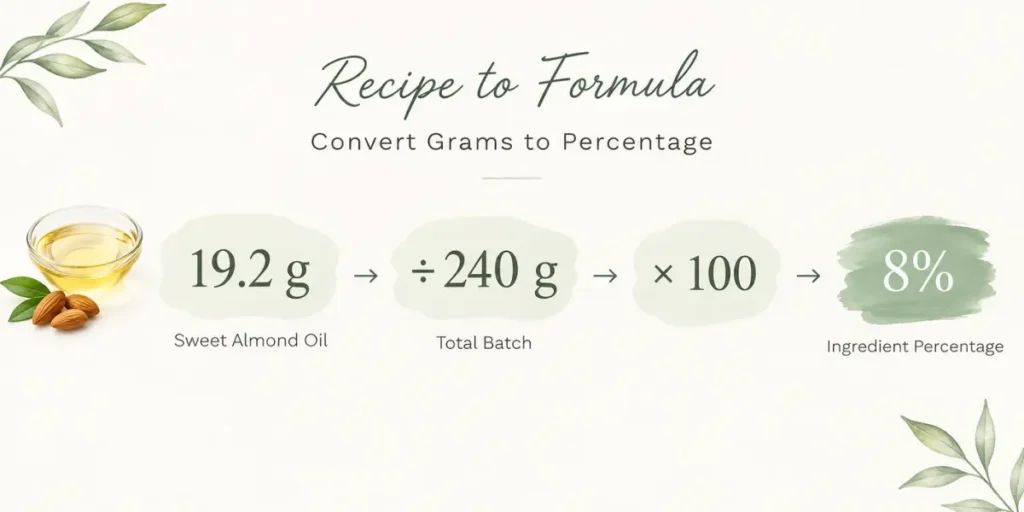
There are 19.2 g of sweet almond oil in a 240 g batch.
19.2 ÷ 240 × 100 = 8%
So sweet almond oil makes up 8% of the formula.
Now let’s try the shea butter.
4.8 ÷ 240 × 100 = 2%
So shea butter makes up 2% of the formula.
Let’s do one more.
The recipe contains 12 g of emulsifying wax.
12 ÷ 240 × 100 = 5%
So emulsifying wax makes up 5% of the formula.
You can use this same calculation for every ingredient.
Converting the Entire Recipe
Here’s the complete calculation:
| Ingredient | Original Weight | Calculation | Formula |
|---|---|---|---|
| Distilled Water | 188.4 g | 188.4 ÷ 240 × 100 | 78.5% |
| Vegetable Glycerin | 7.2 g | 7.2 ÷ 240 × 100 | 3% |
| Sweet Almond Oil | 19.2 g | 19.2 ÷ 240 × 100 | 8% |
| Shea Butter | 4.8 g | 4.8 ÷ 240 × 100 | 2% |
| Emulsifying Wax | 12 g | 12 ÷ 240 × 100 | 5% |
| Stearic Acid | 4.8 g | 4.8 ÷ 240 × 100 | 2% |
| Fragrance Oil | 2.4 g | 2.4 ÷ 240 × 100 | 1% |
| Germall Plus | 1.2 g | 1.2 ÷ 240 × 100 | 0.5% |
| Total | 240 g | 100% |
And that’s it.
We’ve converted the recipe into a formula.
How Do I Know the Formula Is Correct?
Add all of the percentages together.
78.5 + 3 + 8 + 2 + 5 + 2 + 1 + 0.5 = 100%
A complete cosmetic formula should total 100%.
This is an important check to make whenever you’re creating or converting a formula.
If your percentages don’t equal 100%, go back and check your calculations.
Trust me, I have accidentally forgot to double-checked before.
A total of 99.9% or 100.1% can sometimes happen because of rounding, but larger differences usually mean something has been left out or calculated incorrectly.
Now We Can Make Any Batch Size
This is where formulas become really useful.
Once we know the percentages, we can make the same lotion at a completely different batch size.
The calculation is:
Desired batch size × percentage ÷ 100 = ingredient weight
For example, let’s say we want to make 300 g instead of 240 g.
For sweet almond oil:
300 × 8 ÷ 100 = 24 g
So we need 24 g of sweet almond oil.
For shea butter:
300 × 2 ÷ 100 = 6 g
For emulsifying wax:
300 × 5 ÷ 100 = 15 g
We can do this for every ingredient.
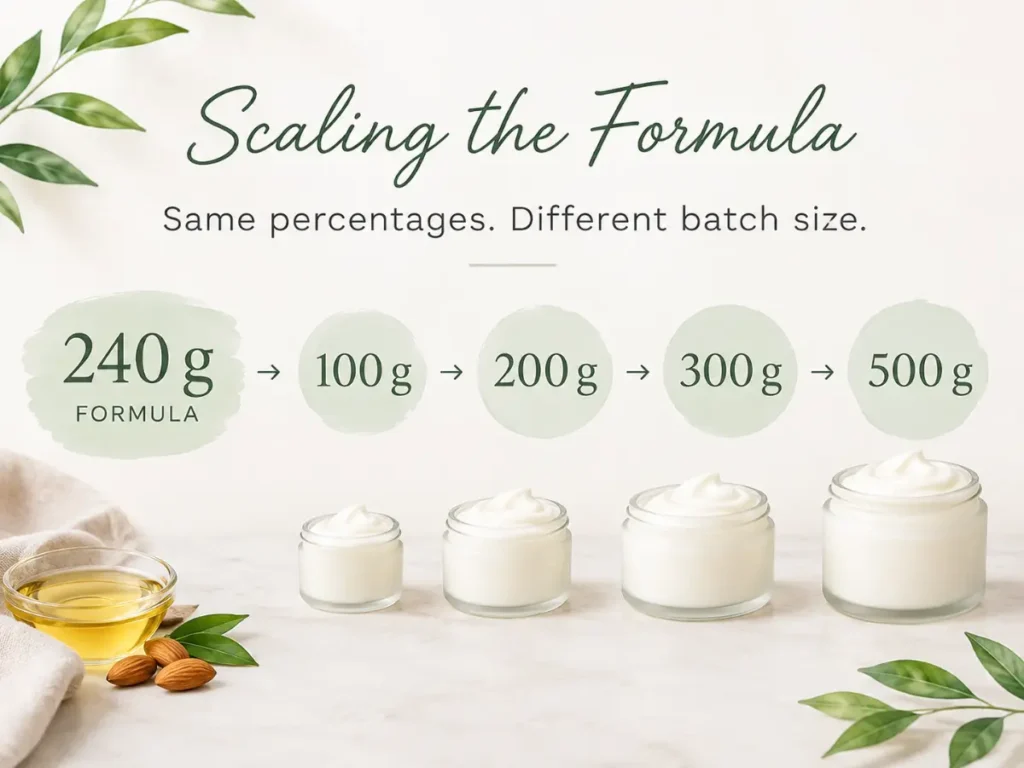
Scaling the Lotion Formula
Here’s what the 240 g formula looks like when scaled to several useful batch sizes:
| Ingredient | % | 100 g | 200 g | 240 g | 300 g | 500 g |
|---|---|---|---|---|---|---|
| Distilled Water | 78.5% | 78.5 g | 157 g | 188.4 g | 235.5 g | 392.5 g |
| Vegetable Glycerin | 3% | 3 g | 6 g | 7.2 g | 9 g | 15 g |
| Sweet Almond Oil | 8% | 8 g | 16 g | 19.2 g | 24 g | 40 g |
| Shea Butter | 2% | 2 g | 4 g | 4.8 g | 6 g | 10 g |
| Emulsifying Wax | 5% | 5 g | 10 g | 12 g | 15 g | 25 g |
| Stearic Acid | 2% | 2 g | 4 g | 4.8 g | 6 g | 10 g |
| Fragrance Oil | 1% | 1 g | 2 g | 2.4 g | 3 g | 5 g |
| Germall Plus | 0.5% | 0.5 g | 1 g | 1.2 g | 1.5 g | 2.5 g |
| Total | 100% | 100 g | 200 g | 240 g | 300 g | 500 g |
Notice something important.
The percentages never change.
Only the gram weights change.
That’s the entire advantage of having a formula.
What If I Want to Make a 100 g Test Batch?
This is one of my favorite reasons to formulate in percentages.
You don’t always need to make a large batch when you’re experimenting with a new product.
Using the same lotion formula, a 100 g test batch would be:
- 78.5 g distilled water
- 3 g vegetable glycerin
- 8 g sweet almond oil
- 2 g shea butter
- 5 g emulsifying wax
- 2 g stearic acid
- 1 g fragrance oil
- 0.5 g Germall Plus
Total: 100 g
Now you can test the texture, absorption, fragrance, and overall feel without making 240 g of product.
What If the Recipe Only Gives Me Grams?
That’s actually a great starting point.
If you have a recipe that already gives you the weight of every ingredient, you can convert it directly into percentages.
First, add all of the ingredients together to find the total batch weight.
Then use:
Ingredient weight ÷ total batch weight × 100
Do this for every ingredient.
Once you have all of the percentages, check that they total 100%.
What If My Recipe Uses Tablespoons or Teaspoons?
This is where things get more complicated.
If a recipe says:
- 2 tablespoons oil
- 1 tablespoon butter
- 1 teaspoon emulsifying wax
you don’t have the precise weight needed to calculate an accurate formula.
Different ingredients have different densities, so you can’t assume that a tablespoon of one ingredient weighs the same as a tablespoon of another.
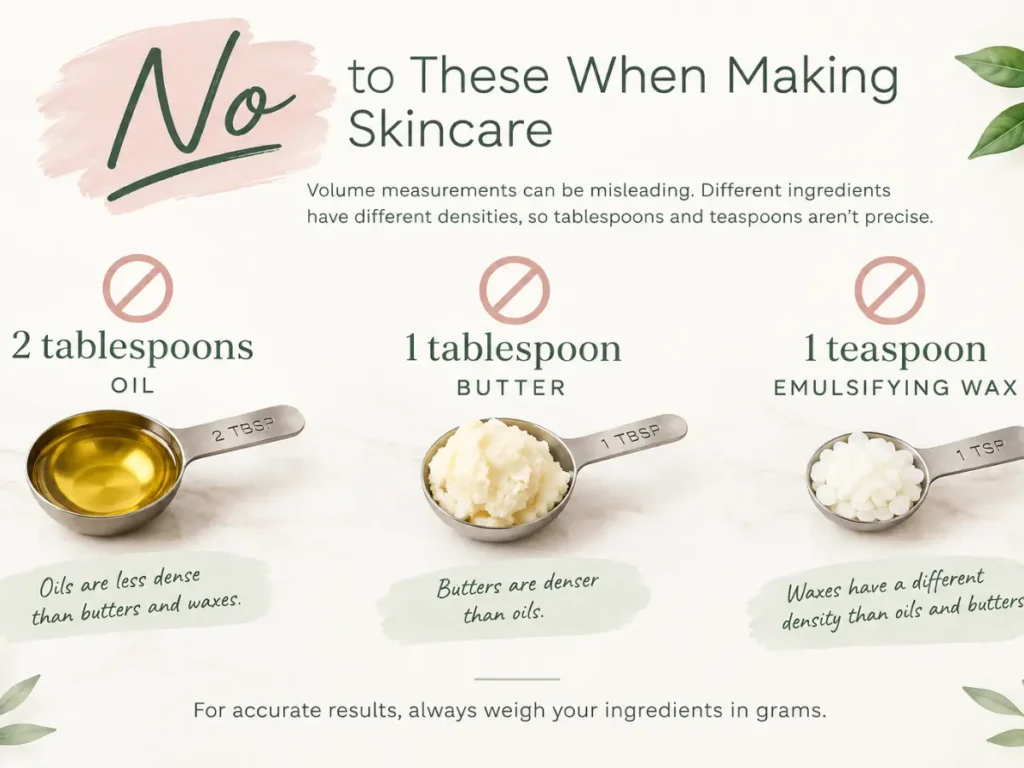
If you’re converting an older recipe that uses volume measurements, I recommend weighing each ingredient in grams.
For future recipes, I would also recommend writing your recipes by weight from the beginning.
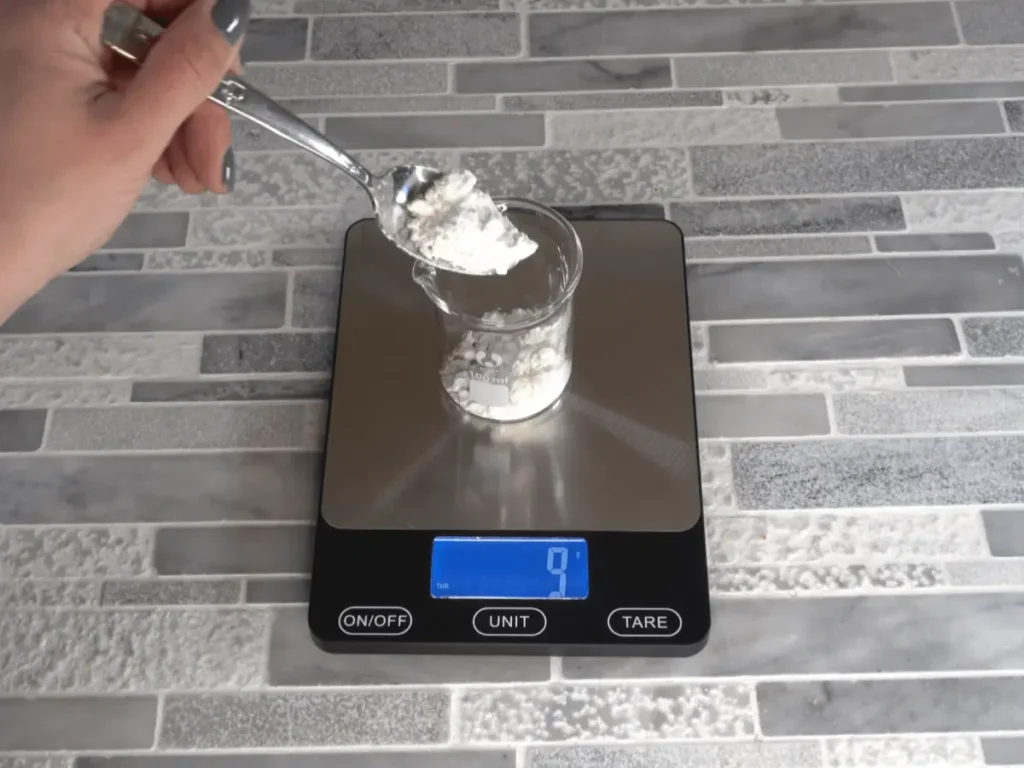
A digital scale is one of the most useful tools for cosmetic formulation.
And this, is why I am always saying we do not measure in teaspoons and tablespoons unless if we never want to make that again!
Why I Recommend Weighing Ingredients
When you’re making skincare products, small differences can matter.
Imagine your recipe calls for 1% preservative.
In a 100 g batch, that’s 1 g.
In a 500 g batch, that’s 5 g.
If you’re measuring that preservative with a teaspoon instead of weighing it, you may not actually be adding the amount the formula calls for.
Which means you can be making your skin care unsafe to use.
The same applies to oils, emulsifiers, fragrance, butters, powders, and other ingredients.
If you are formulating, weigh your ingredients.
A Formula Is More Than Just Math
Here’s an important distinction.
Converting a recipe into percentages tells you what the original recipe contains.
It doesn’t automatically tell you whether the formula is well designed.
For example, you could mathematically convert a recipe and discover that it contains 20% of an emulsifier.
The calculation could be completely correct.
That doesn’t necessarily mean 20% is an appropriate usage rate for that particular emulsifier.
When you’re developing or modifying a formula, you also need to consider:
- Recommended usage rates
- Ingredient compatibility
- Emulsion stability
- Preservation
- Fragrance usage limits
- pH
- Product type
- Texture
- Skin feel
- Packaging
- Stability testing
This is where formulation becomes more than simply doing the math.
What Does “100%” Mean in a Formula?
When you see a formula written in percentages, 100% represents the entire product.
It does not mean that every ingredient is 100%.
Instead, each ingredient is a portion of the whole.
For example, in this lotion:
Water = 78.5%
That means that 78.5% of the finished product by weight is distilled water.
Emulsifying Wax = 5%
That means that 5% of the finished product by weight is emulsifying wax.
Germall Plus = 0.5%
That means that 0.5% of the finished product by weight is preservative.
All of those percentages together make up the complete 100% formula.
Formulas Make Modifications Easier
Another advantage of percentages is that they make it easier to understand what happens when you change a formula.
Let’s say you want to experiment with a slightly different amount of sweet almond oil.
The original formula contains:
8% Sweet Almond Oil
If you decide to test 10%, you know exactly how much you’ve changed.
You can then adjust the rest of the formula so that everything still adds up to 100%.
This is much easier to track than changing a recipe from “4 tablespoons” to “a little more oil.”
When you’re experimenting, make one change at a time whenever possible.
That way, if the new batch turns out differently, you have a much better idea of what caused the change.
Keep Your Original Formula
If you’re modifying a recipe, don’t overwrite the original.
Keep the original version and create a new version.
For example:
1.0 Lotion Formula
Original formula
1.1 Lotion Formula
Changed oil percentage
1.2 Lotion Formula
Changed thickener
This makes it much easier to troubleshoot.
I am old school and I love to hand write all my formulas, but the naming convention is the same regardless if you hand write or type them out.
I also recommend recording the date, batch size, ingredient percentages, and any changes you made.
If you’re testing a product over time, you can also record observations such as:
- Texture
- Color
- Fragrance
- Absorption
- Separation
- pH
- Appearance after storage
Good formulation notes become incredibly valuable when you’re trying to recreate a product you really like.
Recipe to Formula: The Quick Method
If you want the short version, here’s what to do.
1. Weigh every ingredient
Use grams whenever possible.
2. Add all the ingredients together
This gives you the total batch weight.
3. Divide each ingredient by the total
For example:
19.2 g ÷ 240 g = 0.08
4. Multiply by 100
0.08 × 100 = 8%
So 19.2 g of sweet almond oil in a 240 g batch equals 8%.
5. Repeat for every ingredient
Do the same calculation for every ingredient in the recipe.
6. Add all the percentages
Your completed formula should equal 100%.
7. Use the percentages to scale the formula
For a new batch size:
Desired batch size × percentage ÷ 100 = grams needed
That’s it.
Final Thoughts
Converting a recipe to a formula may look complicated when you first see a formulation written entirely in percentages, but the math is actually very simple.
The real advantage comes after the conversion.
Once you have your formula, you can make a 100 g test batch, a 240 g batch, a 300 g batch, or a 500 g batch without changing the proportions of your ingredients.
That’s why I recommend getting into the habit of working with percentages, even if you’re only making skincare products at home.
And if you’re starting with an existing recipe, you don’t have to completely reinvent it.
Take a recipe you already like, make sure you know the weight of every ingredient, convert those weights into percentages, and check that your formula adds up to 100%.
From there, you have a much better foundation for learning how cosmetic formulation actually works.
FAQ
How do I convert a recipe to a formula?
Add all of the ingredient weights together to find the total batch weight. Then divide each ingredient’s weight by the total batch weight and multiply by 100.
Ingredient weight ÷ total batch weight × 100 = percentage
Does a formula always have to equal 100%?
Yes. A complete formula should total 100%.
How do I scale a formula to a different batch size?
Multiply the desired batch size by the ingredient’s percentage and divide by 100.
Batch size × percentage ÷ 100 = ingredient weight
Can I convert a recipe that uses cups and tablespoons?
You can, but you first need accurate weights for the ingredients. Volume measurements are less precise because different ingredients have different densities.
Why are cosmetic formulas written in percentages?
Percentages make formulas easier to scale, reproduce, compare, and modify.
Can I make a 100 g batch from a 240 g recipe?
Yes. Once you’ve converted the recipe into percentages, you can use those percentages to make any batch size.
Is converting a recipe the same as formulating?
No. Conversion is the mathematical process of expressing an existing recipe as percentages. Formulation also involves deciding which ingredients to use, at what levels, and how they work together in the finished product.
Do I need a digital scale?
If you’re making skincare products, I strongly recommend one. Weighing ingredients gives you much more consistent and reproducible results than measuring by volume.
Can I change the percentages after converting my recipe?
You can, but changing an ingredient can change the properties and stability of the finished product. When modifying a formula, understand the recommended usage rate and role of each ingredient, and make controlled changes rather than changing several things at once.