
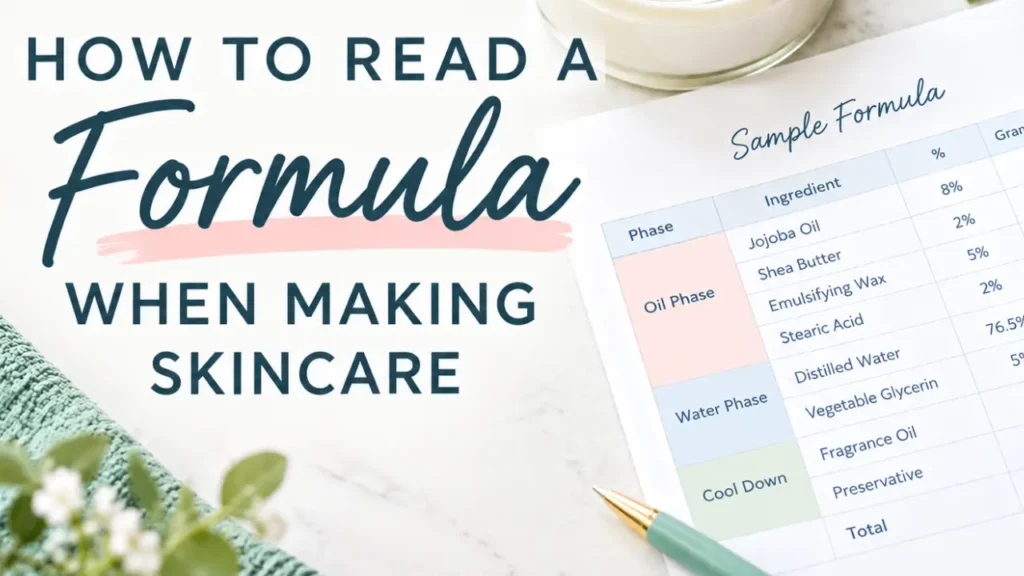
When you first start making your own skincare products, a formula can look confusing. You might see ingredient names, percentages, weights in grams, phase labels, and processing instructions without knowing exactly what each part means.
Once you understand how to read a skincare formula, those details become much easier to follow.
A formula tells you more than which ingredients to combine. It explains how much of each ingredient to use, how the ingredients fit together, and how the product should be prepared. Learning to read one is an important step toward making your own lotions, creams, and other skincare products with greater accuracy and confidence.
In this guide, I’ll explain how to read a formula step by step, understand ingredient percentages, identify the different phases, calculate ingredient weights, and recognize what to check before making a product.
What Is a Skincare Formula?
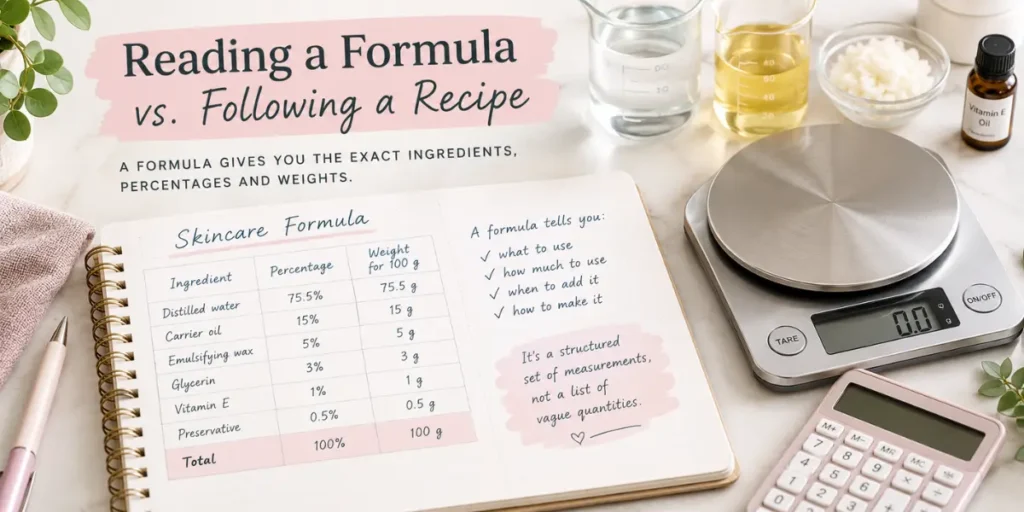
A skincare formula is a structured list of ingredients and their proportions, usually expressed as percentages by weight. It may also include ingredient weights for a specific batch size, phase labels, processing temperatures, and instructions for making the finished product.
A traditional DIY recipe might tell you to add a tablespoon of oil or a teaspoon of glycerin. A cosmetic formula tells you the percentage of the total product that each ingredient represents.
This distinction matters because ingredients have different densities, and measuring them by volume can produce inconsistent results. Formulating by weight makes it easier to reproduce a product and adjust the batch size accurately.
A formula also helps you understand the relationship between ingredients. For example, a lotion containing water and oils needs an appropriate emulsifying system to combine those phases. A water-containing product generally also needs a suitable preservative system.
The formula provides the framework for making the product, but you still need to follow the appropriate processing instructions and verify that the ingredients work together.
If you’re new to formulation, start with my guide to skincare formulation for beginners.
Understanding the Parts of a Skincare Formula
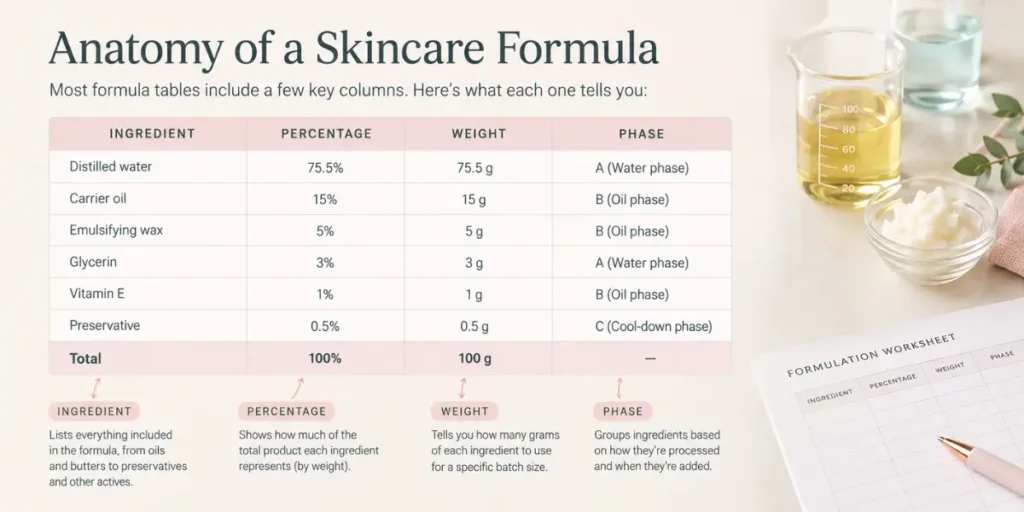
Most formula tables contain several columns. The exact layout varies, but once you understand the information each column provides, you can interpret most beginner-friendly formulations.
1. Ingredient Name
The ingredient column lists everything included in the formula.
Depending on the product, you might see carrier oils, butters, humectants, emulsifiers, thickeners, preservatives, or other cosmetic ingredients.
Each ingredient serves a particular purpose. Some help soften the skin, some influence texture, and others help combine ingredients or protect a water-containing product against microbial growth.
The ingredient name alone doesn’t always tell you everything you need to know. Different ingredients can have similar names but different properties, and ingredients with similar functions are not necessarily interchangeable.
When reading a formula, identify each ingredient and understand why it is included before attempting to make substitutions.
My guide to what each ingredient does in skincare formulation explains common ingredient functions in more detail.
2. Percentage
The percentage column tells you how much of the total formula is made up by each ingredient.
In a standard formula expressed as percentages by weight, all ingredient percentages should add up to 100%.
For example, if a formula contains 15% carrier oil, the carrier oil represents 15% of the total batch weight.
This percentage does not mean 15% of the oil phase. Unless a formula specifically states otherwise, ingredient percentages are calculated against the total weight of the finished batch.
Percentages are useful because they describe the proportions of the ingredients independently of batch size. You can use the same formula to make 100 g, 200 g, or 500 g without changing those proportions.
3. Weight in Grams
The weight column tells you how many grams of each ingredient to weigh out for a particular batch.
For example, if you are making 100 g of a product containing 15% carrier oil, you need 15 g of carrier oil.
If you make a 200 g batch, you need 30 g of that same ingredient.
The percentage remains unchanged; only the weight changes.
A digital scale that measures in grams is essential for accurate cosmetic formulation. Measuring by weight is more repeatable than relying on household spoons or cups.
For a more detailed explanation, see my guide to percentages vs. grams in skincare formulations.
4. Phase
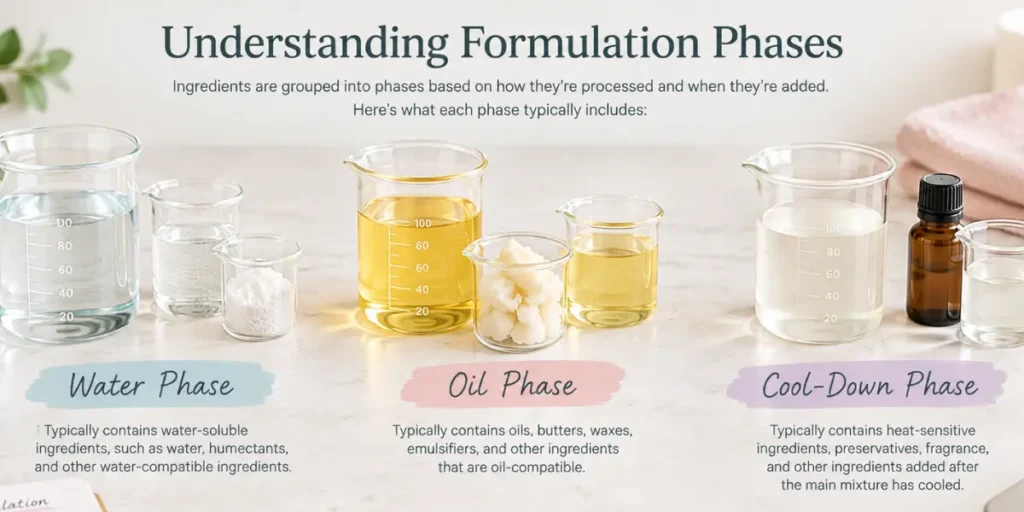
Some formulas divide ingredients into groups called phases. You might see Phase A, Phase B, and Phase C, or simply water phase, oil phase, and cool-down phase.
These labels organize ingredients according to how they are prepared and when they are added.
For example, a lotion may have a water phase that is heated separately from an oil phase. The two phases are then combined according to the formulation instructions, and certain ingredients are added later as the product cools.
The letters are organizational labels rather than universal ingredient categories. Phase A does not always mean water phase, and Phase C does not always mean cool-down phase. Always read the ingredient list and processing instructions.
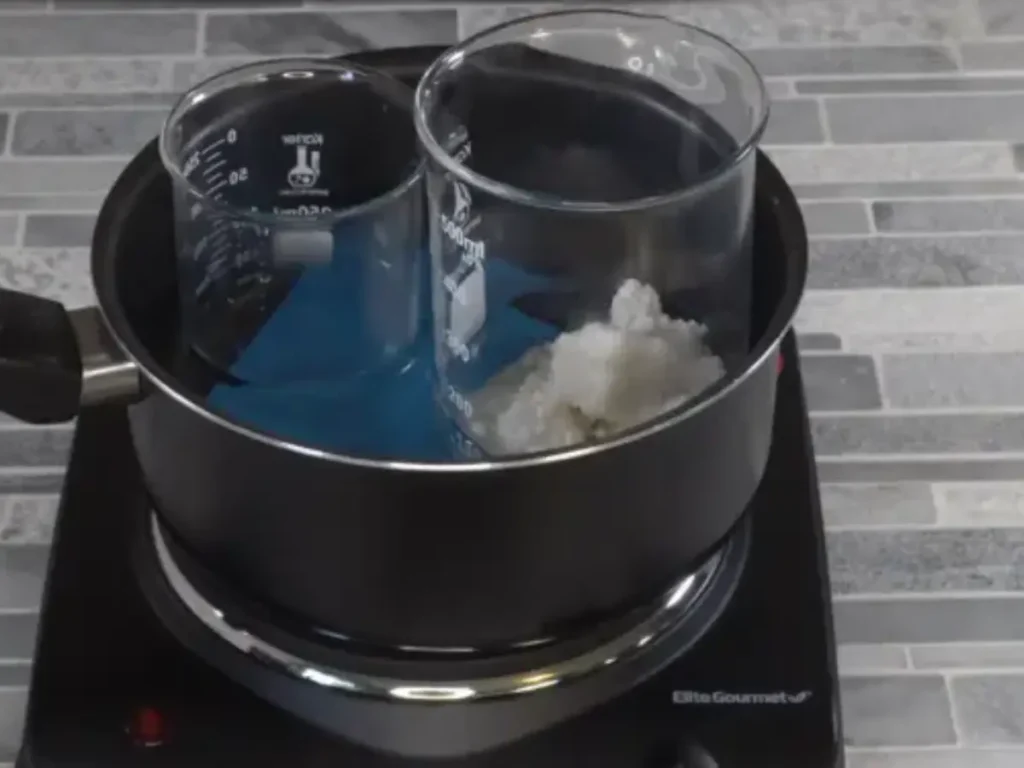
Understanding the water phase
The water phase typically contains water-soluble ingredients that are prepared together according to the formula.
Common ingredient categories may include:
- Distilled water
- Water-soluble humectants
- Water-soluble thickeners
- Other water-compatible ingredients
Not every water-soluble ingredient belongs in the heated water phase. Some ingredients need to be added at a different stage, depending on their properties and supplier instructions.
Understanding the oil phase
The oil phase typically contains oils, butters, emulsifiers, and other ingredients that are compatible with that phase.
| Ingredient category | Common purpose |
|---|---|
| Carrier oils | Provide emollience and soften skin feel. |
| Butters | Add richness and contribute to the texture of the product. |
| Waxes | Add firmness and structure where appropriate. |
| Emulsifiers | Help combine oil and water into an emulsion when the appropriate system is used. |
| Fatty alcohols | Can add thickness, improve skin feel, and support emulsion stability. |
| Oil-soluble ingredients | Provide specific functions depending on the ingredient. |
This chart describes common ingredient categories, not a list of ingredients that must appear in every oil phase. The correct phase depends on the ingredient’s properties and the specific formulation.
For example, not every wax is an emulsifier, and not every oil-soluble ingredient needs to be heated. Follow the supplier’s processing guidance.
Understanding the cool-down phase
The cool-down phase contains ingredients added later in the manufacturing process, often after the main mixture has cooled sufficiently.
These may include certain preservatives, fragrance, heat-sensitive ingredients, or other ingredients that have specific temperature requirements.
Not every preservative or fragrance is added at the same stage. Some ingredients have different processing requirements, so check the supplier’s instructions rather than assuming that all cool-down ingredients can be added at the same temperature.
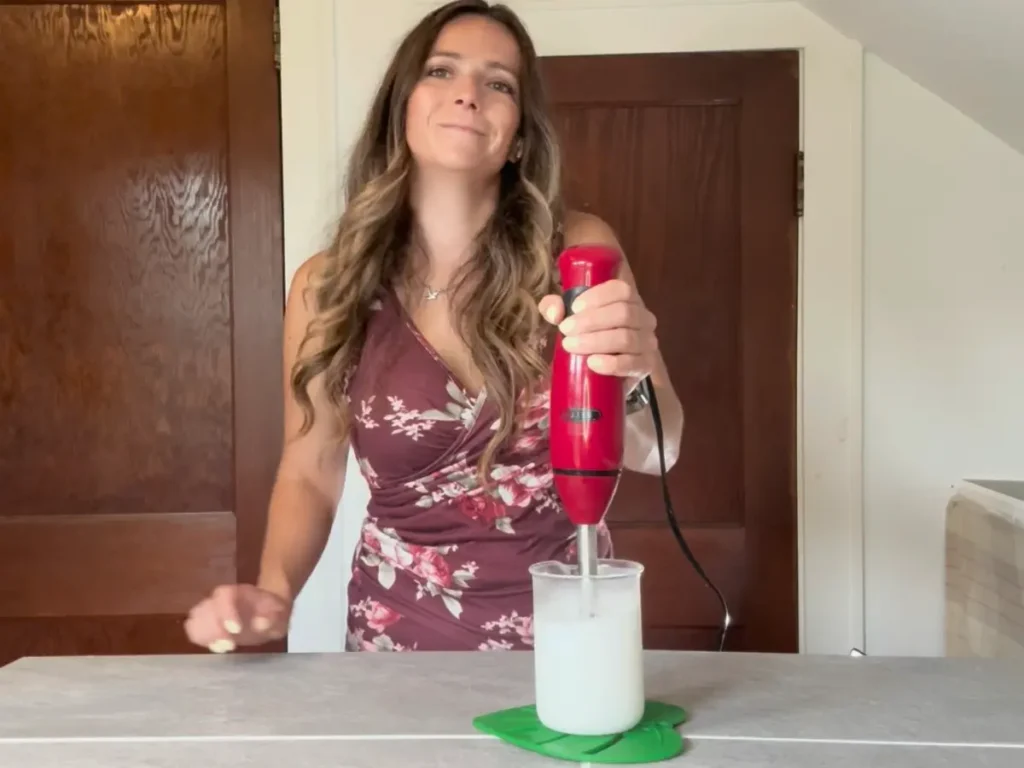
5. Processing Instructions
A formula may also include instructions explaining how to prepare the product.
These instructions can tell you:
- Which ingredients to weigh and combine first
- Which phases need to be heated
- When to combine the phases
- How to mix or emulsify the product
- When to add cool-down ingredients
- Whether to measure or adjust pH
- How to evaluate the finished product
Following these instructions matters because using the correct ingredients in the wrong order or at the wrong temperature can affect texture, stability, and performance.
A formula is more than a list of ingredients. The process is part of the formulation, too.
How to Read a Skincare Formula: A Worked Example
Let’s look at a simplified example to see how the different parts of a formula work together.
The following table is an educational example for learning how to read percentages and gram weights.
| Ingredient | Percentage | Weight for 100 g |
|---|---|---|
| Distilled water | 75.5% | 75.5 g |
| Carrier oil | 15% | 15 g |
| Emulsifying wax | 5% | 5 g |
| Glycerin | 3% | 3 g |
| Vitamin E | 1% | 1 g |
| Preservative | 0.5% | 0.5 g |
| Total | 100% | 100 g |
Notice that the percentages add up to exactly 100%, and the ingredient weights add up to exactly 100 g.
This is the first thing I would check when reading a formula.
The example uses a preservative at 0.5%, but that level is appropriate only if the selected preservative’s supplier permits it and it is suitable for the finished formulation. A water-containing product needs an effective preservation system, and preservation cannot be confirmed by the percentage alone.
The example also does not establish that the emulsifier level, ingredient combination, or processing method will produce a stable lotion. Those details would need to be assessed before the formula could be used as a real recipe.
What does each ingredient percentage tell you?
Using this example, you can interpret the table as follows:
- Distilled water — 75.5%: Water makes up the largest proportion of the formula and serves as the primary water-phase ingredient.
- Carrier oil — 15%: The oil contributes emollience and affects the product’s skin feel.
- Emulsifying wax — 5%: The emulsifier helps combine the oil and water phases when used in a suitable formulation.
- Glycerin — 3%: Glycerin is a humectant that helps attract and retain water in the outer layers of the skin.
- Vitamin E — 1%: Vitamin E can help protect oils against oxidation in suitable formulations. It does not replace a preservative.
- Preservative — 0.5%: The preservative is intended to protect the water-containing product against microbial growth, provided the specific preservative is suitable and used correctly.
Reading a formula means understanding both the quantities and the functions of the ingredients. It also means recognizing when you need more information before making the product.
How to Calculate Ingredient Weights
Once you understand the percentages, calculating ingredient weights is straightforward.
Use this formula:
Ingredient weight = Total batch weight × Ingredient percentage ÷ 100
For example, suppose you want to make 300 g of a product containing 15% carrier oil.
300 × 15 ÷ 100 = 45 g
You would weigh out 45 g of carrier oil.
You can use the same calculation for every ingredient in the formula.
Let’s calculate the preservative weight for a 300 g batch at 0.5%:
300 × 0.5 ÷ 100 = 1.5 g
The calculated amount is 1.5 g, assuming that 0.5% is the correct usage level for the selected preservative.
For more help converting ingredient quantities into percentages, read how to convert a recipe to a formula.
How to Read a Formula When Scaling a Batch
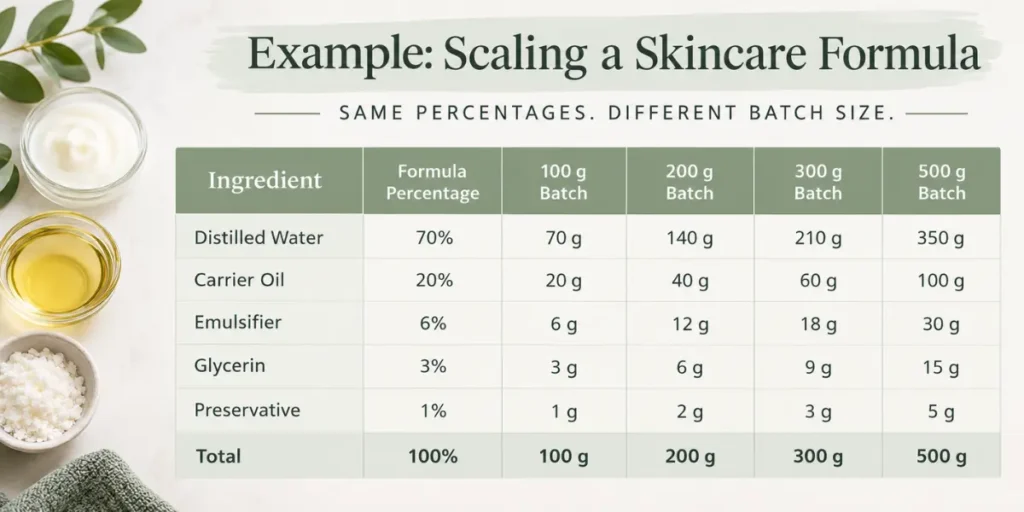
One of the main benefits of a percentage-based formula is that you can calculate ingredient weights for different batch sizes.
For example, an ingredient used at 15% would have the following weights:
| Total batch size | Ingredient at 15% |
|---|---|
| 100 g | 15 g |
| 200 g | 30 g |
| 300 g | 45 g |
| 500 g | 75 g |
The percentage remains 15% in every batch.
However, scaling a formula does not automatically guarantee identical results. Mixing equipment, heating, cooling, and processing conditions can influence the finished product, particularly emulsions.
You should also avoid changing only one ingredient without considering how that adjustment affects the total formula and the other ingredients.
If you change the amount of an ingredient, recalculate the formula and check that the percentages still total 100%. Any adjustment to a water-containing product should also take preservation, stability, and other formulation requirements into account.
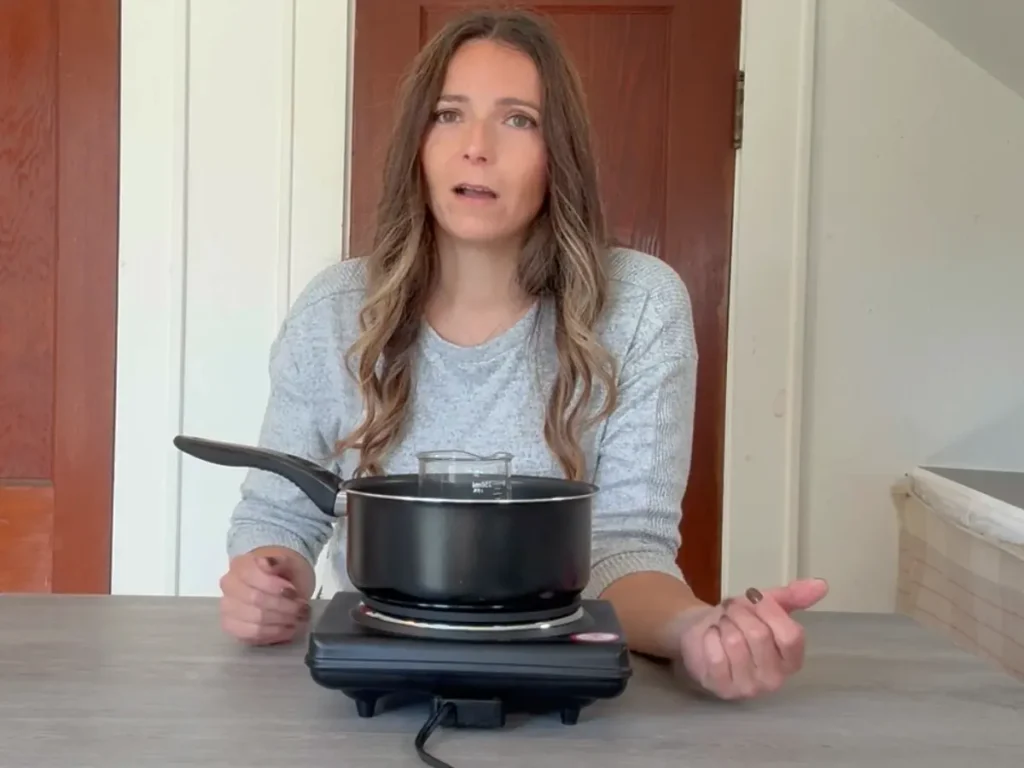
What to Check Before Making a Skincare Formula
Before weighing your ingredients, review the formula carefully.
Check that the percentages total 100%
Add all the ingredient percentages together.
A standard formula expressed as percentages of the total batch weight should total 100%. If it does not, check for a missing ingredient, a calculation error, or a documented adjustment.
Do not automatically add extra water to correct a formula unless you understand why the total is incorrect and how the adjustment affects the formulation.
Check the recommended usage rates
Look up the supplier’s instructions for each ingredient, especially preservatives, emulsifiers, fragrance, and other ingredients with specific usage requirements.
A percentage that works for one ingredient may not be suitable for another, even if the ingredients serve similar purposes.
Check the processing instructions
Identify which ingredients need to be heated, which phases need to be combined, and which ingredients must be added later.
Follow the instructions for the actual ingredients you are using. Similar ingredients may have different processing requirements.
Check preservation requirements
Products containing water generally need an appropriate preservative system. The correct preservative depends on the product, the full formulation, the preservative’s specifications, and the conditions in which the product will be used.
A preservative percentage by itself does not prove that a product is adequately preserved. Follow the supplier’s recommended usage range and compatibility guidance, and use appropriate testing to establish preservation effectiveness.
Check pH requirements
Some ingredients and preservatives work only within particular pH ranges.
If the formula requires a specific pH, use an appropriate measurement method and follow the formulation instructions for any adjustments. Do not assume that every skincare product needs the same pH.
My guide to making products with a balanced pH level explains why pH matters.

Check the function of each ingredient
Before substituting an ingredient, consider why it is in the formula.
Replacing one carrier oil with another may change the skin feel or oxidation characteristics. Replacing an emulsifier can affect stability, and changing a preservative can affect both the recommended usage rate and the product’s preservation requirements.
Some ingredients also perform more than one function. My guide to double-duty ingredients in skincare formulation explains why this matters when selecting ingredients.
Frequently Asked Questions
Do all skincare formulas need to add up to 100%?
A standard cosmetic formula expressed as percentages of the total batch weight should add up to 100%. If it does not, check for missing ingredients, calculation errors, or documented adjustments before making the product.
Are percentages or grams more important in a skincare formula?
Both are important. Percentages define the proportions of the ingredients, while grams tell you how much to weigh for a particular batch size. Percentages also make it possible to scale a formula accurately.
Can I make a skincare formula without a digital scale?
A digital scale that measures in grams is strongly recommended. Household volume measurements can vary depending on an ingredient’s density, so teaspoons and tablespoons are not reliable substitutes for accurate cosmetic formulation.
Can I change an ingredient in a skincare formula?
You can modify a formula, but substitutions and percentage changes can affect the product’s texture, stability, preservation, and performance. Check the functions, compatibility, and recommended usage rates of the ingredients before making changes.
What is the difference between a skincare recipe and a formula?
A recipe may use approximate household measurements and focus on the steps for making a product. A cosmetic formula defines ingredients in precise proportions, usually by weight, and may include processing phases, temperatures, and other technical requirements.
What does Phase A, Phase B, or Phase C mean?
These are labels used to organize ingredients into groups for processing. Their meanings depend on the specific formula. Always check the phase descriptions and instructions rather than assuming that a particular letter always refers to the same group of ingredients.
Final Thoughts
Learning how to read a skincare formula is an important step toward understanding how cosmetic products are made.
Start by identifying the ingredients, reading the percentages, checking the weights, and understanding the phases. Then review the processing instructions, usage rates, preservation requirements, and pH requirements where applicable.
Once you understand these parts, a formula becomes easier to follow and evaluate. You’ll also have a stronger foundation for scaling batches, understanding ingredient substitutions, and learning to develop your own formulations.
If you’re continuing your formulation journey, explore my guide to skincare formulation for beginners for more help understanding the ingredients and principles behind DIY skincare.