
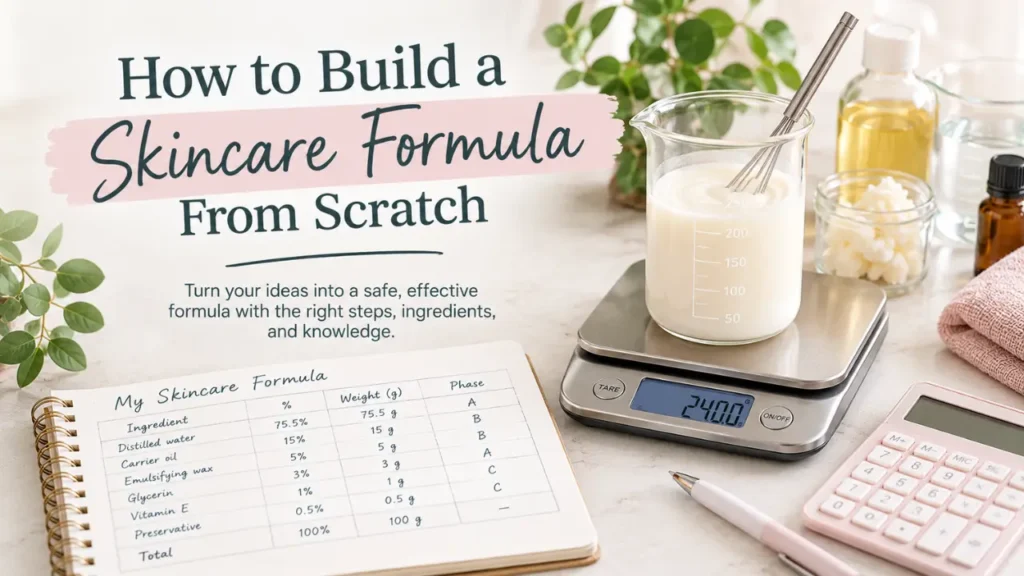
Have you ever looked at a list of skincare ingredients and wondered how to turn them into a product that actually works?
Understanding what an ingredient does is an important first step in DIY skincare formulation. But knowing that glycerin attracts water, shea butter adds richness, and an emulsifier helps oil and water combine is only part of the process. You also need to know how much of each ingredient to use, how the ingredients work together, and how to turn your idea into a stable, safe product.
That is where formulation begins.
Building a skincare formula from scratch doesn’t mean guessing at ingredient amounts until something looks right. It means starting with a clear goal, choosing ingredients for specific purposes, calculating their percentages, and testing the finished product.
In this guide, I’ll walk you through the process step by step, from choosing your product type to adjusting your formula based on the results.
You don’t need to know everything about cosmetic chemistry before you start. You do, however, need to understand a few fundamental principles and be willing to test your work carefully.
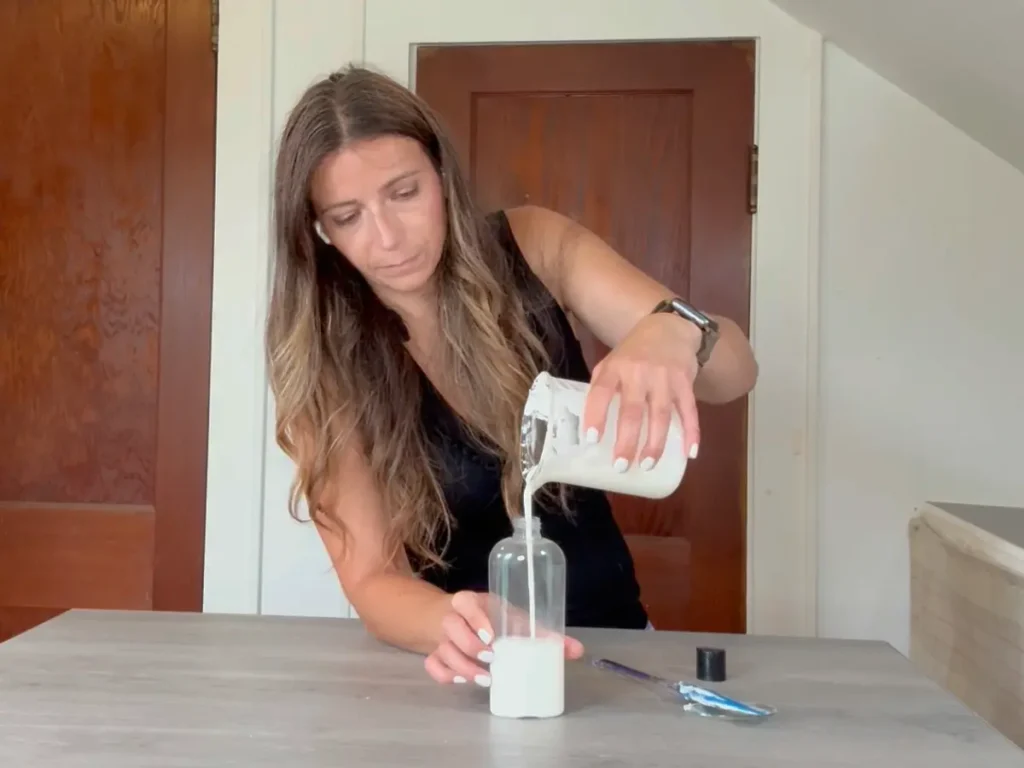
What Does It Mean to Build a Skincare Formula From Scratch?
Building a skincare formula means designing a product by deciding which ingredients to use, what each ingredient contributes, and how much of each ingredient the finished product should contain.
Instead of following an existing recipe, you begin with a goal.
For example, you might want to create:
- A lightweight facial lotion that absorbs quickly.
- A rich body cream for dry skin.
- A water-free body butter.
- A gentle facial cleanser.
- A hydrating facial serum.
- An emulsified sugar scrub that rinses clean.
Each product has different requirements. A body butter doesn’t need the same ingredients as a facial lotion, and a water-based serum presents different formulation challenges than an oil-based product.
The process involves making a series of decisions. You choose the product type, identify its phases, select compatible ingredients, assign percentages, calculate the weights, and test the finished formula.
The goal is to create a formula in which every ingredient has a purpose and the ingredients work together to produce the product you want.
If you’re completely new to skincare ingredients, start with my DIY Skincare for Beginners: Start Here guide before working through the steps below.
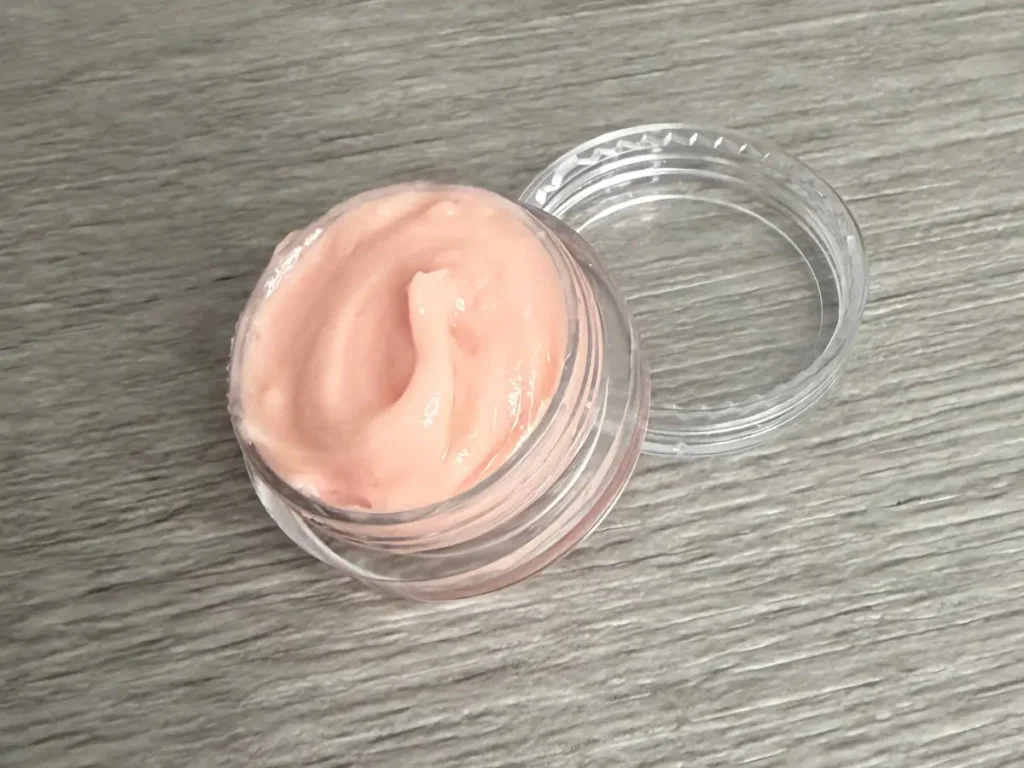
How to Build A Skincare Formula From Scratch
Step 1: Decide What Type of Skincare Product You Want to Make
Before choosing ingredients, define the product you want to create.
This sounds simple, but it influences nearly every decision that follows.
Start by answering three questions:
- What type of product am I making?
- What should the product feel and perform like?
- What should the product do for the person using it?
For example, saying you want to make a moisturizer is a starting point, but it doesn’t tell you enough to build a formula.
A lightweight facial moisturizer might need to spread easily, absorb without a heavy residue, and provide hydration without feeling greasy. A rich body cream might need a thicker consistency and a more substantial after-feel.
Those goals will lead you toward different ingredient choices and percentages.
Choose the product structure first
Skincare products generally fall into a few broad categories.
| Product type | Basic structure | Examples |
| Anhydrous products | No intentionally added water | Body butter, facial oil, balm |
| Water-based products | Water is the primary liquid | Facial mist, water-based serum |
| Emulsions | Water and oil combined into one product | Lotion, cream, cleansing lotion |
| Cleansing products | Ingredients designed to remove oil, dirt, or residue | Facial cleanser, cleansing balm |
| Exfoliating products | Ingredients or materials that help remove dead surface cells | Sugar scrub, exfoliating cleanser |
These categories are useful starting points, although some products fit into more than one category.
A water-based product generally requires an appropriate preservative system because microorganisms can grow in products containing water. Learn more in my Why Preservatives Matter in Skincare Guide.
An anhydrous product may not need a conventional water-phase preservative, but it still needs protection against oxidation and contamination appropriate to its ingredients and intended use.
An emulsified product has additional requirements because its oil and water phases must remain properly combined.
For your first formula, choose something relatively simple. A basic lotion or an anhydrous balm is easier to use as a learning exercise than a complex cleanser or multi-active serum.
Step 2: Determine the Phases of Your Formula
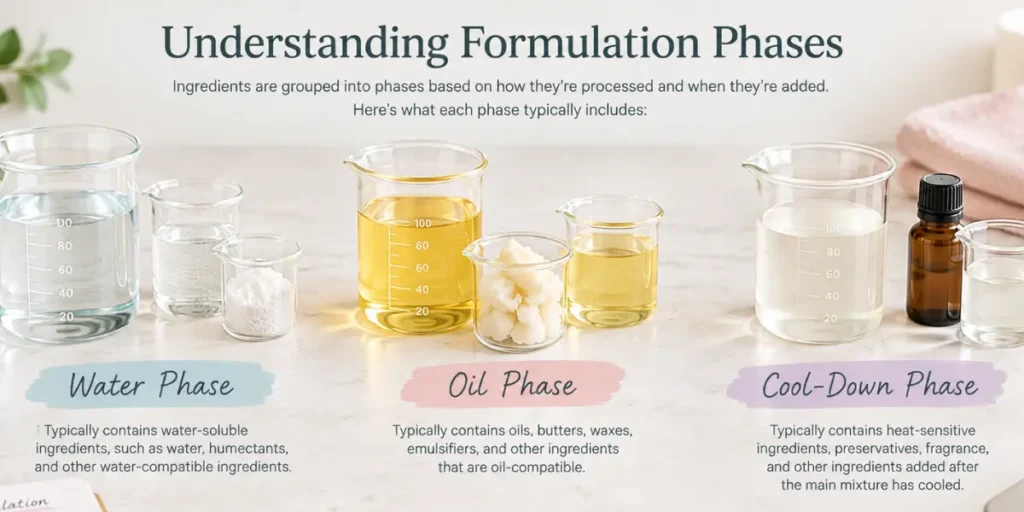
Once you know what you want to make, determine how the ingredients will be organized and processed.
A phase is a group of ingredients that are handled together during formulation, often because they have similar solubility or temperature requirements.
The phases depend on the product type and the properties of the ingredients you choose.
Water phase
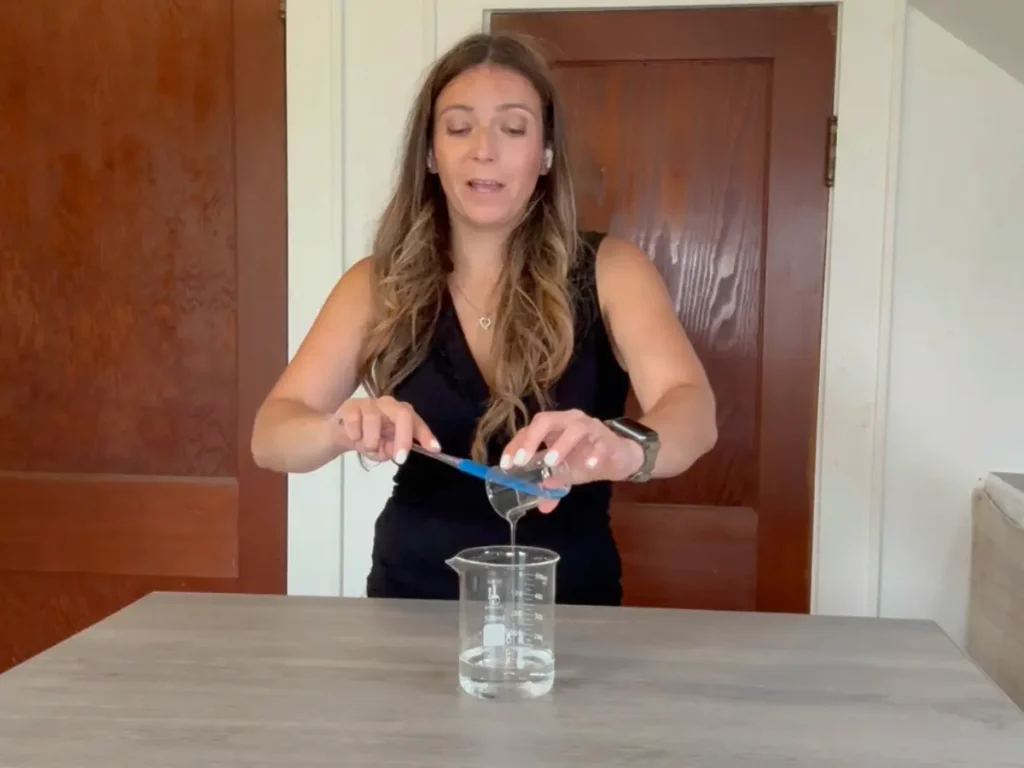
The water phase contains water-soluble ingredients and other ingredients that are intended to be dispersed or dissolved in the water portion of the formula.
Common examples include:
- Distilled water.
- Glycerin.
- Certain water-soluble humectants.
- Some water-soluble extracts.
- Certain thickeners and gelling agents.
Not every water-soluble ingredient can be added at the same stage. Some ingredients are sensitive to heat, so their supplier’s instructions determine when they should be incorporated.
Oil phase
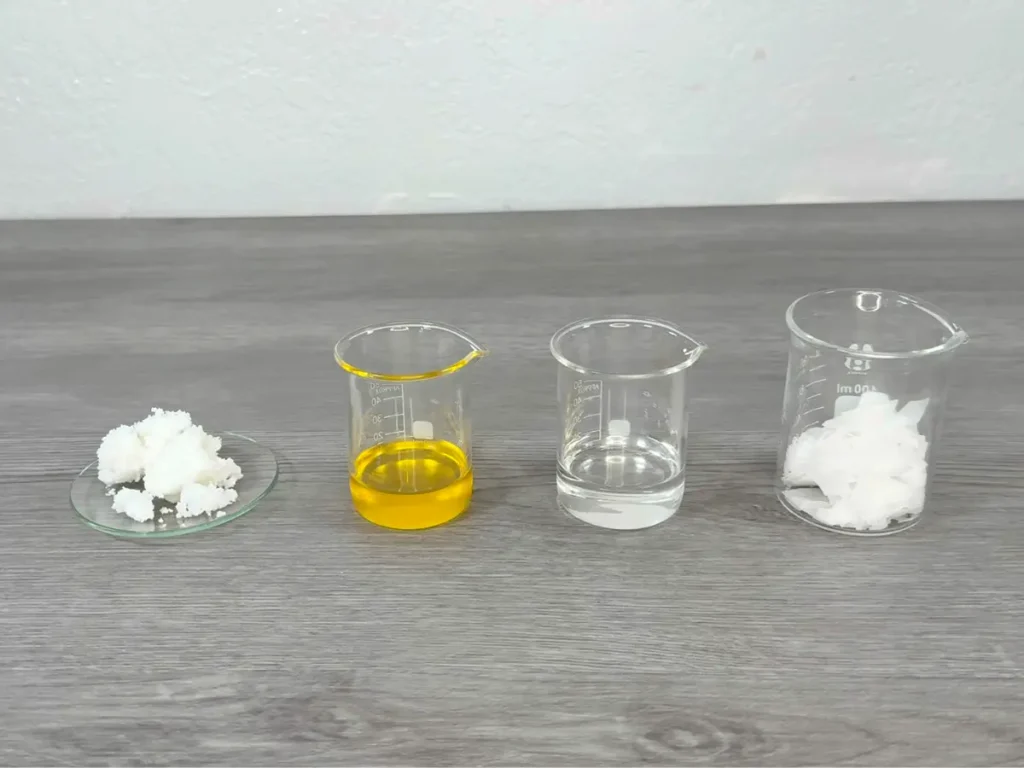
The oil phase contains oil-soluble ingredients that are typically heated together when making a conventional hot-process lotion or cream.
Examples include:
- Sunflower oil.
- Fractionated coconut oil.
- Shea butter.
- Cocoa butter.
- Emulsifying wax.
- Cetyl alcohol.
The oil phase is not simply a collection of oils. Emulsifiers, waxes, and fatty alcohols may also be included because they help create the product’s structure and texture.
For example, shea butter can contribute richness and firmness, while an emulsifier helps combine the oil phase with the water phase.
Cool-down phase
Some ingredients should be added after the heated phases have cooled sufficiently.
These may include:
- Preservatives with temperature restrictions.
- Certain botanical extracts.
- Heat-sensitive active ingredients.
- Fragrance or essential oils, where appropriate for the product.
- Certain vitamins and other specialty ingredients.
The correct addition temperature depends on the specific ingredient. Some preservatives can be added during heating, while others must be added during cool-down.
Always follow the supplier’s recommended processing conditions.
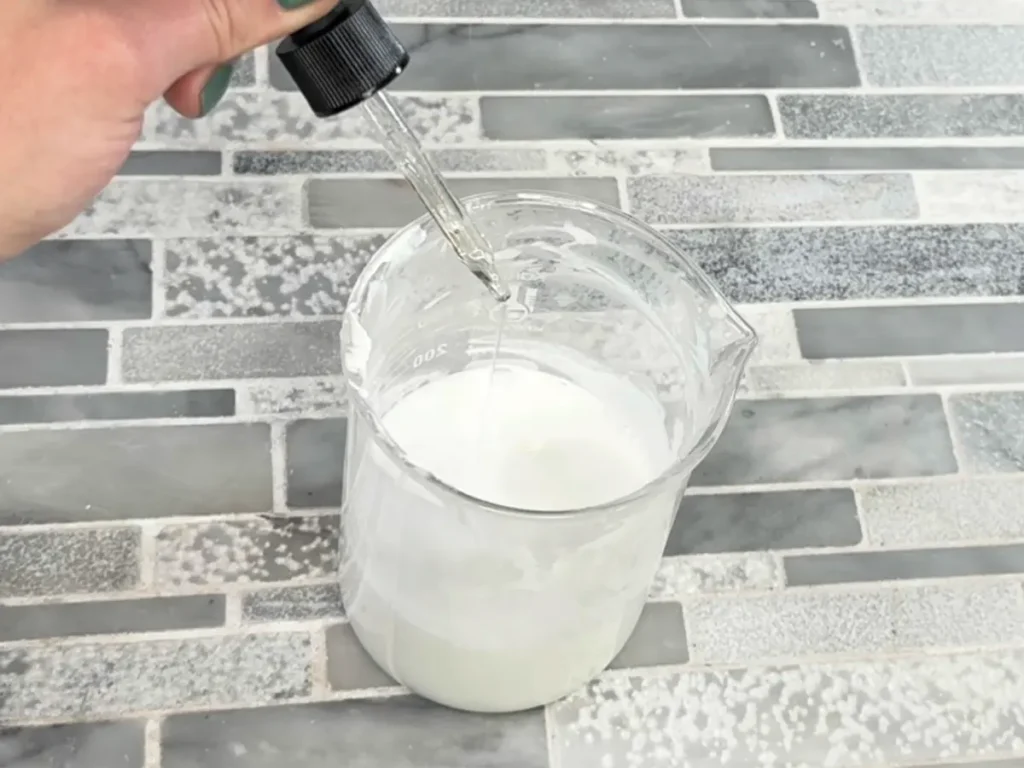
Does every formula need all three phases?
No.
A water-free balm may contain only an oil phase, with ingredients melted together and added at the appropriate temperatures.
A simple water-based gel may have a water phase and a later addition stage for ingredients that cannot tolerate the initial processing conditions.
A conventional lotion often uses a water phase, an oil phase, and a cool-down phase.
Important: The phase labels are a processing guide, not a substitute for understanding ingredient compatibility. An ingredient’s solubility, heat sensitivity, and recommended method of incorporation determine where it belongs.
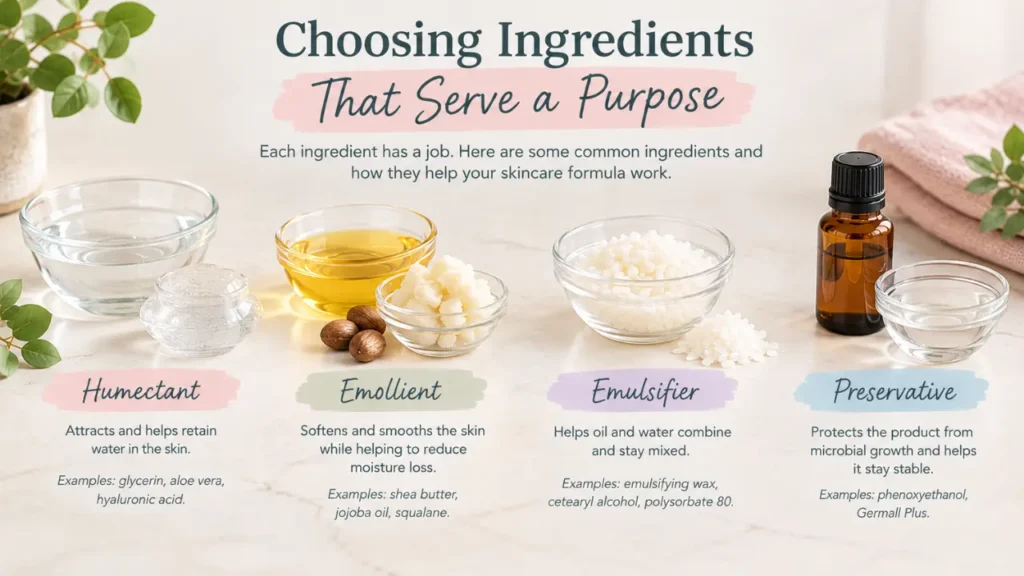
Step 3: Choose Ingredients That Serve a Purpose
Now you can begin selecting the ingredients for your formula.
Instead of choosing ingredients simply because they sound beneficial, decide what each one needs to accomplish.
A well-designed formula balances several functions. It needs ingredients that provide the desired skin feel, structure, performance, and stability.
Start with the essential ingredient functions
For a basic lotion, you might need the following functions.
| Function | Ingredient examples | Why it matters |
| Main liquid | Distilled water | Forms the water phase |
| Humectant | Glycerin | Helps attract and retain moisture in the outer layers of skin |
| Emollient | Sunflower oil, fractionated coconut oil | Helps soften skin and improve glide |
| Structuring ingredient | Cetyl alcohol | Adds body, viscosity, and a smoother feel |
| Emulsifier | Olivem 1000 or another suitable emulsifier | Helps stabilize the combination of oil and water |
| Preservative | A compatible broad-spectrum preservative | Helps protect the product against microbial growth |
| pH adjuster | A suitable acid or base, when needed | Helps bring the product into its intended pH range |
Some ingredients perform more than one function. For example, cetyl alcohol can contribute to both viscosity and emulsion structure, depending on the overall formula.
You don’t necessarily need a separate ingredient for every function, and adding more ingredients does not automatically make a product better.
For your first formula, keep the ingredient list manageable. Every additional ingredient introduces another variable that may affect texture, stability, preservation, or compatibility.
Choose ingredients that work together
Ingredient compatibility is just as important as ingredient function.
Before choosing an ingredient, check:
- Its recommended usage range.
- Whether it is oil-soluble, water-soluble, or dispersible.
- Whether it can tolerate heat.
- Its recommended pH range.
- Whether it is compatible with your emulsifier and preservative.
- Whether it requires a particular mixing or dispersion method.
For example, choosing an emulsifier because it is commonly used in lotions doesn’t guarantee it will work with every combination of oils, butters, and additives.
Start by reviewing the manufacturer’s technical information for each ingredient. These documents are often more useful for formulation than a general description of what an ingredient does.
For additional ingredient research, see my ingredient guides, including Cocoa Butter and Olivem 1000.
Step 4: Assign Percentages to Each Ingredient
This is where your idea begins to become a formula.
In cosmetic formulation, ingredients are generally measured by weight and expressed as percentages of the total finished product.
The percentages must add up to 100%.
That means the formula describes the relative amount of every ingredient, regardless of whether you eventually make 100 grams, 250 grams, or 1,000 grams.
How do you decide what percentage to use?
There isn’t one universal percentage for each ingredient. The appropriate amount depends on the ingredient, the product type, the desired performance, and the other ingredients in the formula.
Start with the supplier’s recommended usage range, then consider what the ingredient needs to do in your product.
For example:
- A humectant level affects hydration, tackiness, and skin feel.
- The amount and type of oil affect richness, spreadability, and residue.
- An emulsifier must be used at a suitable level for the particular oil phase and formulation.
- A thickener influences viscosity and texture.
- The preservative must be used according to its documented requirements.
The amount of emulsifier required is particularly important. Don’t assume that a fixed emulsifier percentage works for every oil phase or that more emulsifier will always produce a better emulsion.
Follow the emulsifier manufacturer’s guidelines for the specific grade you’re using.
Work from the main components toward the smaller additions
One practical approach is to plan the formula in this order:
- Decide on the main liquid or base.
- Choose your primary oils, butters, or other functional ingredients.
- Select the emulsifier or structuring system, if needed.
- Add humectants, thickeners, and other supporting ingredients.
- Account for the preservative, fragrance and any pH-adjusting ingredients.
- Use the remaining percentage to bring the formula to 100%.
The order is a planning method, not a universal rule. In some formulations, the emulsifier and preservative need to be chosen much earlier because they determine what other ingredients can be used.
Example: Building a simple lotion formula
The following is an illustrative starting formula for learning the calculations. The emulsifier and preservative must be selected and verified for compatibility with the complete formula, and the finished product must be tested.
| Ingredient | Phase | Percentage |
| Distilled water | A | 68.7% |
| Glycerin | A | 3.0% |
| Xanthan gum | A | 0.3% |
| Sunflower oil | B | 15.0% |
| Shea butter | B | 5.0% |
| Olivem 1000 | B | 5.0% |
| Cetyl alcohol | B | 1.0% |
| Panthenol | C | 1.0% |
| Compatible broad-spectrum preservative | C | 1.0% |
| Total | 100% |
This example assumes that the chosen preservative is appropriate for a 1% use level and compatible with the formula. If its supplier specifies a different use level, or if the chosen emulsifier requires a different composition, the formula must be revised accordingly.
The phase assignments are also provisional: confirm the recommended processing method for the exact grades of xanthan gum, panthenol, emulsifier, and preservative you use.
Notice that the water makes up the largest portion of the formula. The oils and butter provide emollience, the emulsifier helps combine the phases, and the other ingredients contribute specific functions.
The water percentage is not an arbitrary amount. It is the quantity needed to bring the complete formula to 100%.
If you change one ingredient, you must account for that change elsewhere in the formula.
For example, if you increase the oil percentage, you may need to reduce the water percentage to keep the total at 100%. Depending on the change, you may also need to adjust the emulsifier or thickener.
This is why a formula should be considered a complete system rather than a collection of independent ingredients.
Step 5: Calculate the Grams for Your Batch
Once the percentages are established, calculating the weight of each ingredient is straightforward.
Use this formula:
Ingredient weight = Total batch weight × Ingredient percentage ÷ 100
For example, if you want to make a 200-gram batch containing 3% glycerin:
200 × 3 ÷ 100 = 6 grams of glycerin.
The percentage stays the same regardless of the batch size.
Example: Scaling the lotion formula to 200 grams
| Ingredient | Percentage | Weight for 200 g |
| Distilled water | 68.7% | 137.4 g |
| Glycerin | 3.0% | 6.0 g |
| Xanthan gum | 0.3% | 0.6 g |
| Sunflower oil | 15.0% | 30.0 g |
| Shea butter | 5.0% | 10.0 g |
| Olivem 1000 | 5.0% | 10.0 g |
| Cetyl alcohol | 1.0% | 2.0 g |
| Panthenol | 1.0% | 2.0 g |
| Preservative | 1.0% | 2.0 g |
| Total | 100.0% | 200.0 g |
The math is the same whether you’re making a 100-gram test batch or a larger batch.
For small batches, use a scale with sufficient precision to measure the smallest ingredients accurately. A 0.6-gram ingredient, for example, requires a scale that can reliably measure that amount.
Don’t substitute teaspoons or tablespoons for gram measurements when developing a formula. Volume measurements vary with ingredient density and can introduce significant errors.
Step 6: Choose and Account for a Preservative
Preservation is one of the most important parts of developing a safe skincare formula.
Any product containing water may support microbial growth, including bacteria, yeast, and mold. This includes lotions, creams, gels, and water-based serums.
Adding a preservative is not optional simply because the product is homemade, contains natural ingredients, or looks clean.
How do you choose a preservative?
Choose a preservative based on the needs of the entire formula.
Check the supplier’s documentation for:
- Recommended usage rate.
- Effective pH range.
- Water solubility and recommended addition method.
- Heat stability and addition temperature.
- Compatibility with emulsifiers, surfactants, and other ingredients.
- The types of microorganisms the preservative system is designed to control.
Not all preservatives work in all formulations. Some have narrow pH requirements, and some are incompatible with particular ingredients or processing methods.
A preservative that works well in one lotion may not be appropriate for another product.
Include the preservative in the formula percentage
The preservative counts toward the 100% total, just like every other ingredient.
Suppose you initially have a formula that totals 99%. If you add a preservative at 1%, the formula reaches 100%, provided that the other percentages and processing requirements are appropriate.
If your original formula already totals 100%, adding an extra 1% preservative would make the total 101%. You would need to revise the formula.
When possible, reserve room for the preservative during the initial design rather than trying to fit it into the formula at the end.
Does a preservative make a product safe indefinitely?
No.
A preservative is one part of a preservation system. Manufacturing hygiene, packaging, water quality, ingredient compatibility, and storage conditions also matter.
The effectiveness of the finished product should be verified through appropriate testing, including preservative efficacy or challenge testing when applicable.
Vitamin E and rosemary antioxidant extract are not substitutes for a broad-spectrum antimicrobial preservative. They may help slow oxidation in suitable oil-containing formulas, but they do not provide equivalent protection against microbial growth.
An anhydrous product also isn’t automatically contamination-proof. Water introduced during use, contaminated tools, or wet fingers can create additional risks.
Step 7: Determine the Correct pH
If you’re developing a water-based product, pH is another important formulation consideration.
pH measures how acidic or alkaline an aqueous system is. It can influence skin compatibility, ingredient performance, preservative effectiveness, and the stability of certain cosmetic ingredients.
However, there is no single ideal pH for every skincare product.
The target depends on the product type and the ingredients you use.
For example, many conventional facial lotions are formulated in a mildly acidic range, often around pH 5 to 5.5. That can be a useful starting point for research, but it isn’t a universal target for every lotion.
Your preservative, active ingredients, and other formulation requirements may call for a different range.

How do you measure pH?
For a suitable water-based product:
- Allow the product to reach the appropriate measurement temperature.
- Use a calibrated pH meter suitable for the sample.
- Follow the meter manufacturer’s instructions for measuring creams or other semisolid products.
- Record the measured pH.
- Compare it with the intended range for the complete formula
pH strips can be less reliable in opaque, colored, or thick products. A properly calibrated pH meter is generally preferable for formulation work.
Oil-only products do not have a meaningful conventional aqueous pH measurement in the same way that water-based products do.
How do you adjust pH?
If your product’s pH is outside the intended range, a suitable acid or base may be used to adjust it.
Recheck the pH after adjustment and allow the product to equilibrate as appropriate.
Also remember that pH adjustment is not a substitute for preservation. A product can have a suitable pH and still be microbiologically unsafe.
Step 8: Make the First Test Batch
Once the formula is calculated, you can make a small test batch.
Keep detailed records so that you can repeat the process and understand what happened.
Before you begin
Prepare your ingredients, equipment, and workspace.
- Clean and appropriately sanitize equipment and work surfaces.
- Use suitable distilled water for the formula.
- Weigh every ingredient accurately.
- Prepare separate containers for ingredients that need to be heated or added later.
- Record ingredient names, supplier details, lot numbers, and weights.
- Follow the recommended heating and processing instructions for your emulsifier and other ingredients.
The manufacturing method matters as much as the ingredient list. Two people can use the same percentages and produce different results if they heat, mix, or cool the formula differently.
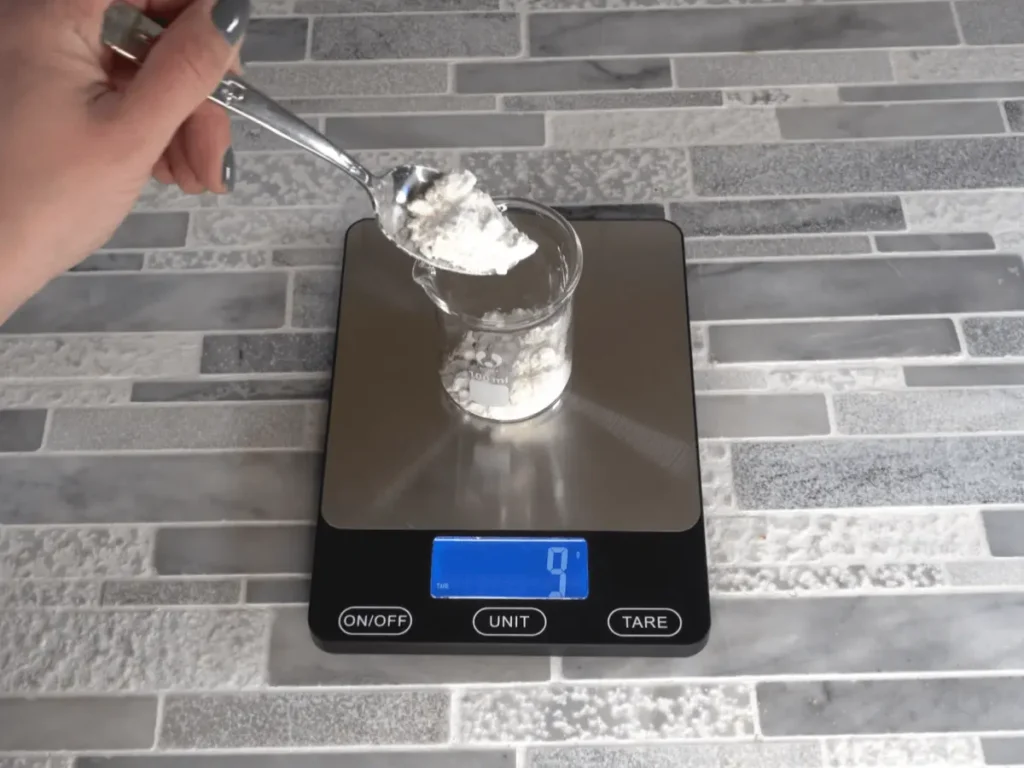
Follow the processing requirements
For a conventional heated lotion, the process generally involves preparing the water and oil phases separately, heating them according to the emulsifier’s instructions, combining them with appropriate mixing, and continuing to mix as the emulsion forms and cools.
Add cool-down ingredients at their specified temperatures. Confirm that the preservative is incorporated correctly, and follow the supplier’s instructions for any ingredients that require a particular dispersion method.
This is a general description, not a universal manufacturing procedure. Your exact method must match the ingredients in your formula.
Record what you observe
During and after production, note:
- How easily the ingredients combine.
- The appearance of the emulsion.
- The texture while warm.
- The texture after cooling.
- Whether the product appears uniform.
- The final batch weight.
- The measured pH, where applicable.
Don’t judge a lotion only by how it looks while warm. Viscosity and texture can change as the product cools and continues to develop.
Keep the first test batch small so that changes are easier to evaluate and less material is wasted.
Step 9: Test the Formula Before Making Changes
A formula that looks good immediately after mixing isn’t necessarily stable, well-preserved, or suitable for use.
Testing helps you determine whether the product meets its intended requirements.
Evaluate the texture and performance
Once the product has cooled and reached an appropriate evaluation point, assess:
- Appearance: Is the product uniform? Are there visible clumps, oil separation, or unexpected changes?
- Texture: Is it too thick, too thin, waxy, sticky, or gritty?
- Spreadability: Does it spread as intended?
- After-feel: Does it leave the skin feeling comfortable, greasy, tacky, or coated?
- Odor and color: Are they consistent with the expected characteristics of the ingredients?
- pH: Does it remain within the required range, where applicable?
These observations help you identify areas for improvement, but they do not establish that the product is safe.
Evaluate stability
A stability assessment examines how a product changes over time and under relevant storage conditions.
Depending on the formula and its intended use, this may include monitoring:
- Separation or changes in emulsion structure.
- Changes in viscosity.
- Color or odor changes.
- pH drift.
- Changes after exposure to appropriate temperature conditions.
- Packaging compatibility.
Accelerated or temperature-based observations can reveal potential weaknesses, but they do not automatically predict a product’s complete shelf life.
Consider microbial testing
For water-containing products, appropriate microbial quality and preservative efficacy testing are important parts of product development.
A product that looks and smells normal may still contain harmful microorganisms. Visual inspection and a short period without visible separation cannot establish microbial safety.
If you’re developing products for other people, don’t rely on a home observation period to determine shelf life. Use appropriate testing and qualified guidance to establish whether the product is adequately preserved and suitable for its intended use.
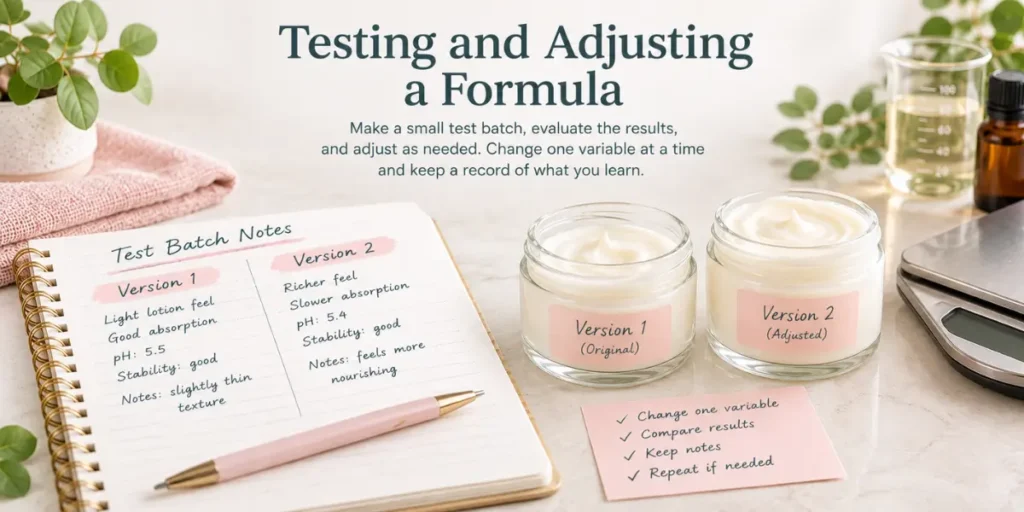
Step 10: Adjust the Formula Based on the Results
Now comes one of the most useful parts of formulation: making informed changes.
The goal isn’t to change several ingredients until the product seems better. It’s to identify a specific problem, consider its likely cause, and test a controlled adjustment.
What if the lotion is too thin?
Possible factors include the emulsifier system, oil-phase composition, thickener level, processing method, and cooling conditions.
Before increasing a thickener, check whether the emulsifier was used correctly and whether the product was processed as intended.
If you decide to adjust a structuring ingredient, make a small, documented change and recalculate the entire formula to 100%.
What if the lotion is too thick?
Possible causes include an excessive structuring-agent level, the choice of oils and butters, or the overall emulsifier system.
You may be able to reduce a thickener or adjust the oil-phase composition, but the change can also affect stability and skin feel.
Avoid simply adding water to thin a finished lotion. Doing so changes the formula, can disrupt the emulsion, and can compromise the preservation system.
What if the lotion feels greasy?
The type and proportion of emollients have a major influence on the after-feel.
Consider whether the formula contains too much of a heavy-feeling oil or butter for your intended product. A different emollient blend may provide better spreadability and a lighter finish.
Changing the oil phase can also affect emulsifier requirements and stability, so evaluate the complete system rather than making an isolated substitution.
What if the lotion feels sticky?
A high humectant level, certain thickeners, or the combination of ingredients may contribute to tackiness.
Review the ingredient levels and consider whether a different balance would produce the desired skin feel. Reducing glycerin, for example, might reduce tackiness in some formulas, but it also changes the formula’s humectant content.
Make a measured adjustment rather than removing an ingredient without considering its function.
What if the lotion separates?
Separation may indicate that the emulsion is not adequately stabilized or that the manufacturing process was unsuitable.
Review the emulsifier’s recommended usage, oil-phase composition, processing temperatures, mixing procedure, and cooling method.
What if the pH is too high or too low?
First, verify that the measurement was made correctly and compare it with the intended pH range.
If adjustment is appropriate, use a suitable pH adjuster according to a documented procedure. Make small, controlled additions, mix thoroughly, and measure again.
Change one variable at a time
This is one of the most useful habits you can develop as a formulator.
Suppose your first lotion is too greasy. If you change the oil blend, reduce the emulsifier, increase the thickener, and alter the humectant level simultaneously, you won’t know which change produced the result.
Instead, create a revised version with one planned change, while keeping the remaining variables as consistent as possible.
Record the new percentages, the reason for the change, and the results.
If the change improves the product without introducing new problems, you can build on that information. If it makes the product worse, you can return to the previous version and investigate another approach.
A formula should evolve through documented testing, not guesswork.
Step 11: Keep a Formula Record
Every time you make a test batch, document what you did.
Your formula record should include:
- Formula name and version number.
- Ingredient names and supplier information.
- Percentage of each ingredient.
- Calculated weight of each ingredient.
- Batch size.
- Processing temperatures and method.
- Mixing equipment and relevant processing details.
- Preservative and pH information.
- Observations during manufacture.
- Test results and storage conditions.
- Changes made between versions.
For example, you might label your first version Facial Lotion V1. If you change the oil blend after evaluating the first batch, the revised formula becomes Facial Lotion V2.
This simple practice prevents confusion and helps you identify which changes improved the product.
It also makes it easier to reproduce a successful batch rather than trying to remember what you did several weeks or years earlier.
Common Mistakes When Building a Skincare Formula
As you begin formulating, watch out for these common problems.
Choosing ingredients before defining the goal. Start with the product’s intended function and skin feel, then select ingredients that support those goals.
Treating recommended usage rates as a complete formula. Individual ingredient guidelines don’t tell you how all the ingredients will behave together. The finished formulation still needs to be designed and tested.
Forgetting that the total must equal 100%. Every ingredient counts, including the preservative and any pH-adjusting materials included in the formula.
Adding a preservative at the end without checking compatibility. Preservation needs to be considered during formula design, not treated as an afterthought.
Assuming every product needs the same pH. The correct range depends on the formulation, its ingredients, and the preservative system.
Changing several ingredients at once. Make controlled adjustments so you can identify the cause of an improvement or failure.
Assuming that a stable appearance means the product is safe. Appearance, stability, and microbial safety are separate considerations.
Making large batches before testing. Begin with manageable test batches, document your results, and scale up only when the formula and process are sufficiently understood.
Frequently Asked Questions
Can you create a skincare formula without a chemistry degree?
Yes. You can learn the fundamentals of cosmetic formulation without having a chemistry degree. Start with simple products, learn how ingredients function, follow supplier documentation, and build your understanding through careful testing.
However, some products and ingredients require more advanced knowledge, equipment, and testing than others.
What is the easiest skincare product to formulate from scratch?
A simple anhydrous balm is often a useful first project because it doesn’t require combining a water phase and an oil phase. You still need to consider ingredient compatibility, melting behavior, texture, oxidation, and contamination risks.
A basic lotion is a useful next step because it introduces emulsification, preservation, pH considerations, and additional stability requirements.
How many ingredients should a beginner use?
There is no fixed number. For a first project, use only the ingredients needed to achieve the product’s goals.
A shorter ingredient list can make it easier to understand the role of each ingredient and troubleshoot problems. However, you should never omit a necessary preservative, emulsifier, or other essential component just to keep the ingredient list short.
Do all skincare formulas need a preservative?
No. A genuinely anhydrous product may not require the same antimicrobial preservation system as a water-based lotion.
However, water-containing products generally require an appropriate preservative system, and products that may be exposed to water during use need careful consideration. Antioxidants do not replace antimicrobial preservatives.
Do all skincare products need their pH adjusted?
No. Conventional pH measurement and adjustment are relevant primarily to aqueous systems and suitable water-containing products. Pure oil blends and anhydrous balms do not have a conventional aqueous pH in the same sense.
For products that do require pH control, determine the target from the needs of the complete formula rather than applying one pH target to every product.
Can I change an ingredient in an existing formula?
Sometimes, but substitutions should not be assumed to be one-for-one.
Two oils may feel different on the skin, two emulsifiers may require different usage levels, and two preservatives may have different pH or compatibility requirements.
After a substitution, recalculate the formula and reassess processing, stability, pH where applicable, and preservation.
How do I know when my formula is finished?
A formula is ready for its intended use only when it meets the defined performance requirements and has undergone the appropriate evaluation for stability, compatibility, and safety.
A pleasant texture and attractive appearance are useful observations, but they aren’t sufficient evidence of a successful finished product.
If you’re developing a product for sale, you will also need to consider applicable cosmetic regulations, manufacturing practices, safety substantiation, and labeling requirements.
Final Thoughts
Building a skincare formula from scratch is a process of making informed decisions.
Start with a clear product goal, choose ingredients for specific functions, organize the phases, and assign percentages that work together. Calculate the grams for your chosen batch size, account for preservation and pH requirements, and test the finished product before making adjustments.
You won’t necessarily get your ideal formula on the first attempt, and that’s normal. Formulation involves observing how ingredients behave together and using those observations to make better decisions the next time.
The more carefully you document your work, the easier it becomes to understand why a formula succeeds or fails.
Once you understand this process, you’re no longer limited to following a recipe. You’re developing the skills to design, evaluate, and refine your own skincare products.
Continue Learning
If you’re ready to keep learning, explore these related guides:
- DIY Skincare for Beginners: Start Here
- How to Read a Skincare Formula
- Percentages vs. Grams in Skincare Formulation
- How to Scale a Skincare Formula to Any Batch Size
- Why Preservatives Matter in Skincare
- How to Make Products with a Balanced pH Level