
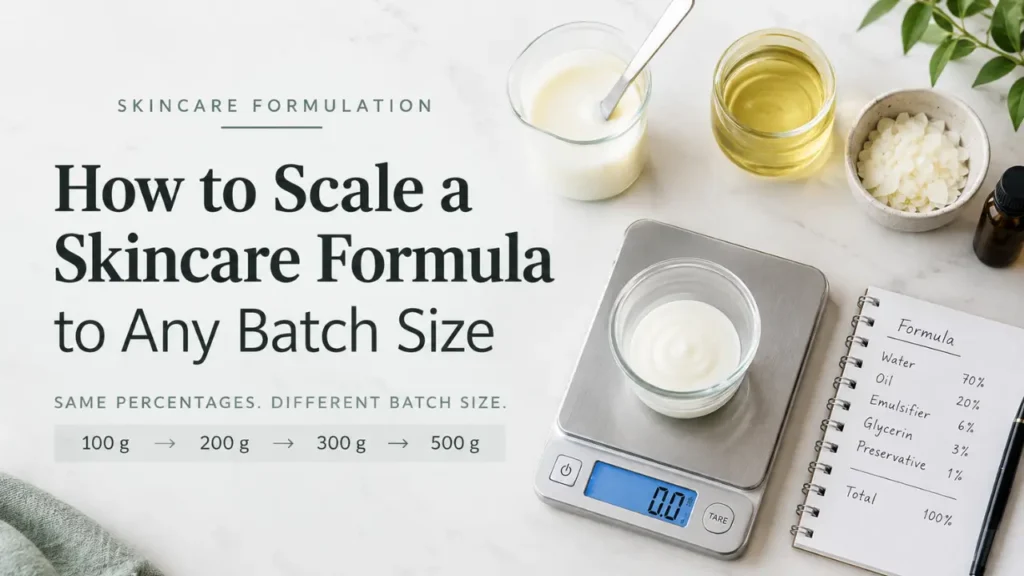
Have you ever found a DIY skincare recipe you love, only to realize it makes far more—or far less—than you need? Maybe you want to make a small batch of lotion to test the texture, prepare enough body butter to fill several jars, or turn a 100 g formula into a 500 g batch.
The good news is that you don’t need to start over or calculate every ingredient from scratch. Once you understand how to scale a skincare formula, you can make almost any batch size while keeping the original ingredient proportions consistent.
The secret is working with percentages.
In this guide, I’ll show you how to scale a skincare formula step by step, with examples for 100 g, 200 g, 300 g, and 500 g batches. I’ll also cover what to do when your numbers don’t add up, how to round ingredient weights, and the important things to check before making a larger batch.
Whether you’re making your first DIY lotion or learning to formulate your own skincare products, this is a skill you’ll use again and again.
What Does It Mean to Scale a Skincare Formula?
Scaling a skincare formula means increasing or decreasing the total amount of product while maintaining the same percentage of each ingredient.
For example, imagine you have a body butter formula containing 10% cocoa butter. If you make a 100 g batch, you need 10 g of cocoa butter. If you make a 300 g batch, you need 30 g.
The percentage stays the same. Only the weight changes.
This is important because the proportions of ingredients help determine the finished product’s texture, consistency, performance, and stability. Simply adding more of one ingredient without adjusting the rest can change how the product behaves.
Once a formula is written in percentages, you can calculate the weight of each ingredient for almost any batch size.
If you’re new to formulation, start with my Skincare Formulation for Beginners guide to understand how ingredients work together before moving on to scaling formulas.
Percentages vs. Grams: Why Both Matter
Before scaling a formula, it helps to understand the difference between percentages and grams.
Percentages describe the formula. Grams tell you how much of each ingredient to weigh.
For example, a formula might contain:
| Ingredient | Percentage |
| Distilled water | 70% |
| Carrier oil | 20% |
| Emulsifier | 6% |
| Glycerin | 3% |
| Preservative | 1% |
| Total | 100% |
These percentages describe the proportions of the ingredients, regardless of whether you’re making 100 g or 500 g.
If you want to make 100 g, 1% equals 1 g. If you want to make 500 g, 1% equals 5 g.
This is why I recommend working with percentages whenever possible. You don’t have to rewrite your entire recipe every time you want a different batch size.
For a more detailed explanation, read Percentages vs. Grams in Skincare Formulation.
Does a formula always need to equal 100%?
Yes. A complete formula expressed as percentages should total 100%.
This represents the entire finished product, including water, oils, butters, emulsifiers, preservatives, fragrance, and other ingredients.
If the total is 98%, for example, you need to find out what is missing or whether an ingredient intended to make up the remainder has been omitted. Don’t simply add 2% of a random ingredient to make the numbers work.
For a formula that uses water to make up the remainder, the water percentage may be calculated as the amount needed to bring the complete formula to 100%. This is often described as water q.s. to 100%, meaning enough water to reach the final total.
The Formula for Scaling Any Batch Size
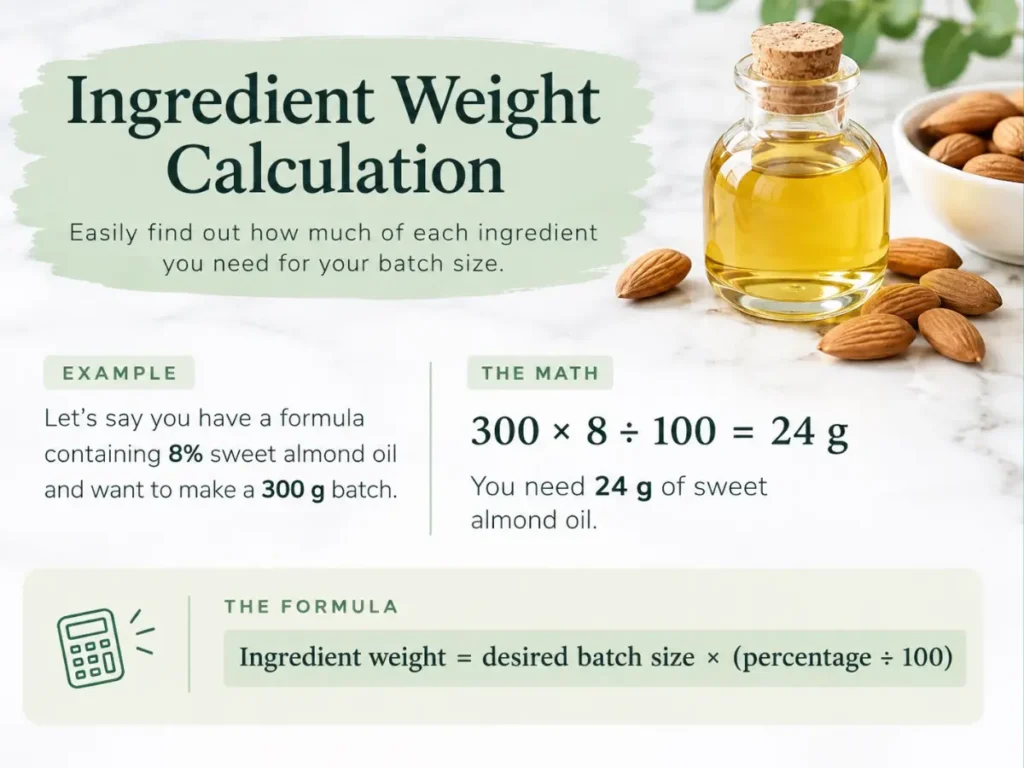
Here’s the calculation you’ll use every time:
Ingredient weight = desired batch size × ingredient percentage ÷ 100
Let’s say you have a formula containing 8% sweet almond oil and want to make a 300 g batch.
300 × 8 ÷ 100 = 24 g
You need 24 g of sweet almond oil.
That’s it. Repeat the calculation for every ingredient in your formula.
Step-by-Step: How to Scale a Skincare Formula
Let’s walk through the process so you can use it with your own recipes.
Step 1: Start With a Complete Formula
First, make sure you have the full ingredient list and the percentage of every ingredient.
If your recipe is already written in percentages, you’re ready to begin.
If it’s written only in grams, you’ll need to convert it to percentages before scaling it. I explain that process in How to Convert a Recipe to a Formula.
This step matters because a formula must be written in percentages to scale accurately. You cannot use a recipe written for just one batch size.
Step 2: Choose Your Desired Batch Size
Decide how much finished product you want to make.
For example:
- 100 g for a small test batch
- 200 g for a few small containers
- 300 g for several jars
- 500 g for a larger batch
Remember that the batch size refers to the total weight of the finished formula, not the weight of each individual phase.
If you want to make 300 g of lotion, all the ingredients combined should equal 300 g.
Also consider how much product you need after accounting for what remains on your mixing tools and containers. If you need a specific amount of finished product in your jars, you may need to make a slightly larger batch.
I have forgot to account for this way too much and ended up being a little short on filling a jar!
Step 3: Calculate Each Ingredient
Multiply your chosen batch size by each ingredient’s percentage, then divide by 100.
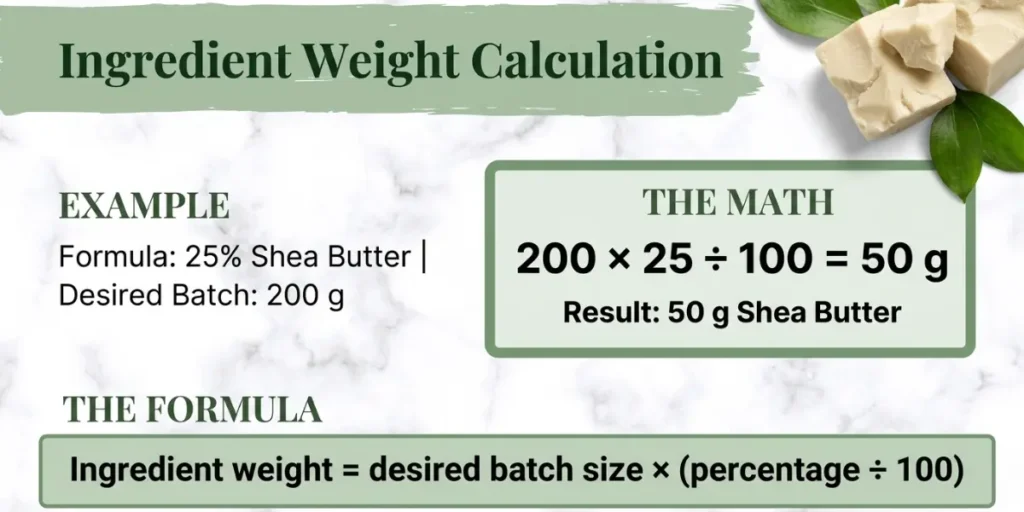
For example, if your formula contains 25% shea butter and you want a 200 g batch:
200 × 25 ÷ 100 = 50 g
You need 50 g of shea butter.
If the same formula contains 5% carrier oil:
200 × 5 ÷ 100 = 10 g
You need 10 g of carrier oil.
Continue until you’ve calculated every ingredient, including small amounts of preservatives, fragrance, and other additives.
Step 4: Check the Total Weight
Once you’ve calculated the ingredient weights, add them together.
For a 300 g batch, the total should be 300 g.
If your total is slightly different, check whether you’ve rounded any ingredient weights. A small difference may be due to rounding, but a larger difference usually means there’s a calculation error or a missing ingredient.
Don’t automatically adjust a preservative, emulsifier, or active ingredient to correct the total. Check the calculations and adjust the appropriate ingredient, often the water when the formula is designed to use water to make up the remainder.
Step 5: Weigh and Make the Formula
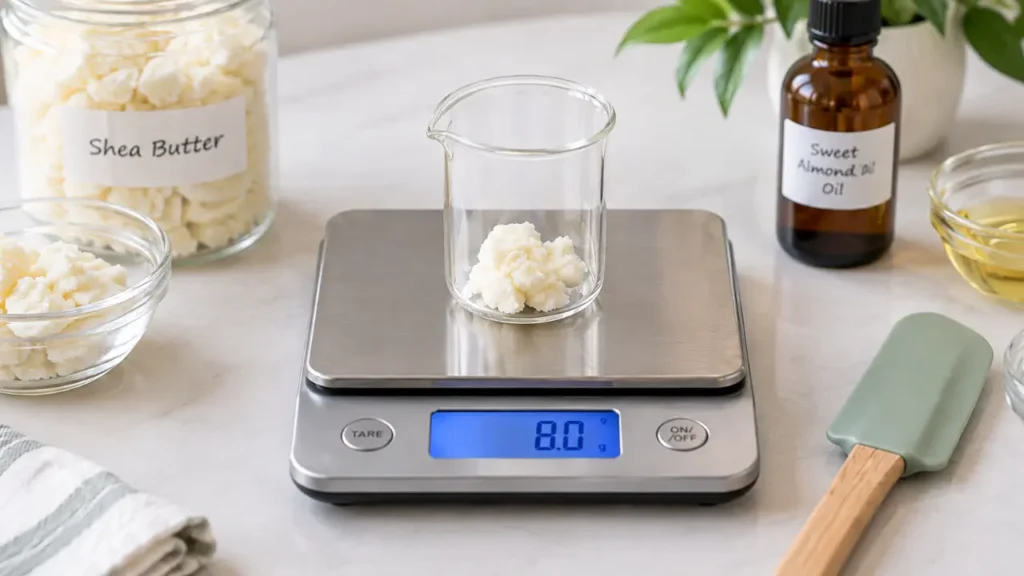
Use a digital scale to weigh each ingredient in grams.
Follow the original formula’s instructions for heating, mixing, cooling, pH adjustment, and adding ingredients at the correct stage. Scaling a formula changes the quantities, but it doesn’t eliminate the need to follow the proper manufacturing process.
For example, a larger batch of lotion may take longer to heat and cool than a small batch. Make sure the ingredients reach the temperatures and processing conditions required by the formula.
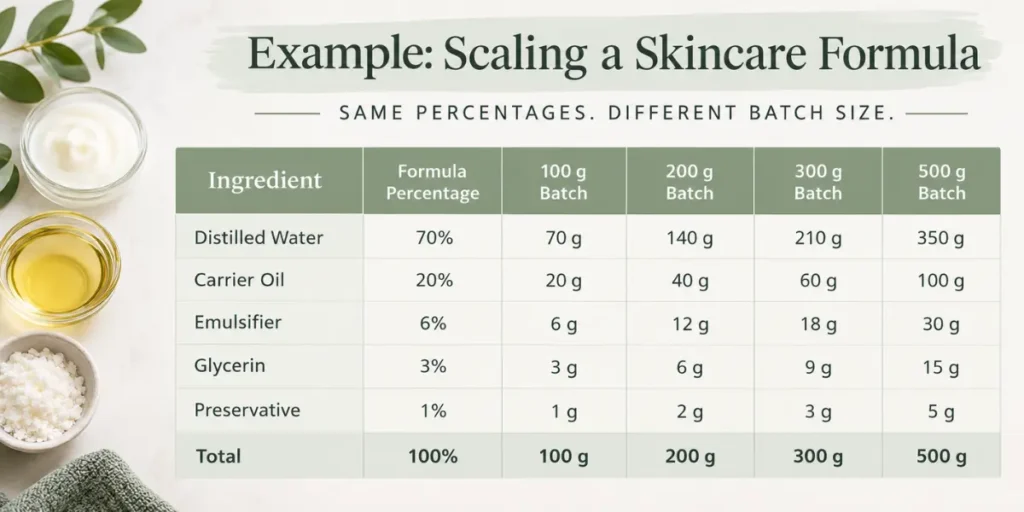
Example: Scaling a Skincare Formula From 100 g to 500 g
Let’s use a simple example to see how the same formula changes across several batch sizes.
This is an illustrative formula for demonstrating the mathematics of scaling, not a tested lotion recipe.
| Ingredient | Formula | 100 g | 200 g | 300 g | 500 g |
| Distilled water | 70% | 70 g | 140 g | 210 g | 350 g |
| Carrier oil | 20% | 20 g | 40 g | 60 g | 100 g |
| Emulsifier | 6% | 6 g | 12 g | 18 g | 30 g |
| Glycerin | 3% | 3 g | 6 g | 9 g | 15 g |
| Preservative | 1% | 1 g | 2 g | 3 g | 5 g |
| Total | 100% | 100 g | 200 g | 300 g | 500 g |
Notice how the percentages never change. Each ingredient increases in proportion to the total batch size.
However, these ingredient levels are for illustrating the math only. In an actual lotion, you must choose a suitable emulsifier and preservative and confirm that their usage rates, compatibility, processing requirements, and other formulation conditions are appropriate. A formula that adds up to 100% is not automatically a stable or safe product.
A Quick Way to Scale a Formula: Use a Scaling Factor
There’s another method that can make scaling even faster, especially when you’re working with a recipe that already has ingredient weights.
A scaling factor tells you how many times larger or smaller your new batch is compared with the original.
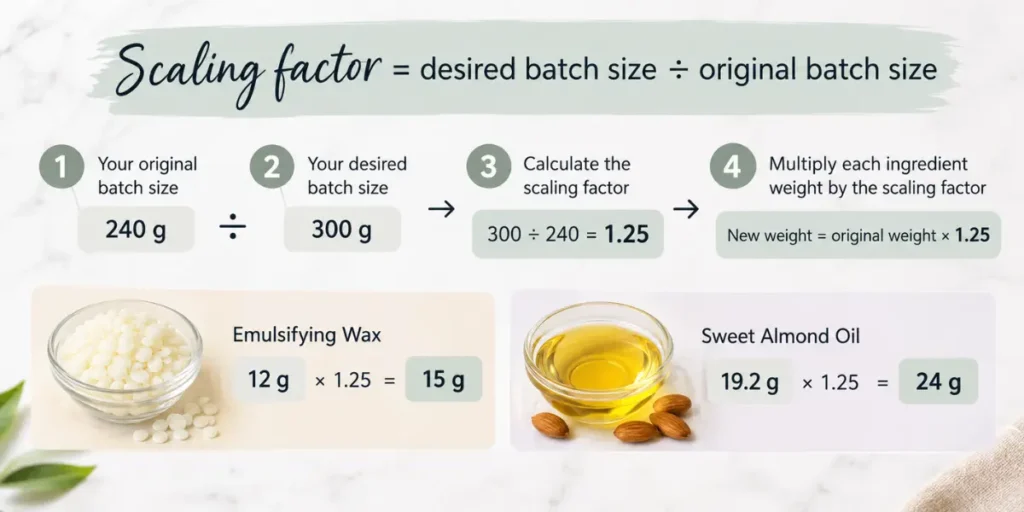
Scaling factor = desired batch size ÷ original batch size
For example, suppose your original formula makes 240 g, but you want to make 300 g.
300 ÷ 240 = 1.25
Your scaling factor is 1.25.
Now multiply every original ingredient weight by 1.25.
If the original recipe contains 12 g of emulsifying wax:
12 × 1.25 = 15 g
If it contains 19.2 g of sweet almond oil:
19.2 × 1.25 = 24 g
Repeat this for every ingredient in the original recipe.
When should you use a scaling factor?
This method is especially helpful when you already have a complete, accurate recipe in grams and simply want a different batch size.
However, if you plan to make the same formula in several different sizes over time, converting it to percentages is more useful. Once you have the percentages, you can scale the formula without having to return to the original recipe.
What If Your Recipe Is Written in Grams Instead of Percentages?
You don’t necessarily need to start over.
If you have an existing recipe with accurate ingredient weights, you can calculate a scaling factor directly from the original batch size.
For example, your original recipe makes 240 g and you want to make 120 g.
120 ÷ 240 = 0.5
Multiply every ingredient weight by 0.5. You’ll end up with half the original amount of each ingredient.
But if you plan to scale the recipe regularly, I recommend converting it to percentages first. That way, you can make 100 g, 200 g, 300 g, or 500 g without recalculating from the original gram amounts each time.
See my guide on How to Convert a Recipe to a Formula for the full process.
Important: This shortcut works when the original ingredient weights are accurate and the recipe represents the intended batch. If the recipe uses tablespoons, teaspoons, or cups, don’t assume that multiplying those volume measurements will give you precise ingredient weights. Different ingredients have different densities.
What Happens When You Scale a Formula Down?
Scaling down uses exactly the same calculation as scaling up.
Suppose you have a 500 g formula but want to make a 100 g test batch.
Your scaling factor is:
100 ÷ 500 = 0.2
Multiply every ingredient weight by 0.2.
An ingredient that weighs 25 g in the original batch will weigh 5 g in the smaller batch.
Small test batches are useful when you’re developing a product because they let you evaluate texture, scent, and application without using as much material.
However, be careful with very small quantities. If an ingredient is present at a low percentage, the calculated weight may be too small for your scale to measure reliably.
For example, 0.2% of a 100 g batch is only 0.2 g. If your scale cannot measure that amount accurately, use a suitable scale with better resolution or an appropriate, validated preparation method. Don’t estimate the amount by eye.
This is when it is important to have a smaller scale that measures to 0.01 grams.
Common Mistakes When Scaling Skincare Formulas
Even though the math is simple, there are a few mistakes that can affect the finished product.
1. Changing the Percentages Instead of the Batch Size
If you want a larger batch, increase the total weight rather than randomly increasing ingredient percentages.
For example, if an oil is 8% of your original formula, it should remain 8% when scaling the same formula.
If you want to change it to 10%, you’re modifying the formula rather than simply scaling it. That may be appropriate during formulation development, but you’ll need to assess how the change affects the finished product.
2. Forgetting That Every Ingredient Counts Toward 100%
Don’t leave out small ingredients when calculating the total.
Preservatives, fragrance, colorants, extracts, and other additives all contribute to the finished formula when included by weight.
Even if an ingredient is used at less than 1%, it still needs to be included in the calculations.
3. Rounding Too Early
Calculations can produce decimal weights, such as 7.35 g or 1.25 g.
Keep the full precision of your calculations until you’ve worked out all the ingredients. Round only when you need to enter the final weights on your scale.
Rounding each ingredient too aggressively can cause the final batch to differ from the intended total. This is particularly important in small batches, where a difference of a few tenths of a gram may be significant.
4. Using Volume Measurements Instead of Weight
A tablespoon of oil doesn’t necessarily weigh the same as a tablespoon of butter or glycerin.
If you’re working with cosmetic formulas, use grams rather than relying on teaspoons, tablespoons, or cups. Weight measurements are more consistent and easier to reproduce.
5. Assuming Scaling Makes a Formula Safe
Scaling preserves the mathematical proportions of a formula. It doesn’t prove that those proportions are appropriate.
For example, an ingredient that is used above its recommended level in the original recipe will still be above that level after scaling. The math won’t correct an unsuitable formula.
Always check supplier guidelines for preservatives, fragrance oils, essential oils, emulsifiers, and active ingredients before making a batch.
6. Assuming a Larger Batch Will Behave Exactly the Same
The percentages may remain identical, but processing can change when you increase the batch size.
Larger batches can take longer to heat and cool, and the mixing equipment may not perform the same way at different volumes. This can affect how a product comes together.
When moving from a small test batch to a much larger one, pay attention to the mixing method, temperature, cooling rate, and final consistency. Don’t assume that a formula has been fully validated at a larger production scale just because the arithmetic works.
Important Things to Check Before Scaling a Formula
Before making a new batch size, work through this checklist.
- The original formula is complete and the percentages total 100%.
- The desired batch size is based on total finished product weight.
- Every ingredient has been recalculated.
- The ingredient weights add up to the intended batch size.
- Preservatives, fragrance, and active ingredients are within their applicable usage limits.
- The formula’s pH requirements and ingredient compatibility have been considered.
- The original processing instructions are suitable for the new batch size.
- Your scale can accurately measure the smallest ingredient amounts.
- The finished product will be evaluated for quality and stability as appropriate.
This is particularly important for lotions, creams, and other products that contain water. Correct percentages alone don’t replace appropriate preservation, hygienic manufacturing, pH control when required, or product testing.
How Scaling Works With Different Types of Skincare Recipes
The math is the same across different product types, but the practical considerations can vary.
Body Butter
For an anhydrous body butter made from oils and butters, scaling is usually straightforward once the formula is established.
You multiply each ingredient by the appropriate factor or calculate each weight from its percentage.
However, changing the batch size can affect melting, cooling, crystallization, and whipping. These factors are particularly important when you’re trying to achieve a smooth, consistent texture.
If you’re making body butter, start with an established recipe such as my Emulsified Body Butter guide, and follow its instructions carefully.
Lotion and Cream
Lotions and creams contain water and oil phases that must be combined correctly.
When scaling these products, calculate every ingredient in both phases and in the cool-down phase. Don’t forget the preservative or any ingredient added after heating.
You may also need to account for changes in heating, mixing, and cooling when moving to a larger batch.
Sugar Scrubs and Body Polishes
Sugar scrubs are also easy to scale mathematically when the formula is expressed in percentages.
However, the ingredient balance determines the final texture and how the product behaves during use. A change in the amount of oil, sugar, emulsifier, or surfactant can affect firmness, spreadability, and rinse-off.
For a practical example, see my Sugar Scrub Cubes: How to Make Solid Exfoliating Bars guide.
Cleansers and Other Water-Based Products
Cleansers and other water-based products may contain surfactants, thickeners, preservatives, and ingredients that require specific pH conditions.
Scaling the weights is only the first step. Check the ingredient supplier’s instructions and confirm that the formula remains suitable after processing.
For example, my guide to making body wash from scratch shows how a formula can be expressed in percentages and grams.
How Scaling Fits Into Learning Skincare Formulation
Scaling is one of the first practical skills that helps you move beyond following a recipe.
When you understand percentages, you can see how each ingredient contributes to the total formula. When you understand ingredient roles, you can begin to see why changing one ingredient may affect the others.
These skills work together:
- Percentages vs. grams: Learn how ingredient percentages translate into weights.
- How to convert a recipe to a formula: Turn an existing gram-based recipe into percentages.
- Skincare formulation for beginners: Learn how ingredient selection, emulsification, preservation, and other formulation principles work together.
Once you understand how to read a formula, scaling becomes even easier because you can identify the percentages, understand the role of each ingredient, and calculate the amount needed for your next batch.
You can explore more formulation topics in my formulation guides.
Frequently Asked Questions
How do I scale a skincare formula to 500 g?
Multiply each ingredient’s percentage by 500 and divide by 100.
For example, if your formula contains 8% carrier oil:
500 × 8 ÷ 100 = 40 g
Repeat the calculation for every ingredient. The finished formula should total 500 g.
Can I scale a 100 g skincare formula to 300 g?
Yes. Multiply each ingredient’s weight by three, or calculate each ingredient from its percentage using 300 g as the target batch size.
The percentages remain the same.
How do I scale a formula from 240 g to 300 g?
Divide the desired batch size by the original batch size:
300 ÷ 240 = 1.25
Multiply every ingredient weight by 1.25.
Can I scale a skincare recipe that only lists grams?
Yes. If the original recipe has accurate weights, you can use a scaling factor to increase or decrease the batch. Converting the recipe into percentages is more convenient if you plan to make several different batch sizes.
Do I need to change the preservative when scaling a lotion?
You should recalculate the preservative according to its percentage in the formula and the new total batch weight. Do not change its percentage simply because you’re making a larger or smaller batch.
You must also confirm that the preservative is appropriate for the formula and used within the supplier’s recommended range and applicable requirements. Scaling does not replace proper preservation or product testing.
Can I scale a skincare formula to any batch size?
Mathematically, a percentage formula can be calculated for almost any batch size. Practically, the amount you can make successfully depends on the accuracy of your scale, the mixing and heating equipment, ingredient limitations, and whether the manufacturing process is suitable for the new batch size.
Why doesn’t my scaled formula add up to the correct weight?
Check for calculation errors, missing ingredients, and rounding differences. Make sure you have included every ingredient and that the original percentages total 100%.
If the formula uses water to make up the remainder, recalculate the water amount according to the formula rather than changing the preservative or another functional ingredient to force the total to match.
Is scaling the same as changing a formula?
No. Scaling changes the total batch size while maintaining the same ingredient percentages. Changing a formula means adjusting one or more ingredient percentages, which may affect the product’s texture, performance, or stability.
Final Thoughts
Scaling a skincare formula is much easier than it first appears. Once you understand the relationship between percentages and grams, you can calculate the ingredients needed for a small test batch or a much larger batch without guessing.
Start with a complete formula, choose your desired batch size, calculate each ingredient, and check the total before you begin making the product.
Most importantly, remember that scaling preserves the formula’s proportions, not necessarily its safety or stability. Ingredient limits, preservation, processing conditions, and testing still matter.
If you’re learning to formulate your own skincare, this is an important step toward understanding not just how much to make, but why the formula works the way it does.