

The question that I am asked most often is How Do You Determine The Shelf Life of Homemade Cosmetics. Nothing lasts forever, including the cosmetics and skin care that you are making. How long do they last? I am going to walk you through how you can determine the shelf life of your homemade cosmetics and body care products. You need to know this whether you are making the products for yourself, friends or selling them. The last thing you want to do is give someone a product that will be unsafe to use.
To start, it is not super difficult to get an approximate shelf life of your homemade products. You just need a little bit of information. Also, there are things that you can do, to extend the shelf life of your products.
Do natural skin care products expire? What is shelf life?
The shelf life of a cosmetic is the period during which the finished product is expected to remain stable and suitable for its intended use when stored under appropriate conditions.
Shelf life isn’t determined by one factor. The formula, ingredients, preservation system, packaging, manufacturing practices, storage conditions, and stability of the finished product can all affect how long a product remains suitable for use.
When you’re making products at home, you can use the shelf life of your ingredients to make a rough estimate, but this should not be confused with a tested shelf life for the finished product.
Prefer to watch How to Determine Shelf Life instead of reading it?
Some of the links are affiliate links, because I am an associate and I earn a small commission on them.
Some cosmetics have a shorter shelf life
When you’re thinking about shelf life, you also have to consider how the product is formulated and how it will be used.
Products used around the eyes require particular care because contamination can present a greater concern. Products used in the shower may also be exposed to water and repeated handling.
Different types of cosmetics have different stability and preservation considerations, so there isn’t one shelf-life rule that applies to every product.
How long does homemade skin care last? Approximating Our Products Shelf Life
You will want to look at the shelf life of each ingredient. Now, this can be kind of difficult depending on how many ingredients you are using. The trick is to find the ingredient with the shortest shelf life.
A useful rule of thumb for making a preliminary shelf-life estimate is to start with the ingredient that has the shortest remaining shelf life. (However, this is only an estimate and does not establish the tested shelf life of the finished product.)
When I buy a product, I will put a label on the container so I know when I opened it and what that ingredient’s shelf life is. This takes a lot of the work out of figuring out how long a product will last.
Variables
There are variables that will have an effect on the shelf life of the products you are making.
- Disinfecting: It is super important that you are disinfecting and keeping a clean work area and equipment. The reason it is so important is that we do not want to do anything to introduce bacteria into our products.
- Preservatives: Equally important is using a preservative when one is needed. Typically you should use a preservative anytime you use water or water may be introduced into a product. This means that you would use a preservative in a container where you would use wet hands to scoop the product out.
- Containers: You might be thinking, how does the container I use matter? Well it does. For example, a product that is in a container that you dip your fingers into is not going to last as long as a product that has a pump top. This is because each time you dip your fingers into it, it is introducing bacteria and fungi into the product. A conditioner that is in a bottle is going to last longer than one that you dip your hands into.
- Emulsions: An emulsion combines water and oil using an emulsifier to create a stable mixture. A properly formulated and manufactured emulsion can remain stable for an extended period of time, but emulsions can become unstable because of factors such as formulation, processing, temperature, ingredients, packaging, and storage. This is why stability testing is important when establishing the shelf life of a finished emulsion.ed, but the separation is inevitable. You can read more on emulsions here.
Watch For Signs
One of the most important things that you need to know when making your own skin care is the finished product’s shelf life.
Why does shelf life matter?
Safety
- You always want to ensure that the products you are putting on your skin are safe to use. You don’t want to use anything that might have mold or bacteria growth in it.
- And you don’t want to sell or give away anything that’s not safe to use.
Container Size
- Knowing the shelf life of your products is going to guide you to the type and size of container you should use.
- If you have a serum that has a 3 month shelf life, you will probably make this in relatively small amounts, an ounce or less.
- On the flip side, if I know my lotion has a shelf life of a year, I would feel comfortable making 2 or 3 – 8 ounce bottles at a time, because I know that I will be able to use it before it goes bad.
Container Type
- The type of product and shelf life can help you choose an appropriate container.
- If you have a product that wet hands might get dipped into, it might make sense to use a container with a pump.
- If you have a product that is stored in the shower, you want to make sure water cannot get into the finished product by using a pump or flip lid.
How to Estimate the Shelf Life of Homemade Cosmetics
To estimate the shelf life of your oil only product, you have to determine the oil with the shortest shelf life. Here is an example from my whipped body butter:
Whipped Body Butter Shelf Life – Example 1
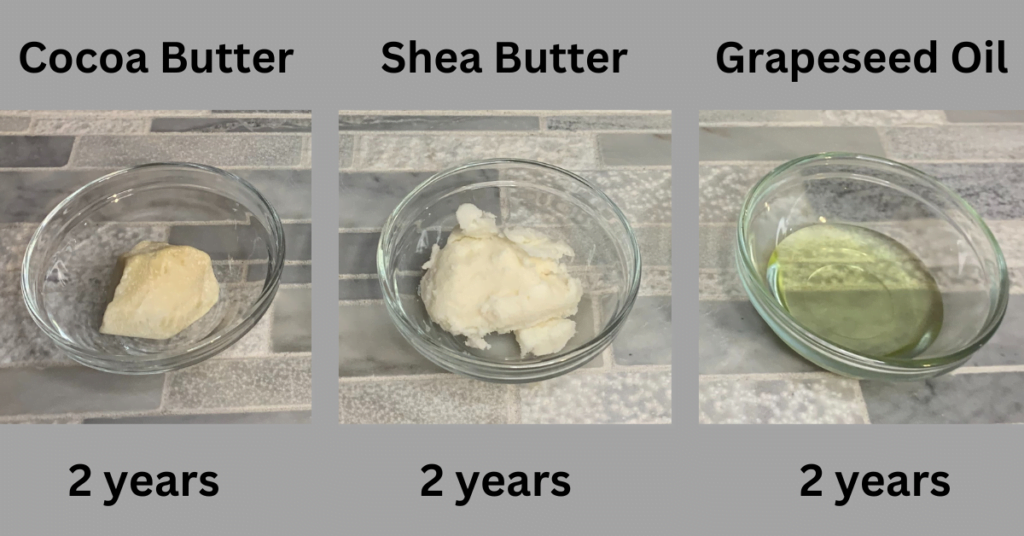
Based on the ingredient shelf lives in this example, 2 years would be the estimate because that is the shortest remaining shelf life among the oils.
Whipped Body Butter Shelf Life – Example 2
Let’s say we are making the same Whipped Body Butter with the same ingredients. If the cocoa butter was opened 18 months ago and its original shelf life was 2 years, there would be approximately 6 months of remaining ingredient shelf life. That would make 6 months the estimate based on the ingredients.
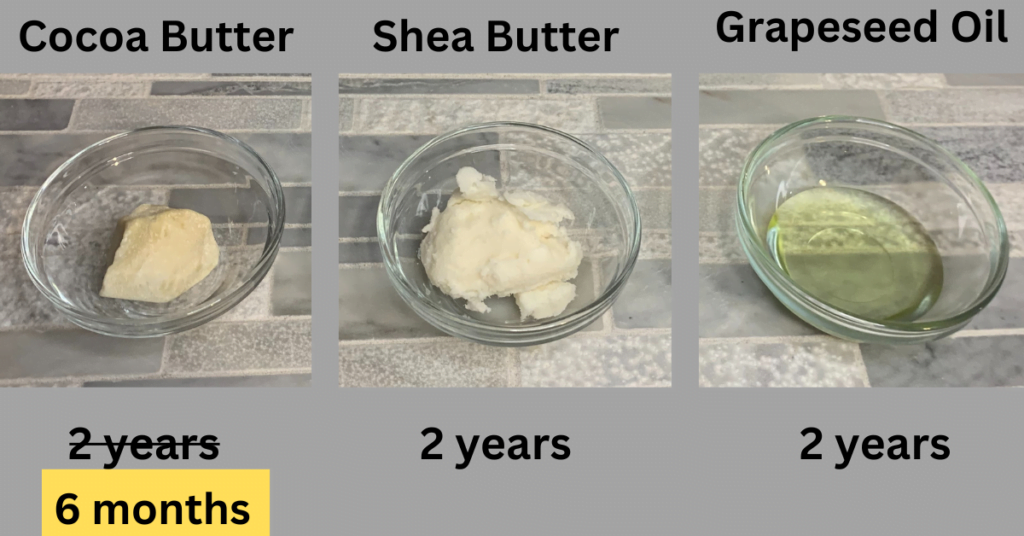
Whipped Body Butter Shelf Life – Example 3
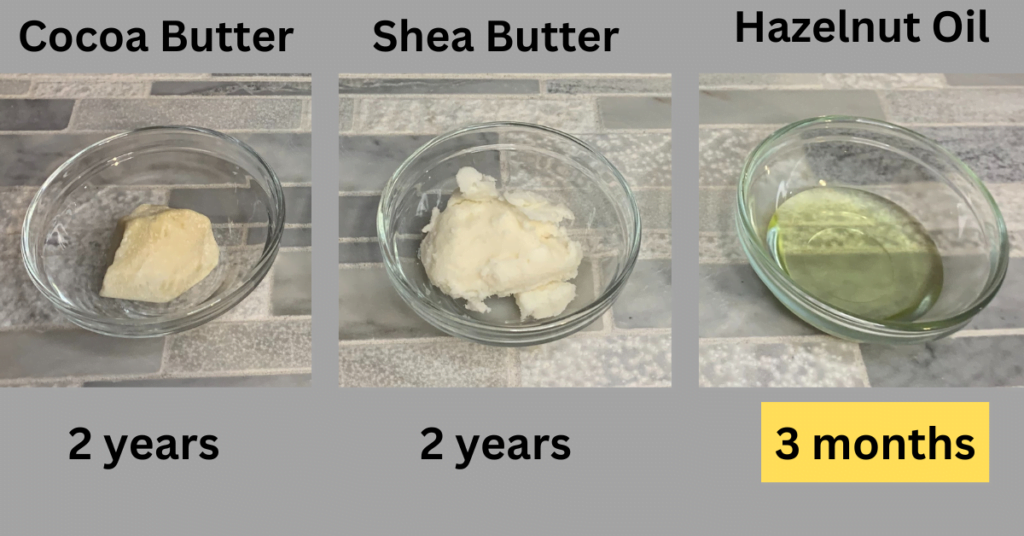
You will notice that I selected oils that have a relatively long shelf life. Personally, I wouldn’t use oil that only had a 3 month window (such as hazelnut oil). Let’s look at what the shelf life would be if we did use Hazelnut Oil.
In this example, the Whipped Body Butter would only have a shelf life of 3 months.
Oil Only Products
Oil only products would be those products that do not contain any water. An example would be Whipped Body Butter , Lotion Bars and DIY Lip Balm.
The cool thing about these types of products is that there is no need for a preservative. There is not a risk that the product is going to grow mold.
The main concern with oil products will be with the oils going rancid. All oils at some point will go rancid. This is caused by a reaction that happens when oils are exposed to air, causing oxidation.
Products with Water
Do I need a preservative in homemade lotion?
If a cosmetic contains water, hydrosols, aloe vera, or another water-containing ingredient, microbial preservation needs to be considered.
Water-containing products can support the growth of microorganisms such as bacteria, yeast, and mold. A suitable preservative system is therefore an important part of formulating products such as lotions, creams, body washes, shampoos, and conditioners.
There isn’t a universal number of days that an unpreserved water-based cosmetic can safely be used.
Refrigerating an unpreserved product does not turn it into a properly preserved cosmetic, and I would not recommend assigning a specific safe shelf life simply because the product is stored in the refrigerator.
A preservative also doesn’t automatically give a product a specific shelf life. The preservative must be appropriate for the formulation, used at the recommended concentration, and compatible with the product’s pH and other ingredients.
You can learn more about this in my article Why Preservatives Matter in DIY Skincare.
Estimating the shelf life when preservative is used
The process of estimating the shelf life is the same as you did with the oil only product. The main difference is that you have more ingredients to consider. Here is an example from my Aloe Vera Lotion:
Olive Oil- 2 years
Macadamia Nut Oil – 2 years
Cocoa Butter – 2 years
Aloe Vera 10X Concentrated – 1 year
The shelf life would be 1 year, because the Aloe that we use has a 1 year shelf life. Even though all of my oils are still good for another year, my aloe has a shorter shelf life and it will expire first. (This is assuming that I just opened all of these ingredients. If they have been opened earlier, you would need to take that into account.)
So even though we know an estimated shelf life of our products that does not mean that shelf life is guaranteed. You should always keep an eye on your products to make sure that they are not going bad.
How Do You Know the Actual Shelf Life?
The ingredient-based method above is useful when you’re learning how to formulate and want to make a preliminary estimate. However, an estimate based on ingredient expiration dates isn’t the same thing as establishing the actual shelf life of the finished product.
Finished cosmetic products can undergo different types of stability problems, including microbial contamination, oxidation, changes in texture, separation, color changes, and changes caused by temperature or packaging.
In professional cosmetic formulation, finished products may undergo stability testing and, for preserved water-containing products, preservative efficacy or challenge testing. These tests provide much more information about how the finished formula behaves over time.
For homemade products, the important takeaway is this: use ingredient shelf life as a starting point, not as a guarantee.
Things to watch for
- Change in consistency
- Getting watery or thinning out
- Change in color
- You notice that it is starting to look brown or yellow.
- Change in smell
- You notice that the product does not smell like it used to.
If you notice any change in your products, air on the side of caution and toss them out!
Important: Changes in appearance, texture, or smell can be signs that a product has deteriorated, but a product can have microbial contamination without obvious visible or sensory changes. Don’t rely on smell or appearance alone to determine whether a product is safe.
Things you can when making skin care to extend the shelf life of homemade cosmetics:
Sanitizing
Before you start making your products, it is important to properly clean and sanitize appropriate equipment, containers, and your work area. This is to ensure that you’re not putting your beautiful creations into an already contaminated container or mixing it with an un-sanitized spoon.
Wear Gloves
As often as you can, you should wear gloves when making your products to help reduce the amount of contamination that can be introduced from your hands.
Distilled Water
Using distilled water can reduce the introduction of minerals and microorganisms compared with untreated water, but it does not replace a suitable preservation system.
Tips to Extend Shelf Life of Homemade Cosmetics
Vitamin E Oil
Vitamin E Oil can be used to help to slow down the oxidation process and help slow oxidation and delay rancidity in products containing oils and butters. Which is great, but it is important to note that it is not a preservative.
Be Careful With Highly Perishable Ingredients
Fresh ingredients such as fruit, dairy, yogurt, or other food-based ingredients can make preservation and stability much more challenging. These ingredients can introduce additional nutrients and water that may support microbial growth.
If you’re learning formulation, it’s generally easier to start with cosmetic-grade ingredients that have established supplier specifications and are intended for use in cosmetic formulations.
Container
The type of container that you use will have an effect on the shelf life of your product. Any time you use a container where you dip your fingers into it, it can increase the opportunity for contamination during use, because you are making it more susceptible to unwanted growth. Using something to scoop the product out of the container, would extend the shelf life.