
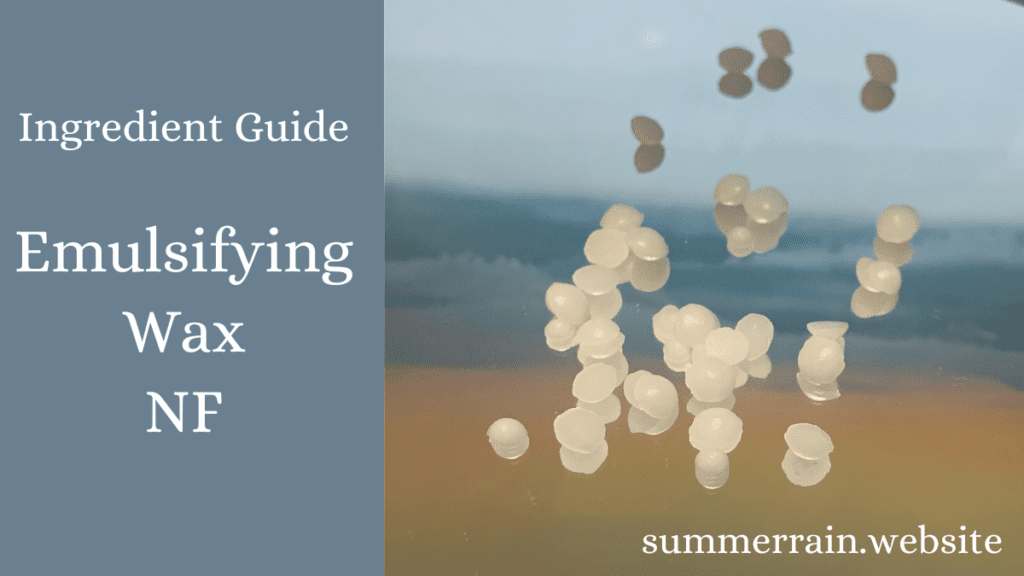
If you’ve ever made lotion at home, you’ve probably discovered one of the first rules of skincare formulation: oil and water don’t naturally stay mixed.
You can stir them together, blend them, and make the mixture look perfectly smooth, but without the right emulsifying system, they will eventually separate.
That’s where Emulsifying Wax NF comes in.
Emulsifying Wax NF is a commonly used emulsifier for oil-in-water emulsions and can be used in products such as lotions, creams, emulsified body butters, and emulsified sugar scrubs.
But how much should you use? When do you add it? Can you substitute another emulsifier? And what should you do if your lotion still separates?
This guide explains what Emulsifying Wax NF does, how to use it, how to formulate with it, and how to troubleshoot common problems.
Emulsifying Wax NF at a Glance
| Question | Answer |
|---|---|
| What is Emulsifying Wax NF? | An emulsifier used to help oil and water stay combined |
| What does it do? | Helps create and stabilize oil-in-water emulsions |
| What does it look like? | Usually small white waxy beads, flakes, or pellets |
| Where is it used? | Lotions, creams, emulsified body butters, and emulsified scrubs |
| How much should you use? | Follow the recommended use rate for your specific product; commonly around 2–10% |
| When is it added? | Generally to the heated oil phase |
| Is it the same as beeswax? | No. Beeswax is not a complete emulsifier for lotion |
| Can it be used in body butter? | Yes, when making an emulsified body butter containing water |
| Can it be used in sugar scrub? | Yes, in an emulsified sugar scrub |
What Is Emulsifying Wax NF?
Emulsifying Wax NF is a nonionic emulsifier commonly used to create oil-in-water emulsions.
An emulsion is a mixture of two phases that don’t naturally want to stay together, such as oil and water.
A typical lotion contains a water phase and an oil phase. Since those phases naturally separate, an emulsifier is needed to help create a stable mixture.
Emulsifying Wax NF helps bring those phases together and stabilize the resulting emulsion.
One important point for beginners is that “emulsifying wax” does not necessarily mean every product sold under that name is chemically identical. Different products can have different compositions, specifications, recommended use rates, and performance characteristics.
Always check the exact INCI and manufacturer’s recommended usage information for the Emulsifying Wax NF you are using.
The “NF” refers to the National Formulary standard. It isn’t simply a name that means any wax that can help thicken or emulsify a product.
If you’re new to the subject of emulsifiers, start with my [Emulsifiers in Skincare: What They Are and How They Work]. It explains the bigger picture before we focus specifically on Emulsifying Wax NF.
What Does Emulsifying Wax NF Do?
The main job of Emulsifying Wax NF is to help oil and water remain mixed.
Think about a basic lotion. It might contain:
- Distilled water
- One or more oils
- Butters
- Emulsifying Wax NF
- A thickener or structuring ingredient
- Humectants
- Fragrance
- Preservative
The oil and water naturally want to separate because they have different chemical properties.
An emulsifier helps stabilize the interface between the two phases. During emulsification, one phase becomes dispersed throughout the other as small droplets, creating a more uniform product.
The result is a lotion or cream instead of a container with a layer of water underneath a layer of oil.
Emulsifying Wax NF can also contribute to the texture and body of a product, which is why it is important to think of it as part of the entire formulation rather than simply an ingredient that “stops separation.”

How Does Emulsifying Wax NF Work?
To understand emulsifiers, it helps to understand that they have an affinity for both oil and water.
One portion of an emulsifier interacts more readily with the oil phase, while another portion interacts more readily with the water phase.
This allows the emulsifier to sit at the boundary between the two phases and help stabilize the tiny droplets created during mixing.
This is why an emulsifier is fundamentally different from a wax such as beeswax.
Beeswax can add hardness and structure to an anhydrous product, but it doesn’t provide the same emulsifying function required to create a stable lotion.
If you’d like a more detailed explanation of oil-in-water emulsions, hydrophilic and lipophilic ingredients, and how emulsifiers work, read [Emulsifiers in Skincare: What They Are and How They Work].
How Much Emulsifying Wax NF Should You Use?
A commonly seen usage range for Emulsifying Wax NF is around 2–10%, but there isn’t one percentage that works for every formula.
The appropriate amount depends on several factors, including:
- The specific Emulsifying Wax NF product
- The amount and type of oil in the formula
- The other ingredients in the formula
- Whether a co-emulsifier or structuring ingredient is being used
- The desired texture
- The manufacturer’s recommended usage range
Always follow the recommended usage rate for the specific product you are using.
More emulsifier isn’t automatically better.
Adding a large amount of emulsifier simply because a lotion is separating can change the texture and skin feel without necessarily fixing the underlying formulation problem.
The goal is to create a balanced formula.
What Does 5% Emulsifying Wax NF Mean?
If a formula contains 5% Emulsifying Wax NF, it means that 5% of the total formula is Emulsifying Wax NF.
For example:
| Batch Size | Emulsifying Wax NF at 5% |
|---|---|
| 100 g | 5 g |
| 200 g | 10 g |
| 500 g | 25 g |
| 1,000 g | 50 g |
This is one of the biggest advantages of formulating in percentages: the formula can be scaled up or down while keeping the ingredient ratios consistent.
If you’re still learning how percentages work in skincare formulation, my Percentages vs. Grams in Skincare Formulation: A Beginner Guide explains how to convert percentages into grams and why professional formulas are written this way.

How to Use Emulsifying Wax NF in Lotion
Emulsifying Wax NF is generally added to the oil phase of a lotion.
A basic lotion can be divided into three stages:
1. Water Phase
The water phase usually contains distilled water and may also contain water-soluble ingredients such as certain humectants.
2. Oil Phase
The oil phase can contain:
- Oils
- Butters
- Emulsifying Wax NF
- Fatty alcohols
- Stearic acid
- Other oil-soluble ingredients
Emulsifying Wax NF is generally heated along with the oil phase so that it melts and can properly participate in the emulsification process.
3. Cool Down Phase
Heat-sensitive ingredients, fragrance, and preservative are commonly added during cool down according to the requirements of the individual ingredients.
The exact temperatures and processing requirements depend on the formula and ingredients being used, so don’t assume every lotion should be processed in exactly the same way.

How to Make Lotion With Emulsifying Wax NF
Once you understand the purpose of each phase, the basic process becomes much easier to follow.
- Weigh each ingredient accurately.
- Prepare the water phase.
- Prepare the oil phase with the Emulsifying Wax NF.
- Heat the phases according to the requirements of your formula.
- Combine the phases.
- Blend thoroughly to create the emulsion.
- Continue mixing as the lotion cools and begins to thicken.
- Add cool-down ingredients at the appropriate temperature.
- Check and adjust the pH when required.
- Add the finished lotion to a clean, appropriate container.
The exact processing method matters.
Simply mixing oil, water, and Emulsifying Wax NF together doesn’t guarantee a stable lotion.
My Basic Lotion Formula With Emulsifying Wax NF
Here’s an example of how Emulsifying Wax NF fits into a complete lotion formula.
This is a 200-gram batch based on my basic lotion formula.
| Ingredient | Percentage | 200 g Batch |
|---|---|---|
| Distilled Water | 78.5% | 157 g |
| Avocado Oil | 10% | 20 g |
| Emulsifying Wax NF | 5% | 10 g |
| Stearic Acid | 4% | 8 g |
| Fragrance Oil | 2% | 4 g |
| Preservative | 0.5% | 1 g |
| Total | 100% | 200 g |
Notice that the Emulsifying Wax NF is only one part of the formula.
The distilled water creates the main water phase. Avocado oil provides the oil phase. Emulsifying Wax NF helps bring those phases together, while stearic acid contributes to the structure and texture of the finished lotion.
The fragrance and preservative have their own purposes and requirements as well.
You can see the complete process in my Basic Lotion Formula: How to Make and Customize a Basic Lotion.
How to Formulate With Emulsifying Wax NF
One of the biggest steps in learning skincare formulation is moving away from thinking of recipes as a list of ingredients and instead thinking about what each ingredient is doing.
When you formulate a lotion, ask:
What makes up the water phase?
What makes up the oil phase?
What is emulsifying the formula?
What creates the desired thickness?
What contributes to the skin feel?
What provides humectancy?
What preserves the finished product?
What ingredients need to be added during cool down?
This way of thinking makes it much easier to understand why changing one ingredient can affect the entire formula.
The Water Phase
Water is often the largest ingredient in a lotion.
Use distilled or appropriately purified water rather than relying on tap water, which can introduce minerals and microorganisms into the formula.
The Oil Phase
The oil phase can contain liquid oils, butters, and other oil-soluble ingredients.
Changing the type or amount of oil can change the texture and performance of a lotion and may also affect the requirements of the emulsifying system.
The Emulsifier
Emulsifying Wax NF helps create the emulsion that keeps the water and oil phases together.
It is important to select the emulsifier based on the complete formula rather than choosing an emulsifier percentage in isolation.
Supporting Ingredients
Ingredients such as cetyl alcohol or stearic acid may be used to influence viscosity, structure, and skin feel.
These ingredients aren’t necessarily interchangeable with an emulsifier.
For example, adding stearic acid to a formula doesn’t mean you can remove the emulsifier and expect the same result.
Preservative
A lotion contains water, which means preservation is essential.
The preservative needs to be compatible with the formula and used according to the manufacturer’s recommended usage rate, temperature, pH range, and other requirements.
Preservation isn’t something that should be guessed or adjusted casually.

Can You Use Emulsifying Wax NF in Body Butter?
Yes, but it’s important to distinguish between traditional body butter and emulsified body butter.
Traditional body butter is usually anhydrous, meaning it doesn’t contain water. It can be made from butters and oils without an emulsifier.
Emulsified body butter is different because it contains water.
Once water is introduced into the formula, you need an appropriate emulsifying system to bring the water and oil phases together.
Emulsifying Wax NF can be used in an emulsified body butter formula to create a rich, creamy product that contains water.
You can see an example in my Emulsified Body Butter recipe.
Can You Use Emulsifying Wax NF in an Emulsified Sugar Scrub?
Yes.
An emulsified sugar scrub combines an oil phase with an emulsifying system so that the scrub can rinse more cleanly than a simple oil-and-sugar scrub.
When the scrub comes into contact with water in the shower, the emulsifying system helps the oils interact with the water.
This can give an emulsified scrub a different rinse-off experience than a traditional sugar scrub made primarily from sugar and oil.
Emulsifying Wax NF can be used in this type of formulation.
See my Emulsified Sugar Scrub recipe for an example.
Emulsifying Wax NF vs. Other Emulsifiers
Emulsifying Wax NF is only one of several emulsifiers available to formulators.
Other emulsifiers include ingredients such as:
- BTMS
- Olivem 1000
- Lecithin
- Other complete emulsifying systems
These ingredients should not automatically be treated as one-for-one substitutes.
Different emulsifiers can have different:
- Recommended usage rates
- Processing requirements
- pH considerations
- Texture
- Skin feel
- Compatibility with other ingredients
- Effects on emulsion stability
For example, BTMS is commonly used when formulating hair conditioners and can also be used in certain creams and lotions because of its conditioning properties.
The best emulsifier depends on the product you’re trying to create and the rest of your formulation.
For a broader comparison and explanation of emulsifiers, see Emulsifiers in Skincare: What They Are and How They Work.
Emulsifying Wax NF vs. Beeswax
This is one of the most common points of confusion for beginners.
Beeswax is a wax. It can provide hardness, structure, and a protective feel in anhydrous products.
It is not a complete emulsifier for a lotion containing water.
For example, if you combine water, oil, and beeswax and expect the beeswax to permanently hold everything together, you are likely to experience separation.
The same general principle applies to other waxes.
A wax can contribute structure without being capable of properly emulsifying oil and water.
Why Does Lotion Separate?
If your lotion separates, the emulsifier is an obvious place to investigate, but it isn’t necessarily the only cause.
A lotion can separate because:
- The formula doesn’t contain an appropriate emulsifier.
- The emulsifier was used outside the recommended range.
- The oil phase was changed without reformulating.
- The phases weren’t processed correctly.
- The phases were at inappropriate temperatures when combined.
- The emulsion wasn’t mixed thoroughly.
- The formula needs additional structural support.
- Ingredients aren’t compatible with the emulsifying system.
- The formula wasn’t properly developed during cooling.
- The preservation or pH system isn’t appropriate.
This is why simply adding more Emulsifying Wax NF isn’t always the answer.
If a lotion looks perfect immediately after making it but separates later, that can be a sign that the emulsion isn’t sufficiently stable.
For a deeper look at why emulsions fail and how to troubleshoot them, read Why Some DIY Skincare Separates and How to Fix It.
Troubleshooting Emulsifying Wax NF
My lotion is separating
Start by reviewing the entire formula and process.
Check:
- Emulsifier choice
- Emulsifier percentage
- Oil phase percentage
- Heating process
- Phase temperatures
- Mixing and homogenization
- Cool-down process
- Any substitutions you made
Don’t automatically add more emulsifier without identifying the underlying problem.
My lotion is too thin
Emulsifying Wax NF contributes to the texture of a lotion, but simply increasing the emulsifier isn’t necessarily the best way to thicken a formula.
Look at the entire formulation.
Fatty alcohols, stearic acid, butters, oils, and other structuring ingredients can all affect viscosity and skin feel.
My lotion is too thick
The opposite is also true.
If your lotion is too thick or waxy, look at the combined amount of emulsifier and other structuring ingredients.
The final texture comes from the formula as a whole.
My lotion feels waxy
A waxy or draggy skin feel can sometimes result from using too much structuring material or from the particular combination of emulsifier, fatty alcohols, stearic acid, butters, and oils.
Rather than changing one ingredient at random, look at the whole formula.
My lotion separated after several days
This is an important clue.
A lotion can look completely emulsified immediately after mixing and still have stability problems that become obvious later.
Review the formulation and processing, especially if you changed the original recipe.
Your next step should be troubleshooting the complete emulsion rather than simply increasing Emulsifying Wax NF.
Can You Substitute Emulsifying Wax NF?
Sometimes an emulsifier can be replaced, but it should not be treated as a simple one-for-one substitution.
Different emulsifiers have different chemistry and may require different percentages, processing temperatures, supporting ingredients, and formulation structures.
If you’re considering a substitution, look at:
- The new emulsifier’s recommended usage rate
- The type of emulsion it is designed to create
- The oil phase of your formula
- Processing requirements
- pH compatibility
- Desired texture
- Desired skin feel
- Whether additional stabilizing ingredients are needed
For example, replacing 5% Emulsifying Wax NF with 5% of another emulsifier doesn’t mean the formula will behave the same way.
A substitution should be treated as a reformulation, not simply an ingredient swap.
How to Get Better at Skincare Formulation
The more you understand the role of each ingredient, the less dependent you’ll be on following recipes exactly.
Instead of memorizing that a lotion needs “5% emulsifying wax,” start asking why that particular percentage was used in that particular formula.
Learn to look at the formula as a whole.
For example:
- What percentage of the formula is water?
- How large is the oil phase?
- What emulsifier is being used?
- Are there additional structuring ingredients?
- What gives the lotion its thickness?
- What affects the skin feel?
- What ingredients are heat sensitive?
- What needs to be added during cool down?
- What happens if one ingredient is increased or decreased?
This is where working with percentages becomes especially important.
A recipe written only in grams tells you how much to make. A formula written in percentages helps you understand the relationship between the ingredients and allows you to scale the formula.
If you’re learning formulation from the beginning, start with Percentages vs. Grams in Skincare Formulation: A Beginner Guide.
Then learn the bigger picture with Emulsifiers in Skincare: What They Are and How They Work.
And when you’re ready to troubleshoot real-world problems, Why Some DIY Skincare Separates and How to Fix It is a useful next step.
More Summer Rain DIY Formulation Guides
If you’re learning how to formulate your own skincare products, these guides can help you continue building your skills:
Learn How Formulas Work
Skincare Formulation for Beginners: How to Make Effective DIY Skincare Products
Start here if you’re new to creating your own skincare formulas.
Learn About Ingredients
What Each Ingredient Does in Skincare Formulation
Learn how common skincare ingredients contribute to the finished product.
Learn About Skin-Feel Ingredients
Humectants, Occlusives and Emollients Explained
Understanding these three categories can make it much easier to build and modify skincare formulas.
Make a Lotion
How to Make and Customize a Basic Lotion Formula
Use Emulsifying Wax NF in a practical beginner-friendly lotion formula.
Make an Emulsified Body Butter
See how an emulsifying system can be used to create a rich body butter containing water.
Make an Emulsified Sugar Scrub
See how Emulsifying Wax NF can be used in a rinse-off sugar scrub.
Final Thoughts
Emulsifying Wax NF is a useful ingredient to understand if you want to make lotions, creams, emulsified body butters, or emulsified scrubs.
But the most important thing to remember is that an emulsifier doesn’t work in isolation.
The percentage of emulsifier, oil phase, supporting ingredients, processing method, mixing, cooling, pH, and preservation all work together to determine whether your finished product is successful.
Once you understand those relationships, you can start moving beyond simply following a recipe.
You can look at a formula and understand why each ingredient is there, what it contributes, and what might happen if you change it.
That’s when DIY skincare starts becoming formulation.